

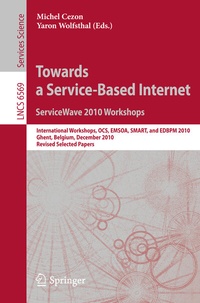
Towards a Service-Based Internet. ServiceWave 2010 Workshops
International Workshops, OCS, EMSOA, SMART, and EDBPM 2010, Ghent, Belgium, December 13-15, 2010, Revised Selected Papers
Published on 11. October 2011
XXIX, 209 pages
978-3-642-22760-8 (ISBN)
Description

This book constitutes the refereed proceedings of four workshops held in conjunction with the Third European Conference, ServiceWave 2010, held in Ghent, Belgium, in December 2010. The book includes 23 reviewed papers from four workshops that were selected from eight high-quality workshop session proposals. They represent diverse aspects of the theory and practice of service computing, ranging from service engineering to service infrastructures. The workshops are: First Workshop on Optimising Cloud Services (OCS 2010), International Workshop on Emergency Management through Service-Oriented Architectures (EMSOA 2010), First International Workshop on Service Modelling and Representation Techniques (SMART 2010), and From Event-Driven Business Process Management to Ubiquitous Complex Event Processing (EDBPM 2010).
More details
Other editions
Additional editions
Michel Cezon | Yaron Wolfsthal
Towards a Service-Based Internet. ServiceWave 2010 Workshops
International Workshops, OCS, EMSOA, SMART, and EDBPM 2010, Ghent, Belgium, December 13-15, 2010, Revised Selected Papers
Book
10/2011
Springer
€53.49
Shipment within 7-9 days
Content
- Title Page
- Preface
- OCS 2010 Workshop Organizers' Message
- OCS 2010 Workshop Organization
- EMSOA 2010 Workshop Organizers' Message
- EMSOA 2010 Workshop Organization
- First International Workshop on Service Modelling and Representation Techniques (SMART 2010)
- SMART 2010 Workshop Organization
- From Event-Driven Business Process Management to Ubiquitous Complex Event Processing (EDBPM 2010)
- EDBPM 2010 Workshop Organization
- Table of Contents
- 1st Workshop on Optimizing Cloud Services (OCS 2010)
- Architecturing a Sky Computing Platform
- Introduction
- Cloud Challenges and Limitations
- Towards a Unified Cloud Programming Interface
- Towards a Platform for Deployment/Execution of Applications Using Resources of Multiple Cloud Providers
- Related Work
- Conclusions and Future Work
- References
- Optimising Development and Deployment of Enterprise Software Applications on PaaS: The CAST Project
- Introduction
- Platform Maturity Levels and the State of Practice
- Summary of Challenges in the Design of the CAST Platform
- Main Concepts and Terminology
- CAST Platform Outline
- Runtime Infrastructure
- Governance Infrastructure
- App/Solution Directory (Store)
- CAST Platform Packaging Model
- CAST Platform Deployment Model
- Type 1: Purely Declarative Apps
- Type 2: Client-Side Code Ap
- Type 3: Client-Side and Server-Side Code Apps
- Conclusions
- References
- The Bullwhip Effect and VM Sprawl in the Cloud Supply Chain
- Motivation
- Bullwhip in Traditional Supply Chains
- Explanation of Bullwhip
- Identified Problem Areas
- Bullwhip in Cloud Supply Chains - The Transfer
- Transfer of Problem Areas, Indicators and Mitigation Techniques
- Explanation of Bullwhip Effect Indicators for the Identified Problem Areas
- A Systems Approach to Tackling Bullwhip Effect in Practice
- VM Sprawl as a Sub-Effect of Bullwhip
- Initialisation of VM Sprawl Monitoring and Assessment with Organisational and Technical Factors
- Architecture for Monitoring and Assessment of VM Sprawl Risk
- Bullwhip Effect Indicator Prototype
- Transfer of Indicators to Prototype
- Bullwhip Effect Equaliser Indicator
- Summary and Outlook
- References
- Using Service Level Agreements for Optimising Cloud Infrastructure Services
- Introduction
- Related Work
- Service Level Management
- Service Level Agreements
- Term Languages
- Hardware Parameters
- Eco-Efficiency Parameters
- Expressing the Risk Level
- Conclusions and Future Work
- References
- International Workshop on Emergency Management Through Service-Oriented Architectures (EMSOA 2010)
- Process-Aware Information Systems for Emergency Management
- Introduction
- User Requirements
- Survey of the Current-Day PAIS' Approaches for Emergency Management
- The WORKPAD Approach
- Conclusion
- References
- Semantic Services for Information and Management Support in Mass Casualty Incident Scenarios
- Introduction
- From Checklists to Intelligent Checklists
- An Architecture for Intelligent Checklist Support
- Representation of the Situation
- Grounding Checklist Execution
- Realizing Abstract Checklist Entries
- Related Work and Open Problems
- Conclusion
- References
- Information Conceptualization for Emergency Management
- Introduction
- Emergency Management Information Systems
- Emergency Planning
- Emergency Response
- Emergency Recovery
- Ontologies for Emergency Management
- Information Source
- Developed Sample
- Conclusions and Further Work
- References
- Simulator for PROSIMOS (PRiority communications for critical SItuations on MObile networkS) Service
- Introduction
- User Requirements and Scenarios
- CAPEX and OPEX Costs
- Radio Access Technologies
- Business Models
- Conclusions and Current Progress of Work
- Reference
- Active Knowledge Modeling Supporting Emergency Mitigation
- Introduction
- Overall Approach to Emergency Management
- Introduction of AKM
- Case Study
- Conclusions
- References
- A JXTA-Based Peer Architecture for Enhanced Service Discovery in SOA-Based P2P Applications
- Introduction
- Model-Driven QoS Management Framework
- JXTA Basic Concepts
- JXTA-Based Peer Architecture
- Keyword-Based Service Discovery
- QSHARE Example Application
- Conclusions
- References
- 1st International Workshop on Service Modelling and Representation Techniques (SMART 2010)
- A Service Portfolio Model for Value Creation in Networked Enterprise Systems
- Introduction
- Related Work
- A Value Co-creation Model for Knowledge Services
- Managing Value Co-creation
- The Framework in Action
- Conclusions and Further Work
- References
- On the Use of Feature Models for Service Design: The Case of Value Representation
- Introduction
- Feature Modeling
- Feature-Based Service Design
- Mapping Feature Concepts to Service Aspects
- Feature-Based Value Representation
- Feature-Based Methods in the Service Lifecycle
- Example of a Service Feature Model
- Related Work
- Conclusion and Future Work
- References
- Towards a Hybrid Simulation Modelling Framework for Service Networks
- Motivation
- Business Process Simulation
- Hybrid Simulation
- Towards a Hybrid Simulation Approach for Service Networks
- Exploratory Case Study
- Conclusion
- References
- Empowering Citizens in Public Service Design and Delivery: A Reference Model and Methodology
- Introduction
- Empowering Citizens Role in Designing and Delivering Public Service Offerings
- A Reference Model for Public Service Design and Delivery
- Discussions and Related Work
- Conclusion
- References
- A Description Framework for Digital Public Services
- Introduction
- Relevant Work
- The Service Description Framework Fundamentals
- The Detailed Service and Resources Metadata
- Services
- Documents
- Controlled Lists
- Conclusions
- References
- The Business Service Representation Language: A Preliminary Report
- Introduction
- The BSRL Meta-model
- The Service Value Model
- Related Work
- Conclusion
- References
- From Event-Driven Business Process Management to Ubiquitous Complex Event Processing (EDBPM 2010)
- Analysis of Complex Events in Memory Evolutive Systems
- Introduction
- Structure of the System
- Configuration of the System around a Given Time
- Change of State
- Self-organization
- Dynamic of the System and Associated Events
- Dynamic of a Particular Coregulator
- Main Events at the Root of Fractures
- Complex Event Processing in Memory Evolutive Systems Satisfying the Multiplicity Principle
- The Multiplicity Principle, Key to Higher Complexity
- Main Consequences of the MP
- Role of the MP in the Generation of Complex Events
- Cascade of Complex Events
- References
- Business Process Modelling Notation from the Methodical Perspective
- Introduction - Business Process Management and Standards
- Modelling Business Processes
- Evaluation of the BPMN towards the Methodology Requirements
- Summary and Conclusions
- References
- A Transformation from SBVR Business Rules into Event Coordinated Rules by Means of SBVR Patterns
- Introduction
- Related Work
- Business Rules Types
- Syntax and Semantics of Business Rules
- Patterns for Transforming Business Rules into Event Rules
- Overview of Some Templates
- Example
- Conclusion
- References
- About Adopting Event Processing in Manufacturing
- Introduction
- Related Work
- Framework for Enabling Enterprise Integration, and Enhancing Online Monitoring and Control of Enterprise Processes
- Framework Overview
- Event Processing in Manufacturing
- An Industrial Case Study
- Conclusion and Future Work
- References
- A New Biology: A Modern Perspective on the Challenge of Closing the Gap between the Islands of Knowledge
- Introduction: The Quest
- The Miss(ion)
- The Approach
- The Protomodel
- The Challenges
- The Outlook: On Interactions and Events
- References
- Events, Neural Systems and Time Series
- Introduction: Events in Different Contexts
- Contexts 1: Events and Robotics
- Contexts 2: Time Series
- Automating Complex Event Handling Systems
- Conclusions
- References
- A Text Copy Detection System Based on Complex Event Processing Architecture
- Introduction
- Architecture of the Text Copy Detection
- Discussion
- Conclusion and Future Works
- References
- Author Index
