

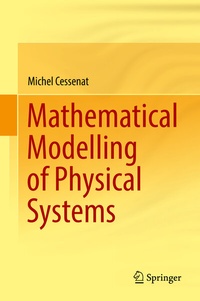
Mathematical Modelling of Physical Systems
Description

Comprehensive and thorough, this monograph emphasizes the main role differential geometry and convex analysis play in the understanding of physical, chemical, and mechanical notions. Central focus is placed on specifying the agreement between the functional framework and its physical necessity and on making clear the intrinsic character of physical elements, independent from specific charts or frames. The book is divided into four sections, covering thermostructure, classical mechanics, fluid mechanics modelling, and behavior laws. An extensive appendix provides notations and definitions as well as brief explanation of integral manifolds, symplectic structure, and contact structure. Plenty of examples are provided throughout the book, and reviews of basic principles in differential geometry and convex analysis are presented as needed. This book is a useful resource for graduate students and researchers in the field.
Reviews / Votes
"This higher level book will certainly be a useful resource for graduate students and researchers in mathematical modeling of physical systems. The book is recommended for university libraries and research establishments." (K. N. Shukla, zbMATH 1428.80002, 2020)"The book is not only a useful resource for researchers in applied mathematics, but can also be used as a demanding textbook for graduate students with a solid knowledge in differential geometry and functional analysis." (Theophanes Grammenos, Mathematical Reviews, July, 2019)
More details
Other editions
Additional editions
Person
Michel Cessenat is a mathematician at the Société de Mathématiques Appliquées et Industrielles and a former researcher at Center for Atomic Energy, France. He is the author of Mathematical Methods in Electromagnetism: Linear Theory and Applications (World Scientific, 1996) and a co-author of Méthodes Probabilistes pour les équations de la physique (Eyrolles, 1989). He has also made contributions to the work presented in the six-volume set Mathematical Analysis and Numerical Methods for Science and Technology by Robert Dautray and Jacques-Louis Lions (Springer, 2000).
