


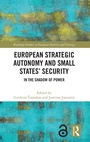
European Strategic Autonomy and Small States' Security
In the Shadow of Power
1st Edition
Published on 26. December 2022
242 pages
978-1-000-83508-3 (ISBN)
Description

This book analyses whether the EU's drift towards European strategic autonomy presents a challenge or a window of opportunity for its small member states to advance their security interests.
The volume presents small states' perceptions of European strategic autonomy, highlighting their expectations and concerns. The chapters focus on the depth and breadth of European strategic autonomy, national security considerations, assessment of the impact on transatlantic relations, the expected outputs, and its potential impact on the EU's institutional structure. It also shows how systemic circumstances and the interests of powerful states, either belonging to the EU (France, Germany, and Poland) or having a significant say in European security architecture (the US), establish opportunities and constraints for the small states to shape European strategic autonomy. In particular, the study focuses on the diverging interests of the Baltic states (Estonia, Latvia, and Lithuania), Belgium, Denmark, Greece, Hungary, and the Netherlands. It demonstrates that, in most cases, European strategic autonomy is perceived not as an alternative to NATO but as a supplementary element that could facilitate the development of national military capabilities, indigenous defence industries and resilience to non-military threats. Ultimately, the book suggests that national approaches towards European strategic autonomy mainly stem from pragmatic national security and foreign policy considerations, while largely ignoring grand strategic ideas.
This book will be of much interest to students of European politics, security studies, and international relations.
The Open Access version of this book, available at www.taylorfrancis.com, has been made available under a Creative Commons Attribution-Non Commercial-No Derivatives 4.0 license.
The volume presents small states' perceptions of European strategic autonomy, highlighting their expectations and concerns. The chapters focus on the depth and breadth of European strategic autonomy, national security considerations, assessment of the impact on transatlantic relations, the expected outputs, and its potential impact on the EU's institutional structure. It also shows how systemic circumstances and the interests of powerful states, either belonging to the EU (France, Germany, and Poland) or having a significant say in European security architecture (the US), establish opportunities and constraints for the small states to shape European strategic autonomy. In particular, the study focuses on the diverging interests of the Baltic states (Estonia, Latvia, and Lithuania), Belgium, Denmark, Greece, Hungary, and the Netherlands. It demonstrates that, in most cases, European strategic autonomy is perceived not as an alternative to NATO but as a supplementary element that could facilitate the development of national military capabilities, indigenous defence industries and resilience to non-military threats. Ultimately, the book suggests that national approaches towards European strategic autonomy mainly stem from pragmatic national security and foreign policy considerations, while largely ignoring grand strategic ideas.
This book will be of much interest to students of European politics, security studies, and international relations.
The Open Access version of this book, available at www.taylorfrancis.com, has been made available under a Creative Commons Attribution-Non Commercial-No Derivatives 4.0 license.
Reviews / Votes
'In a world that is too often preoccupied with great power politics, this book is a much-needed and timely contribution for understanding the other side of international relations, small states. It should be required reading for anyone wishing to examine contemporary European politics and security.'Marc Ozawa, NATO Defense College, Rome
'By bringing together for the first time scholars from small states to write about European small states' perceptions of, and engagements with, European strategic autonomy, this book addresses an important gap in the academic literature on European defence. It is a crucial introduction for those interested in the subject.'
Lukas Milevski, Institute of History, Leiden University, the Netherlands
'This monograph, in arguing that the concept of European strategic autonomy is both a challenge to and an opportunity for the national security interests of the small states of the EU, presents vital lessons for all small states facing the vicissitudes of Great Power assertiveness and aggression.'
Bernard Loo Fook Weng, S. Rajaratnam School of International Studies, Nanyang Technological University, Singapore
More details
Series
Edition
1. Auflage
Language
English
Place of publication
London
United Kingdom
Publishing group
Taylor & Francis Ltd
Target group
College/higher education
Professional and scholarly
File size
16,36 MB
ISBN-13
978-1-000-83508-3 (9781000835083)
Copyright in bibliographic data and cover images is held by Nielsen Book Services Limited or by the publishers or by their respective licensors: all rights reserved.
Schweitzer Classification
Other editions
Additional editions

Giedrius Cesnakas | Justinas Juozaitis
European Strategic Autonomy and Small States' Security
In the Shadow of Power
Book
10/2024
1st Edition
Routledge
€63.30
Shipment within 10-20 days
Giedrius Cesnakas | Justinas Juozaitis
European Strategic Autonomy and Small States' Security
In the Shadow of Power
Book
12/2022
1st Edition
Routledge
€185.40
Shipment within 10-20 days
Persons
Giedrius Cesnakas is Professor at the General Jonas Zemaitis Military Academy of Lithuania, heading undergraduate and graduate political studies programmes.
Justinas Juozaitis is Policy analyst at the Centre for Defence Analysis at the General Jonas Zemaitis Military Academy of Lithuania and a lecturer at the Faculty of Political Science and Diplomacy at the Vytautas Magnus University, Lithuania.
Justinas Juozaitis is Policy analyst at the Centre for Defence Analysis at the General Jonas Zemaitis Military Academy of Lithuania and a lecturer at the Faculty of Political Science and Diplomacy at the Vytautas Magnus University, Lithuania.
Content
1. Introduction: Small States, International Institutions and European Strategic Autonomy 2. European Strategic Autonomy: The Origins Story 3. Revisiting France's Commitment to Defence integration: A Case of Political Functionalism 4. Germany: The Renewed Quest for Strategic Autonomy 5. Poland's Resilient Atlanticism 6. US Foreign Policy during the Biden Presidency: A Reset in the US Approach Towards the EU Strategic Autonomy? 7. Through the Estonian Looking Glass: Can NATO's Credible Deterrence and EU Strategic Autonomy Succeed Simultaneously? 8. Military Capabilities First, Politics Later: Latvia's Approach to European Strategic Autonomy 9. European Strategic Autonomy in Lithuania's Foreign Policy Discourse 10. European Strategic Autonomy: Opportunities and Threats for Denmark 11. Belgium and European Strategic Autonomy 12. Dutch Security and Defence Policy: From Faithful Ally to Pragmatic European 13. A Reluctant Supporter: The Hungarian Perspective on European Strategic Autonomy 14. Shared Values and Common Borders: Why Greece Views European Strategic Autonomy as an Opportunity 15. Conclusions: Domination of Pragmatism Towards the European Strategic Autonomy
