
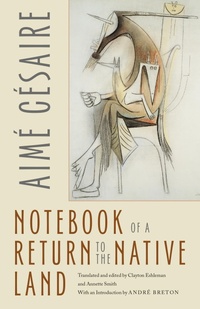
Notebook of a Return to the Native Land
Description
Alles über E-Books | Antworten auf Fragen rund um E-Books, Kopierschutz und Dateiformate finden Sie in unserem Info- & Hilfebereich.
More details
Other editions
Additional editions
Persons
Aimé Césaire is most well-known as the co-creator (with Léopold Senghor) of the concept of négritude. A member of the Communist party and active supporter of a progressive Socialist movement in his native Martinique, Césaire wrote Notebook of a Return to the Native Land at the end of World War II. Clayton Eshleman, Professor of English at Eastern Michigan University, has published eleven books of poetry since 1968. He has translated works by Antonin Artaud, Bernard Bador, Michel Deguy, Vladimir Holan, and Pablo Neruda. He is also the foremost American translator of César Vallejo (with José Rubia Barcia). Annette Smith, born in Algeria, is an Associate Professor of French at the California Institute of Technology. Eshleman and Smith translated Aimé Césaire: The Collected Poetry (1985).
Content
- Cover
- Title Page
- Copyright Page
- Contents
- A Note on André Breton
- A Great Black Poet
- Notebook of a Return to the Native Land
- Commentary
- Notes
- A Césaire Chronology
- About the Author
- About the Translators/Editors

System requirements
File format: ePUB
Copy protection: Watermark-DRM (Digital Rights Management)
System requirements:
- Computer (Windows; MacOS X; Linux): Use a reading software that can process the file format ePUB: e.g., Adobe Digital Editions or FBReader – both free (see eBook Help).
- Tablet/Smartphone (Android; iOS): Before downloading, install the free app Adobe Digital Editions (see eBook Help).
- E-reader: Bookeen, Kobo, Pocketbook, Sony, Tolino and many more (not Kindle).
The file format ePUB works well for novels and non-fiction books – i.e., „flowing” text without complex layout. On an e-reader or smartphone, line and page breaks automatically adjust to fit the small displays.
This eBook uses Watermark-DRM, a „soft” copy protection. This means that there are no technical restrictions to prevent illegal distribution. However, there is a personalised watermark embedded in the eBook that can be used to identify the purchaser of the eBook in the event of misuse and to provide evidence for legal purposes.
For more information, see our eBook Help page.