

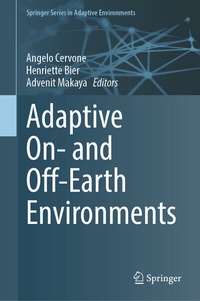
Adaptive On- and Off-Earth Environments
Description

Adaptive on-and off-Earth Environments focuses, among other aspects, on the design, production, and operation processes required to build and maintain such off-Earth infrastructures, while heavily relying on In-Situ Resource Utilisation (ISRU). Such design, production, and operation processes integrate cyber-physical approaches developed and tested on Earth. The challenge is to adapt on-Earth approaches to off-Earth applications aiming at technology advancement and ultimately transfer from on- to off-Earth research. Thischallenge is addressed with contributions from various disciplines ranging from power generation to architecture, construction, and materials engineering involving ISRU for manufacturing processes. All chapters, related to these disciplines, are structured with an emphasis on computing and adaptivity of on-Earth technology to off-Earth applications and vice versa to serve society at large.
More details
Other editions
Additional editions
Persons
Angelo Cervone is Assistant Professor at the Aerospace Engineering Faculty of TU Delft. He holds a PhD in aerospace propulsion from University of Pisa (Italy), followed by a 2-years post-doc fellowship at Osaka University (Japan). His main research areas are space propulsion, small satellite missions, systems engineering, innovative concepts for sustainable use of planetary resources. He is co-/author of more than 150 book chapters, papers in peer-reviewed journals and international conference papers.
Henriette Bier is Associate Professor at TU Delft, Netherlands and Honorary Associate Professor at U Sydney, Australia. She leads the Robotic Building lab at the Faculty of Architecture and the Built Environment since 2014, where she advances with a team of PhD and MSc students off- and on-Earth robotic applications in architecture and building construction. Results of her research are internationally published in books, journals and conference proceedings and she regularly lectures and leads workshops internationally.
Advenit Makaya is an Advanced Manufacturing Engineer at the European Space Research and Technology Centre of the European Space Agency (ESA). Since 2014, he has been supporting the development of promising advanced materials and processes for space applications and provides support to ESA missions in the field of Materials and Processes. In this context, he is leading various technology development activities on In-Situ Resource Utilisation for construction of infrastructure and manufacturing of hardware, to support future exploration missions to the Moon and Mars. He is also supporting technology development activities for on-demand, on-orbit additive manufacturing of polymer and metallic parts, to support crew during future long-term exploration missions.
