

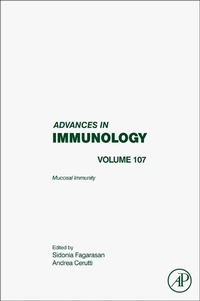
Mucosal Immunity
Published on 14. May 2014
307 pages
978-0-12-381301-5 (ISBN)
Description

Advances in Immunology, a long-established and highly respected publication, presents current developments as well as comprehensive reviews in immunology. Articles address the wide range of topics that comprise immunology, including molecular and cellular activation mechanisms, phylogeny and molecular evolution, and clinical modalities. Edited and authored by the foremost scientists in the field, each volume provides up-to-date information and directions for future.
- Contributions from leading authorities and industry experts
- Informs and updates on all the latest developments in the field
More details
Series
Language
English
Place of publication
San Diego
United States
ISBN-13
978-0-12-381301-5 (9780123813015)
Copyright in bibliographic data and cover images is held by Nielsen Book Services Limited or by the publishers or by their respective licensors: all rights reserved.
Schweitzer Classification
Other editions
Additional editions
Frederick W. Alt
Advances in Immunology: Volume 107
Book
11/2010
Academic Press
€176.09
Shipment within 15-20 days
Content
- Front Cover
- Advances in Immunology
- Copyright Page
- Contents
- Contributors
- Preface
- Chapter 1: Functional Biology of the IL-22-IL-22R Pathway in Regulating Immunity and Inflammation at Barrier Surfaces
- 1. Introduction
- 2. The IL-22-IL-22R Pathway
- 3. Regulation of IL-22 Expression
- 4. Biological Functions of the IL-22-IL-22R Pathway
- 5. Concluding Remarks
- Acknowledgments
- References
- Chapter 2: Innate Signaling Networks in Mucosal IgA Class Switching
- 1. Functions of Mucosal IgA
- 2. Mechanisms of Mucosal IgA Production
- 3. Mucosal IgA Pathways Involving T Cells
- 4. Mucosal IgA Pathways not Involving T Cells
- 5. Dendritic Cell and Macrophage Signals in Mucosal IgA Production
- 6. Epithelial Cell Signals in Mucosal IgA Production
- 7. Conclusions
- Acknowledgments
- References
- Chapter 3: Specificity of the Adaptive Immune Response to the Gut Microbiota
- 1. Introduction
- 2. The Gut Microbiota in the Year 2010
- 3. Determinates of the Intensity of Adaptive Immunity to the Gut Microbiota
- 4. Probiotics
- 5. T Cell Immunity to the Gut Microbiota
- 6. Specificity of the B Cell Response to the Gut Microbiota
- 7. The Future: Grasping the Mist
- Acknowledgments
- References
- Chapter 4: Intestinal Dendritic Cells
- 1. Introduction
- 2. Dendritic Cell Distribution in the Gut
- 3. Gut DC Origins
- 4. Unique Properties of Mucosal DCs
- 5. DC Interaction with the Environmental Factors
- 6. DC Migration to MLN
- 7. DCs in Intestinal Diseases
- 8. Conclusions and Future Perspectives
- Acknowledgments
- References
- Chapter 5: The Many Face-Lifts of CD4 T Helper Cells
- 1. Introduction
- 2. T Helper Subset Paradigm: Th1/Th2
- 3. Contradictions of the Th1/Th2 Paradigm: New Subsets Come to Help
- 4. Plasticity in the T Helper Subsets
- 5. Epigenetic Control of Th Lineage Plasticity
- 6. Concluding Remarks
- Acknowledgments
- References
- Chapter 6: GALT: Organization and Dynamics Leading to IgA Synthesis
- 1. GALT Compartments
- 2. Peyer's Patches
- 3. Characteristics of PP GCs
- 4. Isolated Lymphoid Follicles
- 5. Lamina Propria
- 6. Role of IgA in Gut
- 7. Conclusions and Perspective
- Acknowledgment
- References
- Chapter 7: Bronchus-Associated Lymphoid Tissue (BALT): Structure and Function
- 1. Introduction
- 2. Lymphoid Architecture of BALT
- 3. Development and Maintenance of BALT
- 4. Antigen Acquisition
- 5. B Cell Responses in BALT
- 6. T Cell Responses
- 7. Role of BALT in Resistance to Infectious Disease
- 8. Role of BALT in Pulmonary Responses to Allergens and Environmental Antigens
- 9. Role of BALT in Response to Particulates and Cigarette Smoke
- 10. Contribution of BALT to Autoimmunity and Pulmonary Fibrosis
- 11. Role of BALT in Pulmonary Malignancy
- 12. Summary and Perspectives
- Acknowledgments
- References
- Chapter 8: Host-Bacterial Symbiosis in Health and Disease
- 1. Establishment of Bacterial Communities in the Gastrointestinal Tract
- 2. Development of the Immune System by Commensal Microbiota
- 3. ProInflammatory Responses of Bacterial-Host Gut Interactions
- 4. Commensals Contribute to Host-Microbial Homeostasis by Actively Suppressing Inflammatory Responses During Health and Disease
- References
- Index
- Contents of Recent Volumes
- Color Plates
