

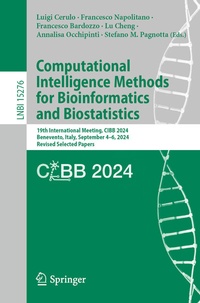
Computational Intelligence Methods for Bioinformatics and Biostatistics
Description

This volume LNCS 15276 constitutes the revised selected papers of the 19th International Meeting on Computational Intelligence Methods for Bioinformatics and Biostatistics, CIBB 2024, held in Benevento, Italy, during September 4-6, 2024.
The 24 full papers and 3 short papers were carefully reviewed and selected from 28 submissions. They were organized in the following topical sections: Bioinformatics; Medical Informatics; Natural Language Processing (NLP) and Large Language Models (LLM) for Unstructured Data in Health Informatics; Modeling and Simulation Methods for Computational Biology and Systems Medicine; Machine Learning for Structured Data in Clinical Informatics and Medical Biology; Computational Intelligence in Personalized Medicine; and Computational Structural Bioinformatics.
More details
Other editions
Additional editions
Content
Bioinformatics.- Clustering-based Negative Sampling Approaches for Protein-Protein Interaction Prediction.- Proteins transcription factor prediction using Graph Neural Networks.- Identification of Differential Alternative Splicing Events: Assessing Tools Performance with Different Sequencing Parameters.- Methods and tools to facilitate RE:IN modeling and analysis of GRNs.- Gene set-focused analysis of RNA-seq data with MIEP (Make-It-Easy-Pipeline).- Cross sequencing integration of compositional microbiome data in cancer.- Medical Informatics.- Private, Efficient and Scalable Kernel Learning for Medical Image Analysis.- Toward a Unified Graph-Based Representation of Medical Data for Precision Oncology Medicine.- FP-Elegans M1: feature pyramid reservoir connectome transformers and multi-backbone feature extractors for MEDMNIST2D-V2.- Natural language processing (NLP) and large language models (LLM) for unstructured data in health informatics.- Driver Gene Detection via Causal Inference on Single Cell Embeddings.- Assessing and Comparing Free Large Language Models' Responses to a Clinical Case: Accuracy, Safety, and Reliability.- Three-stage Data Science methodology to explore genetic heterogeneity of diseases.- Functional data analysis and clustering of haematological parameters in SARS-CoV-2 patients.- Modeling and simulation methods for computational biology and systems medicine.- Gene set optimization for single cell transcriptomics.- MicroRNAs as biomarkers for Ulcerative Colitis.- PHeP: TrustAlert Open-Source Platform for Enhancing Predictive Healthcare with Deep Learning.- Cutting Slices of Complexity in Cancer Therapy Design: An Agent-Based Model of Dabrafenib in Melanoma.- Machine learning for structured data in clinical informatics and medical biology.- Forward and backward feature selection guided by prior biological knowledge for enhanced interpretability.- The impact of mis-labeled artefacts on deep learning models for EEG analysis: a case study.- Benchmark study on supervised Relevance-Redundancy assessment for feature selection in genomic data.- Computational Intelligence in Personalized Medicine.- Group discovery in a clinical database of patients with psychosis who have undergone Metacognitive Training.- Hierarchical Clustering with an Ensemble of Principle Component Trees for Interpretable Patient Stratification.- Computational Structural Bioinformatics.- ESMCrystal : Enhancing Protein Crystallization Prediction through Protein Embeddings.- TARNAS, a TrAnslator for RNA Secondary structure formats.- Short papers.- Novel Approaches for Spatially Resolving Gene Responses and Injection Site Localization in Transcriptomic Data.- Deep Learning Approaches for Forensics DNA Profiling: a Replication Study.
