

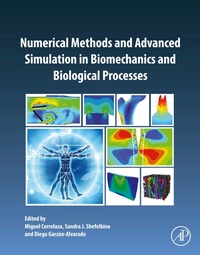
Numerical Methods and Advanced Simulation in Biomechanics and Biological Processes
Published on 28. December 2017
454 pages
978-0-12-811719-4 (ISBN)
Description

Numerical Methods and Advanced Simulation in Biomechanics and Biological Processes covers new and exciting modeling methods to help bioengineers tackle problems for which the Finite Element Method is not appropriate. The book covers a wide range of important subjects in the field of numerical methods applied to biomechanics, including bone biomechanics, tissue and cell mechanics, 3D printing, computer assisted surgery and fluid dynamics. Modeling strategies, technology and approaches are continuously evolving as the knowledge of biological processes increases. Both theory and applications are covered, making this an ideal book for researchers, students and R&D professionals.
- Provides non-conventional analysis methods for modeling
- Covers the Discrete Element Method (DEM), Particle Methods (PM), MessLess and MeshFree Methods (MLMF), Agent-Based Methods (ABM), Lattice-Boltzmann Methods (LBM) and Boundary Integral Methods (BIM)
- Includes contributions from several world renowned experts in their fields
- Compares pros and cons of each method to help you decide which method is most applicable to solving specific problems
More details
Other editions
Additional editions
Miguel Cerrolaza | Sandra Shefelbine | Diego Garzon-Alvarado
Numerical Methods and Advanced Simulation in Biomechanics and Biological Processes
Book
10/2017
Academic Press
€186.50
Shipment within 15-20 days
Content
1. Discontinuous finite-element model of hydrogels: predicting stiffness of nanofibres2. Modeling the influence of mechanics on biological growth3. Finite Element modeling and simulation of the multiphysic behavior of articular cartilage4. Image-driven constitutive modeling for FE-based simulation of soft tissue biomechanics5. Finite element modeling of Turing Pattern formation: An application to appearance and location of dentinal tubules6. A discontinuous Galerkin model for the simulation of chemotaxis processes: application to stem cell injection after a myocardial infarction7. Application of the Boundary Element Method in bioelectromagnetics8. BEM in biomechanics: modelling, advances and limitations9. A particle-finite element based framework for differentiation paths of stem cells to myocytes and adipocytes10. Numerical simulation of bone cutting: hybrid SPH-FE approach11. Smoothed Particle Hydrodynamics method and its applications to cardiovascular flow modeling12. Agent Based Lattice Models of multicellular systems: numerical methods, implementation and applications 13. Multiscale agent-based computer models in skeletal tissue regeneration14. Off-lattice Agent Based models for cell and tumor growth: numerical methods, implementation and applications15. Agent-based numerical methods for 3D bioprinting in tissue engineering16. Coupled Finite Element-Agent Based models for the simulation of vascular growth and remodeling17. The mechanologic bone tissue remodeling analysis: a comparison between mesh-depending and meshless methods18. Strong and weak form meshless methods in computational biomechanics19. The finite volume particle method: towards a meshless technique for biomedical fluid dynamics20. Multicomponent lattice Boltzmann models for biological applications21. Lattice Boltzmann models of highly viscous fluids and multicellular self-assembly22. The Lattice Boltzmann modeling: solving complex flows including biological cells23. Lattice Boltzmann methods for bioengineering applications
