

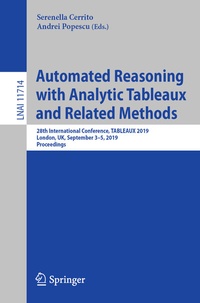
Automated Reasoning with Analytic Tableaux and Related Methods
Description

This book constitutes the proceedings of the 28th International Conference on Automated Reasoning with Analytic Tableaux and Related Methods, TABLEAUX 2019, held in London, UK, in September 2019, colocated with the 12th International Symposium on Frontiers on Combining Systems, FroCoS 2019.
The 25 full papers presented were carefully reviewed and selected from 43 submissions.They present research on all aspects of the mechanization of tableaux-based reasoning and related methods, including theoretical foundations, implementation techniques, systems development and applications. The papers are organized in the following topical sections: tableau calculi, sequent calculi, semantics and combinatorial proofs, non-wellfounded proof systems, automated theorem provers, and logics for program or system verification.
More details
Other editions
Additional editions
Content
- Intro
- Preface
- Organization
- Abstracts of Invited Talks
- Automated Reasoning for the Working Mathematician
- Remembering Roy Dyckhoff
- Contents
- Tableau Calculi
- A SAT-Based Encoding of the One-Pass and Tree-Shaped Tableau System for LTL
- 1 Introduction
- 2 Preliminaries
- 2.1 Linear Temporal Logic
- 2.2 The One-Pass and Tree-Shaped Tableau System
- 3 SAT-Based Encoding of the Tableau
- 3.1 Notation
- 3.2 Expansion of the Tree
- 3.3 Encoding of Accepted Branches
- 4 Completeness
- 5 Experimental Evaluation
- 6 Conclusions
- References
- Certification of Nonclausal Connection Tableaux Proofs
- 1 Introduction
- 2 Connection Calculi
- 3 Compressed Connection Calculi
- 4 Connection Proof Translation
- 4.1 Clausal Proof Translation
- 4.2 Nonclausal Proof Translation
- 5 Implementation
- 6 Evaluation
- 7 Related Work
- 8 Conclusion
- References
- Preferential Tableaux for Contextual Defeasible ALC
- 1 Introduction
- 2 Logical Preliminaries
- 3 Contextual Defeasible ALC
- 4 Tableau for Preferential Reasoning in dALC
- 5 Related Work
- 6 Concluding Remarks
- References
- A Tableau Calculus for Non-clausal Maximum Satisfiability
- 1 Introduction
- 2 Background
- 3 A Non-clausal MaxSAT Tableau Calculus
- 3.1 Soundness and Completeness
- 4 Extension to Hard and Weighted Formulas
- 5 Conclusions
- References
- Sequent Calculi
- First-Order Quasi-canonical Proof Systems
- 1 Introduction
- 2 Preliminaries
- 3 Quasi-canonical Systems
- 3.1 Introducing Quasi-canonical Proof Systems
- 3.2 The Semantics of Quasi-canonical Proof Systems
- 3.3 Soundness, Completeness, and Cut-Elimination
- 4 Existential Information Processing
- 4.1 Sources of Information
- 4.2 Gathering and Processing the Information
- 4.3 Proof System for Processors
- 5 Conclusion and Future Research
- References
- Bounded Sequent Calculi for Non-classical Logics via Hypersequents
- 1 Introduction
- 2 Preliminaries
- 3 A Guided Example Demonstrating the Methodology
- 4 The Disjunction Form of a Rule: A Formal Definition
- 5 Disjunction Forms for Commutative Substructural Logics
- 6 Bounded Calculi for Commutative Substructural Logics
- 6.1 Application: Decidability and Complexity Of FLecm Extensions
- 7 The Methodology Applied to Modal Logics
- References
- A Proof-Theoretic Perspective on SMT-Solving for Intuitionistic Propositional Logic
- 1 Introduction
- 2 Syntax and Kripke Semantics of IPL
- 3 The Theorem Prover intuit
- 3.1 intuit in Detail
- 4 Adapting the Sequent Calculus LJT to Clausal Forms
- 4.1 Root-First Proof Search, Invertibility and Recursivity
- 4.2 LJT Specialised to Clausal Forms
- 4.3 A Generalised Version of (L)
- 5 The Calculus LJTSAT
- 6 Proof-Search Using LJTSAT
- 7 Discussion, Further Work and Conclusions
- References
- Relating Labelled and Label-Free Bunched Calculi in BI Logic
- 1 Introduction
- 2 The Logic BI
- 2.1 Syntax and Sequent Calculus LBI
- 2.2 Semantics of BI
- 3 The Labelled Calculus GBI
- 3.1 Soundness of GBI
- 4 From LBI-Proofs to GBI-Proofs
- 5 Back from GBI-Proofs to LBI-Proofs
- 6 Conclusion and Future Work
- References
- Sequentialising Nested Systems
- 1 Introduction
- 2 Sequent Systems
- 3 Nested Systems
- 3.1 Normal Forms in NS
- 4 Recovering Sequent Systems
- 5 Examples and Discussion
- 6 Conclusion and Future Work
- References
- A Hypersequent Calculus with Clusters for Data Logic over Ordinals
- 1 Introduction
- 2 Freeze Tense Logic over Ordinals
- 3 Hypersequents with Clusters
- 3.1 Syntax
- 3.2 Semantics
- 4 Proof System
- 4.1 Notations
- 4.2 Rules
- 4.3 Soundness
- 5 Restricted Logic and Completeness
- 5.1 Restricted Syntax
- 5.2 Completeness and Complexity
- 6 Restricted Logic on Given Ordinals
- 7 Related Work and Conclusion
- References
- Syntactic Cut-Elimination and Backward Proof-Search for Tense Logic via Linear Nested Sequents
- 1 Introduction
- 2 Preliminaries
- 3 A Linear Nested Sequent Calculus for Kt
- 4 Completeness via Proof Search and Counter-Models
- 4.1 Pruning Irrelevant Branches from the Search Space
- 5 Completeness via Cut Elimination
- 6 Application: Linear Nested Sequents for Modal Logic KB
- 7 Conclusion
- References
- Combining Monotone and Normal Modal Logic in Nested Sequents - with Countermodels
- 1 Introduction
- 2 The Basic System
- 3 Cut Elimination
- 4 Completeness via Countermodel Generation
- 5 Extensions
- 6 Implementation
- 7 Conclusion
- References
- Semantics and Combinatorial Proofs
- On Combinatorial Proofs for Modal Logic
- 1 Introduction
- 2 Sequent Calculus
- 3 Relation Webs
- 4 RGB-Cographs and Linear Proofs for K and KD
- 5 Skew Fibrations
- 6 Combinatorial Proofs for the Modal Logics K and D
- 7 Combinatorial Proofs for the Logics in the S4-plane
- 8 Non-normal Modal Logics
- 9 Conclusion and Future Work
- References
- A Game Model for Proofs with Costs
- 1 Introduction
- 2 A Game Model of Branching
- 3 Adding Costs
- 3.1 The Spectrum of a Provable Sequent
- 3.2 Cut Admissibility
- 4 Alternative Cost Structures
- 5 Modalities in Positive Contexts
- 6 Concluding Remarks and Future Work
- References
- Towards a Combinatorial Proof Theory
- 1 Introduction
- 2 Formulas and Cographs
- 3 Combinatorial Proofs
- 4 Open Deduction
- 5 Homomorphisms Classes and Structural Proof Systems
- 6 Basic Correspondences
- 7 Restricting c"3223379 or w"3223379 : Affine and Relevance Logic
- 8 Restricting to Shallow Inference: A Logic of Fibrations
- 9 Conclusion
- References
- Birkhoff Completeness for Hybrid-Dynamic First-Order Logic
- 1 Introduction
- 2 Hybrid-Dynamic First-Order Logic
- 3 Entailment
- 4 Atomic Completeness
- 5 Quasi-completeness
- 6 Horn-Clause Completeness
- 7 Conclusions
- References
- Non-Wellfounded Proof Systems
- Infinets: The Parallel Syntax for Non-wellfounded Proof-Theory
- 1 Introduction
- 2 Background
- 3 A First Taste of Proof-Nets in Logics with Fixed Points
- 4 Infinets
- 5 Correctness Criteria
- 6 Sequentialization
- 7 Canonicity
- 8 Cut Elimination
- 9 Conclusion
- References
- PSPACE-Completeness of a Thread Criterion for Circular Proofs in Linear Logic with Least and Greatest Fixed Points
- 1 Introduction
- 2 Background on Circular Proofs and Thread Validity
- 2.1 Formulas
- 2.2 Sequents and Preproofs
- 2.3 Proofs
- 2.4 Deciding Thread Validity in PSPACE
- 3 PSPACE-Completeness
- 3.1 Outline of the PSPACE-Completeness Proof
- 3.2 Defining the Reduction
- 3.3 Main Theorem
- 4 Comments on Our Approach and Discussion of Related Works
- 5 Conclusion
- References
- A Non-wellfounded, Labelled Proof System for Propositional Dynamic Logic
- 1 Introduction
- 2 PDL: Syntax and Semantics
- 3 An Infinitary, Labelled Sequent Calculus
- 4 Completeness
- 4.1 Cut-Free Completeness of G3PDL
- 4.2 Completeness of G3PDL for PDL
- 5 Proof Search for Test-Free, Acyclic Sequents
- 6 Conclusion
- References
- Automated Theorem Provers
- Herbrand Constructivization for Automated Intuitionistic Theorem Proving
- 1 Introduction
- 2 Overview of the Prover
- 3 Expansion Proofs
- 4 Proof Constructivization
- 5 Optimizations
- 6 Completeness on Subclasses
- 7 Experimental Evaluation
- 8 Conclusion
- References
- ENIGMAWatch: ProofWatch Meets ENIGMA
- 1 Introduction
- 2 Guiding the Given Clause Selection in ATPs
- 2.1 Automated Theorem Proving and Machine Learning
- 2.2 ENIGMA: Learning from Successful Proof Searches
- 2.3 ProofWatch: Proof Guidance by Clause Subsumption
- 3 ENIGMAWatch: ProofWatch Meets ENIGMA
- 3.1 Completion Ratios as Semantic Embeddings of the Proof Search
- 3.2 Proof Vector Construction
- 4 Multi-indices Subsumption Indexing
- 5 Experiments
- 5.1 Multi-indices Subsumption Indexing Evaluation
- 5.2 Experimental Evaluation of ENIGMAWatch
- 5.3 Training, Model Statistics and Analysis
- 6 Conclusion and Future Work
- References
- Logics for Program or System Verification
- Behavioral Program Logic
- 1 Introduction
- 2 Preliminaries: An Actor Language with Futures
- 3 Behavioral Program Logic
- 4 A Sequent Calculus for BPL: Behavioral Types
- 5 Conclusion and Related Work
- References
- Prenex Separation Logic with One Selector Field
- 1 Introduction
- 2 Preliminaries
- 2.1 First Order Logic
- 2.2 Separation Logic
- 2.3 Test Formulas for SLk
- 3 From Infinite to Finite Satisfiability
- 4 PRE(SL1) is Decidable but Not Elementary Recursive
- 5 The BSR(SL1) Fragment is PSPACE-complete
- 6 Conclusion
- References
- Dynamic Doxastic Differential Dynamic Logic for Belief-Aware Cyber-Physical Systems
- 1 Introduction
- 2 Technical Approach
- 3 Syntax of d4L
- 3.1 d4L Terms and Formulas
- 3.2 Doxastic Hybrid Programs
- 4 Semantics of d4L
- 5 Sound Sequent Calculus
- 6 Validation and Application
- 7 Related Work
- 8 Conclusions
- References
- Operational Semantics and Program Verification Using Many-Sorted Hybrid Modal Logic
- 1 Introduction
- 2 Preliminaries: A Many-Sorted Polyadic Modal Logic
- 3 Many-Sorted Hybrid Modal Logic
- 4 A SMC-like Language and a Hoare-Like Logic for It
- 5 Conclusions and Related Work
- A Proofs from Sect.3
- B Proofs from Sect.4
- References
- Author Index
