

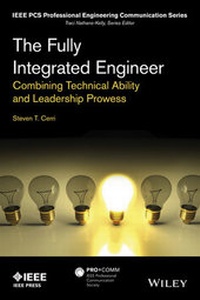
The Fully Integrated Engineer
Description

More details
Other editions
Additional editions
Person
Content
2
Why Should You Read a Book by Me? Or . Why Is This Book Important Now?
It is reasonable to ask, "Who is this guy and why should I read his book?"
Let me start by where I come from so that you can see how I so easily understand where the technical professional lives and what has to happen in order to achieve long-term career success and even to transition to management.
From the time I was a small boy, I knew I wanted to be an aeronautical/aerospace engineer. In elementary and high school, as well as in college, I built rockets. Not the cardboard kind, but rockets made of cold rolled steel tubing, using zinc and sulfur as solid propellant. My rockets reached altitudes of almost a mile and returned by parachute, sometimes. Although my friends helped me launch my rockets on launch day, I did most of my rocket work alone. I was not a member of a rocket society or club. I built my rockets through long hours in the family basement and launched them on our large family farm. I loved what I did and there was no need to share it with anyone else until the launch day.
I went off to college and received a Bachelor of Science degree in aeronautical engineering and upon graduation joined Rockwell International working in the advanced systems division as a flight performance engineer. After two years at Rockwell, I left to go back to school and received a Master of Science degree in geophysics. I then worked for several years for the United States Geological Survey as a software engineer and earth resources sciences researcher.
I then returned to Rockwell International to my flight performance team and worked on advanced deep space systems as a flight performance engineer and as chief systems engineer. While at Rockwell, I met three other engineers and after several more years at Rockwell the four of us left and started our own company focused on software development and computer systems engineering.
After ten years and a couple of moves to field offices, the company was worth $100 million. During that time I received an M.B.A. Also, during that time I advanced my career from engineer to Program Manager, to Director of Engineering, to Vice President of Engineering, to Chief Operations Officer, to General Manager of a company division.
I later joined a start-up that became a highly successful commercial bar-code printer manufacturer. I was its first Product Manager and later became the Director of Corporate Training.
About 16 years ago, I started my own training, facilitation, coaching, and consulting company. It became clear that throughout my career I had developed a technology, processes, and an approach that most effectively transformed engineers and other technical professionals into even more effective technical professionals. That process transformed them into great technical managers, as well. I did not receive any official training in communication or management that was worth a dime along the way. All of the management training available then (and seemingly now as well), is most concentrated on using software to manage projects or on developing budgets and schedules. Even so-called communication and management courses are seldom taught by people who have communication or management experience in technical organizations. Instructors seldom have degrees in engineering or other technical fields (they often have degrees in psychology, not engineering) and often merely repeat what they have been told to say in their trainings. Nowhere was there anyone from the technical world who could teach me how to deal with people, and I quickly learned that dealing with people is what effective communication and good management are all about.
I learned how to deal with people on my own, often by taking courses that had nothing to do with technical management, and I became very, very good at interpersonal communication, management, leadership, and motivation. I built incredibly effective teams made up of people that other managers often did not want. I was able to turn around projects that had become unmanageable. I had a reputation of being able to handle very challenging issues around technology and people. Often, I was given the teams and projects that were broken, and I fixed them.
The processes and the technology of management that I developed over this period I call becoming a Fully Integrated Technical Professional©. It means being an engineer AND being able to contribute fully to your organization, using all your talents and all your capabilities. Whether you want to become a more effective engineer or you want to be an effective technical manager, I believe the processes I teach are necessary and, if followed, will get you there.
Since becoming a coach, facilitator/trainer, consultant, author, and speaker on this topic, I have worked with both large and small high-technology companies. I have been an adjunct professor at the University of California, Santa Barbara in the Technology Management Program in the Department of the Engineering. I have worked internationally training and coaching engineers, technologists and non-technologists to be more effective communicators and to smoothly transition to management.
Therefore, the reason I can write this book is because I have made the transition from engineer and scientist to manager myself and in the process I have developed tools that are unique and are tailored for the engineer by an engineer. I know what it takes to embrace this new career called management. I know what it feels like to be in the early stages of a technical management career. I know what it is like to think you have the skills to manage and yet have the feeling of uncertainty in the pit of your stomach when you approach a new management situation for the first time. I know what it is like to be in the cycle where you need to be a manager to get management experience and yet if you had the management experience you could be a manager.
I have coached many engineers into management positions and I am very proud of that fact. In addition, I have coached a handful of engineers who were just weeks away from employment termination when their managers contacted me. These engineers were going to be let go because they "just did not fit." No one argued that the engineers at risk of lay off were not smart engineers; indeed they were. But they either did not fit the organization or they failed in their first management attempts. They were slated for termination and I was their company's last resort in their attempt to keep these people at the company. They are now very successful senior engineers and managers in their organizations and I am very pleased to have played a role in their success.
You will note that there are few references in this book. I have not quoted other people or other sources. The reason for this is that if I have not used the tools, techniques, skills, and processes I put forth in these pages, and if I have not used them successfully, you will not hear about them. None of what you will find here is based on theories or present day fads. Everything I am sharing with you here has been applied by me, successfully, over and over and over again.
A Few Words in Praise of Steven T. Cerri's Work
I have taken a training course from Steven and I have had him as a coach and he is unique in both areas. Not only does Steven understand the world of the engineer, scientist, and technologist, but he also understands the worlds of managers and leaders. This combination makes him unique when it comes to his ability to merge different disciplines and to understand just what technical people need in order to become more effective and successful.
Steven is also refreshing in that he does not deal in theories. He deals in things that work and can be applied now. One of the most valuable aspects of Steven's trainings and coaching is that you get concrete, immediately applicable tools. As Steven often says, "If I haven't used what I'm teaching you successfully myself, you won't hear about it."
Ba Nguyen
Manager, QVS Engineering, a Premier Medical Device Company
* * *
The Fully Integrated Engineer: Combining Technical Ability and Leadership Prowess by Steven T. Cerri, is an eye-opening journey for the technical person who wishes to understand key communication issues that may be hampering personal success at work. Steven T. Cerri offers a thorough analysis of the most common communication stumbling blocks experienced by engineers or scientists. His "Limiting Belief Cycles" and "Gems of Wisdom" are brilliant new ways for technologists to approach how they perceive and relate to others.
Having worked with Steven for over twenty years, I can positively say that he is an example of a technical person who has become a master communicator. He teaches what he practices in everyday life! In The Fully Integrated Engineer: Combining Technical Ability and Leadership Prowess, Steven offers many of the insights and tools he learned to become as confident with his "people" skills as he is with his technical expertise.
Christine Kopec-Testolini
CEO, Avante Leadership Group
* * *
I have researched, taught and developed managers and leaders for technology driven companies for over 30 years. As a professor at the University of Washington I created a technology entrepreneurship program, lead The Boeing Corporation's aerospace management development...
