

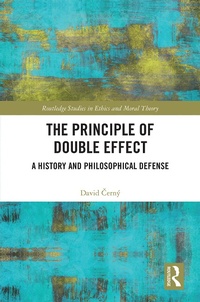
The Principle of Double Effect
A History and Philosophical Defense
1st Edition
Published on 20. March 2020
186 pages
978-1-000-06186-4 (ISBN)
Description

This book offers a comprehensive history of the principle of double effect and its applications in ethics. Written from a non-theological perspective, it makes the case for the centrality of the double effect reasoning in philosophical ethics.
The book is divided into two parts. The first part thoroughly examines the history of double effect reasoning. The author's history spans from Thomas Aquinas's opera omnia to the modern and influential understanding of the principle known as proportionalism. The second part of the book elucidates the principle and addresses various objections that have been raised against it, including those that arise from an in-depth discussion of the trolley problem. Finally, the author examines the role of intentions in ethical thinking and constructs a novel defense of the principle based on fine distinctions between intentions.
The Principle of Double Effect: A History and Philosophical Defense will be of interest to scholars and advanced students working in moral philosophy, the history of ethics, bioethics, medical ethics, and the Catholic moral tradition.
The book is divided into two parts. The first part thoroughly examines the history of double effect reasoning. The author's history spans from Thomas Aquinas's opera omnia to the modern and influential understanding of the principle known as proportionalism. The second part of the book elucidates the principle and addresses various objections that have been raised against it, including those that arise from an in-depth discussion of the trolley problem. Finally, the author examines the role of intentions in ethical thinking and constructs a novel defense of the principle based on fine distinctions between intentions.
The Principle of Double Effect: A History and Philosophical Defense will be of interest to scholars and advanced students working in moral philosophy, the history of ethics, bioethics, medical ethics, and the Catholic moral tradition.
Reviews / Votes
"David Cerny shows in this book that there are several formulations of the principle of double effect, and that they need to be distinguished if we wish to think more carefully about good or possibly good acts that have bad consequences. He presents a novel defense against various objections that have been raised against it. His analysis of the principle's historical context and development allows him to shed new light on the various distinctions presupposed by its correct understanding and use." - Thomas M. Osborne Jr., Chair, Department of Philosophy, University of St. Thomas, USA"David Cerny's monograph is authoritative, imaginative, and cutting-edge. It is the only work I know of that sheds light on the intellectual origins of the principle of double effect and relates them to the contemporary debate in a manner that dispels misunderstandings and advances our understanding or the principle. The 'Principle of Double Effect' could easy be the standard book on the topic for the next ten or twenty years and both students and specialists will learn much from it." - George Pavlakos, Professor of Law and Philosophy, University of Glasgow, UK
"The Doctrine of Double Effect is one of the most important principles in applied ethics yet, at the same time, one of the most puzzling. In his book, David Cerny offers a combination of an historical and an analytical analysis in order to clarify and explain it. His book is compulsory reading for anybody interested in ethical theory and in applied ethics." - Professor Daniel Statman, Chair, Department of Philosophy, University of Haifa, Israel
"The Doctrine of Double Effect is a mainstay of non-consequentialist moral thinking, yet remains misunderstood, and fundamental doubts about it are widespread. In this splendid and path-breaking book, David Cerny does more than has ever been done before to uncover the historical origins of this view, to explore its different formulations, and to defend the reasoning behind it. This is a rare achievement, a genuine contribution to analytic ethical theory and applied moral philosophy, and at the same time an exemplary model of the relevance of the history of ideas to philosophy." - Saul Smilansky, Professor, Department of Philosophy, University of Haifa, Israel
More details
Series
Edition
1. Auflage
Language
English
Place of publication
London
United Kingdom
Publishing group
Taylor & Francis Ltd
Target group
College/higher education
Illustrations
3 Tables, black and white
File size
5,25 MB
ISBN-13
978-1-000-06186-4 (9781000061864)
Copyright in bibliographic data and cover images is held by Nielsen Book Services Limited or by the publishers or by their respective licensors: all rights reserved.
Schweitzer Classification
Other editions
Additional editions
Book
08/2022
1st Edition
Routledge
€66.70
Shipment within 10-20 days
Book
03/2020
1st Edition
Routledge
€231.30
Shipment within 15-20 days
Person
David Cerny studied in Bologna and Rome, received his Ph.D. in Philosophy from Charles University in Prague. He is a Research Fellow at the Institute of State and Law and the Institute of Computer Science of the Czech Academy of Sciences. He has widely published in the Czech and Italian languages.
Content
Foreword by Daniel Statman
1. Introduction
2. A Brief History of the Principle: Thomas Aquinas
3. A Brief History of the Principle: Cajetan to J. P. Gury
4. Peter Knauer and Proportionalism
5. The Principle of Double Effect and Trolleyology
6. Defence of the Principle of Double Effect
7. Conclusion
1. Introduction
2. A Brief History of the Principle: Thomas Aquinas
3. A Brief History of the Principle: Cajetan to J. P. Gury
4. Peter Knauer and Proportionalism
5. The Principle of Double Effect and Trolleyology
6. Defence of the Principle of Double Effect
7. Conclusion
