

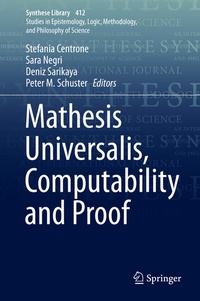
Mathesis Universalis, Computability and Proof
Description

Stefania Centrone is currently Privatdozentin at the University of Hamburg, teaches and does research at the Universities of Oldenburg and of Helsinki and has been in 2016 deputy Professor of Theoretical Philosophy at the University of Göttingen. In 2012 she was awarded a DFG-Eigene Stelle for the project Bolzanos und Husserls Weiterentwicklung von Leibnizens Ideen zur Mathesis Universalis and 2017 a Heisenberg grant. She is author of the volumes Logic and philosophy of Mathematics in the Early Husserl (Synthese Library 2010) and Studien zu Bolzano (Academia Verlag 2015).
Sara Negri is Professor of Theoretical Philosophy at the University of Helsinki, where she has been a Docent of Logic since 1998. After a PhD in Mathematics in 1996 at the University of Padova and research visits at the University of Amsterdam and Chalmers, she has been a research associate at the Imperial College in London, a Humboldt Fellow in Munich, and a visiting scientist at the Mittag-Leffler Institute in Stockholm. Her research interests range from mathematical logic and philosophy of mathematics to proof theory and its applications to philosophical logic and formal epistemology.
Deniz Sarikaya is PhD-Student of Philosophy and studies Mathematics at the University of Hamburg with experience abroad at the Universiteit van Amsterdam and Universidad de Barcelona. He stayed a term as a Visiting Student Researcher at the University of California, Berkeley developing a project on the Philosophy of Mathematical Practice concerning the Philosophical impact of the usage of automatic theorem prover and as a RISE research intern at the University of British Columbia. He is mainly focusing on philosophy of mathematics and logic.
More details
Other editions
Additional editions
Persons
Stefania Centrone is currently Privatdozentin at the University of Hamburg, teaches and does research at the Universities of Oldenburg and of Helsinki and has been in 2016 deputy Professor of Theoretical Philosophy at the University of Göttingen. In 2012 she was awarded a DFG-Eigene Stelle for the project Bolzanos und Husserls Weiterentwicklung von Leibnizens Ideen zur Mathesis Universalis and 2017 a Heisenberg grant. She is author of the volumes Logic and philosophy of Mathematics in the Early Husserl (Synthese Library 2010) and Studien zu Bolzano (Academia Verlag 2015).
Sara Negri is Professor of Theoretical Philosophy at the University of Helsinki, where she has been a Docent of Logic since 1998. After a PhD in Mathematics in 1996 at the University of Padova and research visits at the University of Amsterdam and Chalmers, she has been a research associate at the Imperial College in London, a Humboldt Fellow in Munich, and a visiting scientist at the Mittag-Leffler Institute in Stockholm. Her research interests range from mathematical logic and philosophy of mathematics to proof theory and its applications to philosophical logic and formal epistemology.
Deniz Sarikaya is PhD-Student of Philosophy and studies Mathematics at the University of Hamburg with experience abroad at the Universiteit van Amsterdam and Universidad de Barcelona. He stayed a term as a Visiting Student Researcher at the University of California, Berkeley developing a project on the Philosophy of Mathematical Practice concerning the Philosophical impact of the usage of automatic theorem prover and as a RISE research intern at the University of British Columbia. He is mainly focusing on philosophy of mathematics and logic.
Peter Schuster is Associate Professor for Mathematical Logic at the University of Verona. After both doctorate and habilitation in mathematics at the University of Munich he was Lecturer at the University of Leeds and member of the Leeds Logic Group. Apart from constructive mathematics at large, his principal research interests are about the computational content of classical proofs in abstract algebra and related fields in which maximum or minimum principles are invoked.
