

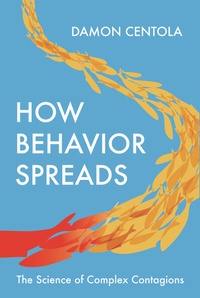
How Behavior Spreads
The Science of Complex Contagions
1st Edition
Published on 21. August 2018
312 pages
978-1-4008-9009-5 (ISBN)
Description

A new, counterintuitive theory for how social networks influence the spread of behavior
New social movements, technologies, and public-health initiatives often struggle to take off, yet many diseases disperse rapidly without issue. Can the lessons learned from the viral diffusion of diseases be used to improve the spread of beneficial behaviors and innovations? In How Behavior Spreads, Damon Centola presents over a decade of original research examining how changes in societal behavior--in voting, health, technology, and finance-occur and the ways social networks can be used to influence how they propagate. Centola's startling findings show that the same conditions accelerating the viral expansion of an epidemic unexpectedly inhibit the spread of behaviors.
While it is commonly believed that "weak ties"-long-distance connections linking acquaintances-lead to the quicker spread of behaviors, in fact the exact opposite holds true. Centola demonstrates how the most well-known, intuitive ideas about social networks have caused past diffusion efforts to fail, and how such efforts might succeed in the future. Pioneering the use of Web-based methods to understand how changes in people's social networks alter their behaviors, Centola illustrates the ways in which these insights can be applied to solve countless problems of organizational change, cultural evolution, and social innovation. His findings offer important lessons for public health workers, entrepreneurs, and activists looking to harness networks for social change.
Practical and informative, How Behavior Spreads is a must-read for anyone interested in how the theory of social networks can transform our world.
New social movements, technologies, and public-health initiatives often struggle to take off, yet many diseases disperse rapidly without issue. Can the lessons learned from the viral diffusion of diseases be used to improve the spread of beneficial behaviors and innovations? In How Behavior Spreads, Damon Centola presents over a decade of original research examining how changes in societal behavior--in voting, health, technology, and finance-occur and the ways social networks can be used to influence how they propagate. Centola's startling findings show that the same conditions accelerating the viral expansion of an epidemic unexpectedly inhibit the spread of behaviors.
While it is commonly believed that "weak ties"-long-distance connections linking acquaintances-lead to the quicker spread of behaviors, in fact the exact opposite holds true. Centola demonstrates how the most well-known, intuitive ideas about social networks have caused past diffusion efforts to fail, and how such efforts might succeed in the future. Pioneering the use of Web-based methods to understand how changes in people's social networks alter their behaviors, Centola illustrates the ways in which these insights can be applied to solve countless problems of organizational change, cultural evolution, and social innovation. His findings offer important lessons for public health workers, entrepreneurs, and activists looking to harness networks for social change.
Practical and informative, How Behavior Spreads is a must-read for anyone interested in how the theory of social networks can transform our world.
More details
Other editions
Additional editions
Book
03/2020
Princeton University Press
€31.50
Shipment within 10-20 days
Book
06/2018
Princeton University Press
€43.00
Shipment within 10-20 days
Person
Damon Centola is an associate professor in the Annenberg School for Communications and the School of Engineering and Applied Sciences at the University of Pennsylvania, where he is director of the Network Dynamics Group.
Content
- Cover
- Title
- Copyright
- Dedication
- Contents
- Preface
- Chapter 1. Introduction
- PART I. THEORY
- Chapter 2. Understanding Diffusion
- Chapter 3. The Theory of Complex Contagions
- Chapter 4. A Social Experiment on the Internet
- PART II. APPLICATIONS
- Introduction to Part II
- Chapter 5. Complex Contagions in Other Contexts
- Chapter 6. Diffusing Innovations That Face Opposition
- Chapter 7. Diffusing Change in Organizations
- PART III. SOCIAL DESIGN
- Introduction to Part III
- Chapter 8. Designing Social Networks for Diffusion
- Chapter 9. Creating Social Contexts for Behavior Change
- PART IV. CONCLUSIONS
- Chapter 10. Conclusion
- Epilogue: Experimental Sociology
- Appendix A: The Ethics of Social Design
- Appendix B: Methods of Computational Social Science
- Appendix C: Technical Appendix for Models
- Acknowledgments
- Notes
- References
- Index
