

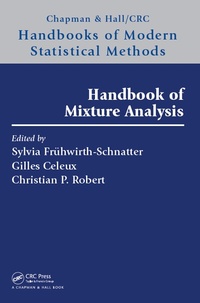
Handbook of Mixture Analysis
1st Edition
Published on 4. January 2019
522 pages
978-0-429-50886-8 (ISBN)
Description

Mixture models have been around for over 150 years, and they are found in many branches of statistical modelling, as a versatile and multifaceted tool. They can be applied to a wide range of data: univariate or multivariate, continuous or categorical, cross-sectional, time series, networks, and much more. Mixture analysis is a very active research topic in statistics and machine learning, with new developments in methodology and applications taking place all the time.
The Handbook of Mixture Analysis is a very timely publication, presenting a broad overview of the methods and applications of this important field of research. It covers a wide array of topics, including the EM algorithm, Bayesian mixture models, model-based clustering, high-dimensional data, hidden Markov models, and applications in finance, genomics, and astronomy.
Features:
Provides a comprehensive overview of the methods and applications of mixture modelling and analysis
Divided into three parts: Foundations and Methods; Mixture Modelling and Extensions; and Selected Applications
Contains many worked examples using real data, together with computational implementation, to illustrate the methods described
Includes contributions from the leading researchers in the field
The Handbook of Mixture Analysis is targeted at graduate students and young researchers new to the field. It will also be an important reference for anyone working in this field, whether they are developing new methodology, or applying the models to real scientific problems.
The Handbook of Mixture Analysis is a very timely publication, presenting a broad overview of the methods and applications of this important field of research. It covers a wide array of topics, including the EM algorithm, Bayesian mixture models, model-based clustering, high-dimensional data, hidden Markov models, and applications in finance, genomics, and astronomy.
Features:
Provides a comprehensive overview of the methods and applications of mixture modelling and analysis
Divided into three parts: Foundations and Methods; Mixture Modelling and Extensions; and Selected Applications
Contains many worked examples using real data, together with computational implementation, to illustrate the methods described
Includes contributions from the leading researchers in the field
The Handbook of Mixture Analysis is targeted at graduate students and young researchers new to the field. It will also be an important reference for anyone working in this field, whether they are developing new methodology, or applying the models to real scientific problems.
Reviews / Votes
"This is another handbook in the remarkable series by CRC Press, which now consists of 21 volumes. The book has 19 chapters, split in to three parts: Foundations and Methods, Mixture Modelling and Extensions, and Selected Applications. Many first-class statisticians have contributed to the book. The editors have taken their coordinating task seriously, even organizing a workshop in Vienna. The balance between the chapters is quite good and the notation is streamlined... To summarize, I can recommend this handbook... The technical quality of typesetting and printing is high."- Paul Eilers, Erasmus University Medical Centre, Netherlands, Appeared in ISCB News, January 2020
"...this is an excellent reference book on mixture models. The different chapters cover the basics as well as the details of specific topics in mixture models, so this handbook will appeal to researchers willing to start with mixture models and others with a stronger background in the field. The contents can well be used to prepare introductory or advanced courses on the subject, and the references on packages for the R programming language can be a starting point to develop hands-on training materials for computer laboratories."
- Virgilio Gomez-Rubio, Universidad de Castilla-La Mancha, Albacete, Spain
More details
Series
Edition
1. Auflage
Language
English
Place of publication
London
United Kingdom
Publishing group
Taylor & Francis Ltd
Target group
College/higher education
Illustrations
34 Tables, black and white; 2 Line drawings, color; 85 Line drawings, black and white; 87 Illustrations, black and white
File size
21,84 MB
ISBN-13
978-0-429-50886-8 (9780429508868)
Copyright in bibliographic data and cover images is held by Nielsen Book Services Limited or by the publishers or by their respective licensors: all rights reserved.
Schweitzer Classification
Other editions
Additional editions
Gilles Celeux | Christian P. Robert | Sylvia Fruhwirth-Schnatter
Handbook of Mixture Analysis
Book
12/2020
1st Edition
Chapman & Hall/CRC
€92.70
Shipment within 15-20 days
Sylvia Fruhwirth-Schnatter | Gilles Celeux | Christian P. Robert
Handbook of Mixture Analysis
Book
01/2019
Chapman & Hall/CRC
€250.90
Shipment within 15-20 days
Persons
Sylvia Fruehwirth-Schnatter is Professor of Applied Statistics and Econometrics at the Department of Finance, Accounting, and Statistics, Vienna University of Economics and Business, Austria. She has contributed to research in Bayesian modelling and MCMC inference for a broad range of models, including finite mixture and Markov switching models as well as state space models. She is particularly interested in applications of Bayesian inference in economics, finance, and business. She started to work on finite mixture and Markov switching models 20 years ago and has published more than 20 articles in this area in leading journals such as JASA, JCGS, and Journal of Applied Econometrics. Her monograph Finite Mixture and Markov Switching Models (2006) was awarded the Morris-DeGroot Price 2007 by ISBA. In 2014, she was elected Member of the Austrian Academy of Sciences.
Gilles Celeux is Director of research emeritus with INRIA Saclay-Ile-de-France, France. He has conducted research in statistical learning, model-based clustering and model selection for more than 35 years and he leaded to Inria teams. His first paper on mixture modelling was written in 1981 and he is one of the co-organisators of the summer working group on model-based clustering since 1994. He has published more than 40 papers in international Journals of Statistics and wrote two textbooks in French on Classification. He was Editor-in-Chief of Statistics and Computing between 2006 and 2012 and he is the present Editor-in-Chief of the Journal of the French Statistical Society since 2012.
Christian P. Robert is Professor of Mathematics at CEREMADE, Universite Paris-Dauphine, PSL Research University, France, and Professor of Statistics at the Department of Statistics, University of Warwick, UK. He has conducted research in Bayesian inference and computational methods covering Monte Carlo, MCMC, and ABC techniques, for more than 30 years, writing The Bayesian Choice (2001) and Monte Carlo Statistical Methods (2004) with George Casella. His first paper on mixture modelling was written in 1989 on radiograph image modelling. His fruitful collaboration with Mike Titterington on this topic spans two enjoyable decades of visits to Glasgow, Scotland. He has organised three conferences on the subject of mixture inference, with the last one at ICMS leading to the edited book Mixtures: Estimation and Applications (2011), co-authored with K. L. Mengersen and D. M. Titterington.
Gilles Celeux is Director of research emeritus with INRIA Saclay-Ile-de-France, France. He has conducted research in statistical learning, model-based clustering and model selection for more than 35 years and he leaded to Inria teams. His first paper on mixture modelling was written in 1981 and he is one of the co-organisators of the summer working group on model-based clustering since 1994. He has published more than 40 papers in international Journals of Statistics and wrote two textbooks in French on Classification. He was Editor-in-Chief of Statistics and Computing between 2006 and 2012 and he is the present Editor-in-Chief of the Journal of the French Statistical Society since 2012.
Christian P. Robert is Professor of Mathematics at CEREMADE, Universite Paris-Dauphine, PSL Research University, France, and Professor of Statistics at the Department of Statistics, University of Warwick, UK. He has conducted research in Bayesian inference and computational methods covering Monte Carlo, MCMC, and ABC techniques, for more than 30 years, writing The Bayesian Choice (2001) and Monte Carlo Statistical Methods (2004) with George Casella. His first paper on mixture modelling was written in 1989 on radiograph image modelling. His fruitful collaboration with Mike Titterington on this topic spans two enjoyable decades of visits to Glasgow, Scotland. He has organised three conferences on the subject of mixture inference, with the last one at ICMS leading to the edited book Mixtures: Estimation and Applications (2011), co-authored with K. L. Mengersen and D. M. Titterington.
Content
Part I: Methods; 1. Introduction to finite mixtures; 2. ML based inference; 3. Bayesian inference; 4. Posterior sampling; 5. Selecting the number of components; 6. Continuous non-Gaussian mixtures; 7. Mixtures for count data; 8. EM Algorithms for finite mixtures; 9. Infinite mixtures and NP mixtures; 10. Bayesian non-parametric mixture models; 11. Mixtures of experts; 12. Model-based clustering; Part II: Extensions and Applications; 13. Hidden Markov models and time series; 14. Infinite Hidden Markov Models; 15. Spatial mixtures and disease mapping; 16. Image analysis and visualisation; 17. High-dimensional panel data; 18. Applications in Genomics; 19. Applications in Medicine; 20. Applications in Economics; 21. Applications in Finance; 22. Applications in Marketing; 23. Applications in Industry; 24. Applications in Astronomy.
