

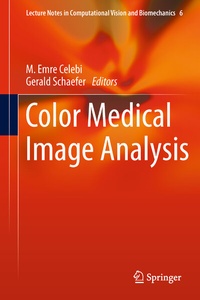
Color Medical Image Analysis
Description

Since the early 20th century, medical imaging has been dominated by monochrome imaging modalities such as x-ray, computed tomography, ultrasound, and magnetic resonance imaging. As a result, color information has been overlooked in medical image analysis applications. Recently, various medical imaging modalities that involve color information have been introduced. These include cervicography, dermoscopy, fundus photography, gastrointestinal endoscopy, microscopy, and wound photography. However, in comparison to monochrome images, the analysis of color images is a relatively unexplored area. The multivariate nature of color image data presents new challenges for researchers and practitioners as the numerous methods developed for monochrome images are often not directly applicable to multichannel images.
The goal of this volume is to summarize the state-of-the-art in the utilization of color information in medical image analysis.
More details
Other editions
Additional editions
Content
1. A Data Driven Approach to Cervigram Image Analysis and Classification, by Edward Kim and Xiaolei Huang.- 2. Macroscopic Pigmented Skin Lesion Segmentation and Its Influence on Lesion Classification and Diagnosis, by Pablo G. Cavalcanti and Jacob Scharcanski.- 3. Color and Spatial Features Integrated Normalized Distance for Density Based Border Detection in Dermoscopy Images, by Sinan Kockara, Mutlu Mete, Sait Suer.- 4. A Color and Texture Based Hierarchical K-NN Approach to the Classification of Non-Melanoma Skin Lesions, by Lucia Ballerini, Robert B. Fisher, Ben Aldridge, Jonathan Rees.- 5. Color Quantization of Dermoscopy Images Using the K-Means Clustering Algorithm, by M. Emre Celebi, Quan Wen, Sae Hwang, and Gerald Schaefer.- 6. Grading the Severity of Diabetic Macular Edema Cases Based on Color Eye Fundus Images, by Daniel Welfer, Jacob Scharcanski, Pablo Gautério Cavalcanti, Diane Ruschel Marinho, Laura W. B. Ludwig, Cleyson M. Kitamura and Melissa M. Dal Pizzol.- 7. Colour Image Analysis of Wireless Capsule Endoscopy Video: A Review, by Mark Fisher and Michal Mackiewicz.- 8. Automated Prototype Generation for Multi-Color Karyotyping, by Xuqing Wu, Shishir Shah, and Fatima Merchant.- 9. Colour Model Analysis for Histopathology Image Processing, by Gloria Bueno, Oscar D´eniz, Jes´us Salido, M. Milagro Fern´andez, Noelia V´allez, and Marcial García-Rojo.- 10. A Review on CAD Tools for Burn Diagnosis, by Aurora S´aez, Carmen Serrano and Begoña Acha.- Index.
