

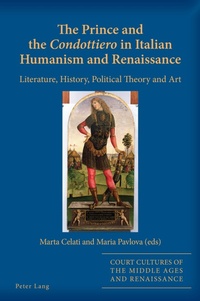
The Prince and the «Condottiero» in Italian Humanism and Renaissance
Description

This volume explores the process of definition, evolution and representation of the figures of the prince and the condottiero in fifteenth- and sixteenth-century Italy: two roles that often appear as interconnected and, in some cases, are embodied by the same political actor. By adopting an interdisciplinary approach and considering different cultural centres (e.g. Milan, Florence, Naples, Ferrara), the contributions to this book examine different forms and genres through which these key political figures have been portrayed and theorised: historical narratives, political treatises, chivalric romances, historical-epic poetry, and visual and artistic representations. These media overlap in various ways but have been rarely considered through a comparative and unified perspective. This viewpoint helps to highlight the synergies, similarities and specificities of these fields and brings recognition to their contribution to the evolution of political ideologies in the Italian Renaissance.
More details
Other editions
Additional editions
Persons
Marta Celati is Professor of Medieval and Humanist Literature at the University of Pisa. She was previously Leverhulme Research Fellow at the University of Warwick, Part-time Lecturer at the University of Oxford, and Frances Yates Short-term Fellow at the Warburg Institute. Her research mainly focuses on humanist and Renaissance literature.
Maria Pavlova is Honorary Research Fellow at the University of Warwick and the University of Oxford. She has held research fellowships at Villa I Tatti, Warwick and Oxford, and in 2023 she was Visiting Lecturer in the Department of Humanities and Arts at the Technion. Her research focuses on Italian Renaissance literature and history.
Content
Contents: Marta Celati: The Felix Prince-Condottiero in Humanist Literature: The Portrayal of Alfonso the Magnanimous's Felicitas - Antonietta Iacono: Le parole del re- condottiero - Hester Schadee: Poggio Bracciolini's Mirrors-for-Prelates: Constructing Grievable Lives - James Hankins: Italian Humanists on Reform of the Condottieri System: The Case of Francesco Patrizi of Siena - Guido Cappelli: Classicismo e tirannide nell'Italia umanistica - Maria Pavlova: 'Dengnissimo mio chapitano': The Figure of the Military Commander in Lorenzo degli Olbizi and Leonardo di Francesco Benci - Valentina Gritti: Eroi antichi alla corte di Ferrara: Alessandro, Cesare, Ciro il Grande ed Ercole specula principis della casa d'Este - Anna Carocci: Buoni e cattivi: Agnadello nelle guerre in ottava rima - Claudia Daniotti: Ancient Heroes to Teach the Young Ludovico il Moro: Alexander the Great and the Indian King Porus in the Codice Sforza - Daniel Jaquet: The Condottiero in Bronze: Portrait Medals of Masters of Arms in Italian Courts (1480-1580) - Livia Stoenescu: The Dynastic Portrait of Charles V and the Habsburgs in the Ephemera of Early Modern Italian Art - Stefano Jossa: Un principe caduto da cavallo: Il Principe e Gli Heroici di Giovan Battista Pigna tra poetica e politica - Bryan Brazeau: Highway to Heaven? Dissimulating Christian Leadership in Torquato Tasso's Gerusalemme Liberata - Simone Testa: Sanguine and Melancholic: The Ideal Prince according to Scipione Di Castro - Cristina Zampese: 'Salerno alto e gentile': Fermenti intellettuali e rovina politica nel principato di Ferrante Sanseverino e Isabella Villamarina - Eugenio Refini: The Unhappy Prince: Queering a Renaissance Myth.
