

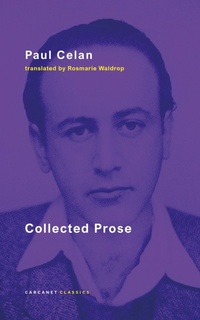
Collected Prose
Description

Paul Celan (1920-70) stands as one of the greatest post-war European poets, a writer whose painful struggle with the possibilities and limitations of German, his native language, has helped to define the response of poetry in the aftermath of the Holocaust.
Celan's prose is as thought-provoking as, and less familiar than, his poetry. The writings and aphorisms on poetry and art illuminate the sources of his language: he explores the condition of being a stranger in the world, the necessity - and limitation - of discourse, enlarging our understanding of the poet and his vocation. A spare and reluctant prose writer, Celan speaks with a quiet authority that insists on the centrality of poetry in the modern world.
Rosmarie Waldrop's translation remains true to the poetic rhythms of Celan's prose; her introduction sets the pieces in context.
More details
Other editions
Additional editions
Persons
Paul Celan (1920-1970) was born Paul Antschel into a Jewish family in Bukovina, a German enclave in Romania which was destroyed by the Nazis. His parents were taken to a concentration camp in 1942, and did not return; Celan managed to escape deportation and to survive. After settling in Paris in 1948, he gained widespread recognition as a poet with the publication of his first collection of poems in German in 1952. His earliest poems were written in Romanian and have been translated by, among others, his friend Nina Cassian. He was a fine translator of poetry, mainly from French, English, Russian and Romanian. His mysterious meeting with Martin Heidegger was the subject of a radio play by John Banville.
