

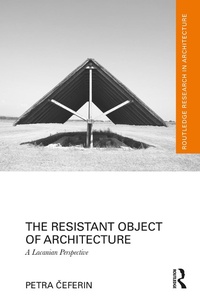
The Resistant Object of Architecture
A Lacanian Perspective
1st Edition
Published on 30. December 2020
162 pages
978-1-000-32944-5 (ISBN)
Description

Architecture's role is becoming increasingly limited to serving the all-pervasive system of globalised capitalism and becoming a constituent, complicit part of its mechanism. The Resistant Object of Architecture addresses this problem, and does so in a way that represents a marked departure from predominant responses which, as the book shows, do not address the core issue.
The book addresses this problem by focusing on the question "what is architecture?," and responds to this question by developing the immanent structural logic of architecture that enables it to work not only as an instrumental thinking practice, but as a practice of creative thinking. This means that it alone determines its issues, problems, and priorities, and precisely because of that it has the capacity and cogency to destabilise, indeed pierce holes in the system in which it operates.
The Resistant Object of Architecture draws on various theoretical sources, from the psychoanalysis of Jacques Lacan and the philosophy of Alain Badiou, to contemporary architectural theory. In contrast to the predominant view of today, it demonstrates that architecture has an affirmative, transformative capacity.
This book is an ideal read for those interested in architectural theory and history, analysis of contemporary architecture, and philosophy of architecture.
The book addresses this problem by focusing on the question "what is architecture?," and responds to this question by developing the immanent structural logic of architecture that enables it to work not only as an instrumental thinking practice, but as a practice of creative thinking. This means that it alone determines its issues, problems, and priorities, and precisely because of that it has the capacity and cogency to destabilise, indeed pierce holes in the system in which it operates.
The Resistant Object of Architecture draws on various theoretical sources, from the psychoanalysis of Jacques Lacan and the philosophy of Alain Badiou, to contemporary architectural theory. In contrast to the predominant view of today, it demonstrates that architecture has an affirmative, transformative capacity.
This book is an ideal read for those interested in architectural theory and history, analysis of contemporary architecture, and philosophy of architecture.
Reviews / Votes
"This book is an excellent example of a systematic and inventive elaboration of those fundamental concepts that are the internal conditions of architectural theory and practice. The work draws on the theoretical framework of the Ljubljana Lacanian school, which certainly well serves to support its elaboration of the architectural concepts developed herein."Rado Riha, philosopher, Head of the Institute of Philosophy, the Research Center of the Slovenian Academy of Sciences and Arts
"This thesis predicated on radical French thought posits a theoretical basis for the cultivation of an autonomous architecture capable of transcending the total commodification of the environment under the aegis of Neoliberal capitalism."
Kenneth Frampton, the Ware Professor of Architecture, Columbia University GSAPP
"The author develops a penetrating analysis of today's architectural reality and points out architecture's dramatic loss of autonomy and the blind surrender to the logic of market economy. She also exposes the often naively idealized self-understanding of the architectural world. Analyzing the understanding of reality in the discipline, Ceferin makes it evident, that today's trivialization of architecture as a critical and transformative practice, calls for a rigorous understanding of its societal and cultural reality."
Juhani Pallasmaa, architect, professor emeritus, writer, Member of the Pritzker Architecture Prize Jury 2008-2014
"This book addresses the pressing concern of architecture's role in globalized capitalism by providing a courageous alternative to yet another gloomy account of architecture's impossibility to act. It points to a way out of the cul-de-sac of post-criticality by formulating a theory of architecture's inherent transformative potential and its capacity to "punch a hole" in the world of consumer capitalism."
Rixt Hoekstra, lecturer creative technology, University of Twente
More details
Series
Edition
1. Auflage
Language
English
Place of publication
London
United Kingdom
Publishing group
Taylor & Francis Ltd
Target group
College/higher education
Product notice
Reflowable
Illustrations
3 Line drawings, black and white; 19 Halftones, black and white; 22 Illustrations, black and white
ISBN-13
978-1-000-32944-5 (9781000329445)
Copyright in bibliographic data and cover images is held by Nielsen Book Services Limited or by the publishers or by their respective licensors: all rights reserved.
Schweitzer Classification
Other editions
Additional editions
Book
01/2023
1st Edition
Routledge
€51.98
Shipment within 15-20 days
Book
12/2020
1st Edition
Routledge
€191.89
Shipment within 15-20 days
Person
Petra Ceferin is an architect practising architectural theory and philosophy of architecture and is Associate Professor of Architecture at the Faculty of Architecture, University of Ljubljana, where she teaches architectural theory and history.
Content
Introduction; 1. The Four Positions in Architecture ; 2. Towards the Fifth Position; Architecture in Crisis; Destruction and Re-Composition; The Architectural Moral Code; An Architecture of Piercing Affirmation ; 3. The Structural Logic of Architecture; The Architectural Triad I; The Lacanian Triad; The Subject of Psychoanalysis; Anamorphosis; The Headless Subject of Architecture; 4. The Four Structural Elements of Architecture; 4.1. The Architectural Condition; The Condition of the Possibility of Architecture; 4.2. The Architectural Act and Architecture as Subject; The Opening Up of a Place; Enacting the "Cause of Architecture" in the World; The Subjectification of Architecture; 4.3. The Architectural Object; The Architectural Triad II; The Structural Joint: An Elementary Particle of Architecture ; The Gigantic Joint: Constructing a Place for Architecture; 5. In Lieu of a Conclusion; Buildings-Machines and the Posthumanist Subject; Extended Rationalism and the Human Factor
