

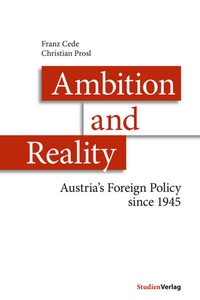
Ambition and Reality
Austria's Foreign Policy since 1945
1st Edition
Published on 7. December 2016
172 pages
978-3-7065-5863-1 (ISBN)
Description

The authors' analysis sheds light on Austria's foreign policy after the Second World war and offers insights into recent developments based on many years of experience in the diplomatic service.
This book describes the most important issues of the Second Republic's foreign policy in a succinct yet captivating way and provides insight into diplomatic practice. It is aimed at readers who are interested in international issues in general and Austrian foreign policy in particular and offers a highly informative and thoroughly readable overview of the developments of the past decades - from the re-establishment of the Foreign Service and Austria's role in the Cold War to the changes that have taken place since Austria's accession to the EU. The book sheds light on Austria's relations with her direct neighbouring states, the ambivalent relationship with the USA and the effects of the collapse of the USSR.
The authors have written this book based on many years of experience in the diplomatic service. With their analysis they aim to contribute to a better understanding of Austria's position in an international context. They do not just direct their gaze into the past but also into the present and future of Austria's foreign policy. Above all they take into account the fundamental changes that took place at the beginning of the 21st century - changes that have brought totally new challenges for Austria.
More details
Other editions
Additional editions
Book
11/2016
1st Edition
Studien Verlag
€21.90
Shipment within 5-7 days
Persons
Ambassador Franz Cede was admitted to the Austrian Foreign Ministry in 1972. In his diplomatic career Cede first worked at the Austrian embassies in Paris and Rabat. He was later appointed ambassador to Zaire (Congo), Consul General in Los Angeles, ambassador to Russia and in Brussels where he was Austrian ambassador to Belgium and to NATO. In Vienna, Ambassador Cede was assigned to the International Law Office of the Foreign Ministry. He was Director of the International Law Office from 1993 to 1999. Ambassador Cede is the author and editor of numerous publications in the fields of international law, European law and international relations. He taught at the Diplomatic Academy in Vienna and the Andrássy University in Budapest and is presently teaching at Webster University in Vienna.
Ambassador Christian Prosl worked with the UN Development Program (UNDP) in Burkina Faso and Rwanda from 1973 to 1977. In 1977 he joined the Foreign Ministry and was assigned to the embassies in London and Washington, followed by an assignment as Head of the Secretary General's Coordination Office in the Foreign Ministry in Vienna. From 1991 to 1995 he served as Consul General in Los Angeles. Back in Vienna, he was appointed Head of the Department for Western and Northern Europe and acted as Head of the Legal and Consular Section from 1998 to 2002. From 2003 to 2009 he served as Austrian ambassador in Berlin, followed by an assignment as ambassador to the US until 2011. He retired in December 2011. Since 2012 he has been the president of the Austrian Cultural Association.
Content
- Intro
- Impressum
- Titel
- Foreword
- Preface Franz Fischler, former EU Commissioner
- 1. Preliminary Remarks on Austria's Foreign Policy
- 1. Domestic and foreign policies are inseparably intertwined.
- 2. The Foreign Service is not the only player in international affairs.
- 3. Foreign policy is not only a matter for central government.
- 4. Austria's Membership in the EU has transformed her concept of state sovereignty.
- 5. The Common Foreign and Security Policy opened up new perspectives for Austrian foreign policy.
- 6. The concept of Austrian neutrality was weakened through EU membership.
- 7. Austrian foreign policy is also security policy.
- 8. The democratic element in foreign policy has become substantially stronger.
- 9. The consular protection of Austrian citizens abroad has developed into a central task for the Foreign Ministry.
- 10. The media influence foreign policy.
- 11. Global problems cannot be solved with local solutions.
- 12. Does Austria have a foreign policy strategy?
- 13. Visions for an Austrian foreign policy.
- 2. The Restoration of Austria and of the Foreign Service in 1945
- A new beginning and physical reconstruction
- The Restoration of the Foreign Service
- Ideological Reorientation
- 3. Austria in the Cold War
- Austria in the Cold War from 1945 until 1955
- Austria's Neutrality in the Cold War (1955-1972)
- Austria and the Policy of Détente in Europe (1972-1991)
- 4. The Marshall Plan in Austria
- 5. The State Treaty
- Development and Structure of the State Treaty Negotiations
- Selected Provisions of the State Treaty
- What remains of the State Treaty?
- 6. Austrian Neutrality
- The Beginnings of Austrian Neutrality
- The Political Compromise on the International Status of Austria
- The Legal Framework of Austria's Neutrality
- The Evolution of Austrian Neutrality from 1955 to 1989
- Neutrality under International Law, but not Ideological Neutrality
- Neutrality and the State Treaty as a Hindrance to Early EC Membership
- Austrian Neutrality after the Global Political Upheavals in 1989
- Domestic Policy Dimensions of Neutrality
- 7. Switzerland: A Model with Differences
- Neutrality and European Politics
- United Nations, Human Rights and Humanitarian Action
- Bilateral Relations between Austria and Switzerland
- 8. The Hungarian Crisis 1956
- 9. The Crisis in Czechoslovakia 1968: Crisis Management and International Law
- 10. Austria and the United Nations
- Excursus: The Non-Aligned Movement
- Austria in the Security Council
- Austrians in Prominent Positions in the United Nations and in the Special Organizations
- Peacekeeping Operations
- 11. Vienna as a City of International Meetings and Conferences
- East-West Summit Meetings and Visits in Austria
- Vienna as the Capital for the Codification of International Law
- Vienna as one of the Headquarters of the United Nations and other International Organizations
- Headquarters and Conferences as a Security Factor
- Assessment of Vienna's Current Opportunities and Shortcomings
- 12. From CSCE to OSCE
- Historical Retrospective
- Austria and the OSCE - a Successful Partnership
- The Period from 1970 to 1990
- Austria and Basket 3
- The Group of "Neutral and Non-Aligned States"
- The Period after the Collapse of Communism
- Vienna as OSCE Headquarters
- Austria's Priorities in the OSCE
- The Austrian OSCE Chairmanship in 2000
- New Challenges for Austria's OSCE Policies
- 13. International Protection of Human Rights
- Human Rights Policies within the Framework of the UN
- Human Rights Protection in the Regional Context
- Austria's Human Rights Policy in the EU
- Bilateral Human Rights Diplomacy
- 14. South Tyrol - the International Solution to a Deep-Seated Problem
- The Political Fate of South Tyrol from 1918 to 1945
- The Path to the Gruber-De Gasperi Agreement
- Milestones to South Tyrolean Autonomy
- Agreement on Expanded Autonomy
- 15. Austria's Peace Policy in the Middle East
- 16. Austria and Central Europe
- 17. Relations with Belgrade and the Collapse of Yugoslavia
- Yugoslavian Territorial Claims
- Protection of the Slovenian Minority
- Economic Aspects of Austrian-Yugoslavian Relations
- Austrian-Yugoslavian Cooperation in view of Détente
- Austria's Role in the Collapse of Yugoslavia
- 18. Austria and the EU
- Immutable Elements of Austrian Integration Policy before the Collapse of Communism in 1989/90
- The Various Stages of Austria's Integration Policy
- Revising Outdated Attitudes
- The Accession Negotiations
- Austria's two EU Council Presidencies
- Austria's first EU Presidency
- The second Presidency
- Excursus: The Sanctions Imposed on Austria by her 14 EU Partners
- 19. "Annus mirabilis" 1989 and the Collapse of Communism
- Introduction
- Impact on the European Unification Process
- Austria and the Consequences of 1989-90
- Developments in Selected Countries
- 20. The Collapse of the Soviet Union and Russia's New Beginning
- Fundamental Factors in the Vienna-Moscow Relationship
- Austrian-Soviet Relations before 1991
- Austrian-Soviet Relations immediately after the Conclusion of the State Treaty
- Austria and the Dissolution of the Soviet Union
- The Emergence of New States on the Territory of the Former Soviet Union
- Excursus: The Role of the Moscow Embassy
- 21. Austria and the USA: An Ambivalent Relationship
- Historical Background
- Bilateral Relations after 1945
- Who in Washington is Responsible for Foreign Policy?
- Austria Caught up by her Nazi Past
- September 11, 2001 - The Beginning of a New Era
- The Role of Bilateral Ambassadors
- Concluding Thoughts on the USA's Relations to Europe and Austria
- 22. Austria and Germany: A Complicated Relationship
- Relations with the Federal Republic of Germany
- Relations with the German Democratic Republic
- West Berlin
- Bilateral Relations after German Reunification
- A Friendly, Matter-of-fact Relationship in Europe's Interest
- 23. Austria and Western Europe
- A Few Fundamental Remarks
- Austro-French Relations
- Relations between Austria and Great Britain
- 24. Austria's Responsibility in the Balkans
- Austria's Special Relationship with the Balkans
- Austria's Balkan Expertise
- Austria and the Balkan States' European Perspective
- Specific Examples of Austria's Close Bilateral Relations in the Balkans
- 25. The Human Dimension of Foreign Policy
- Free Movement of Persons
- Visas
- Policies for Asylum Applicants and Refugees
- Protecting Austrians abroad
- Excursus: Immigration and Integration
- 26. Coming to Terms with the Nazi Past: Restitution and Compensation
- Historical Background
- First Steps toward Restitution
- Reflecting and Rethinking
- Art Restitution and Provenance Research
- Political Solutions instead of a Legalistic Approach
- 27. Austria's Foreign Cultural Policy - "Superpower" despite Modest Means
- 28. Development Cooperation - the Poor Relation of Austrian Politics
- Basic Concepts
- Austrian Development Cooperation
- 29. Foreign Economic Policy in the Age of Globalization
- Preliminary Remarks
- The Consequences of Globalization - the Case of China
- Multilateral Efforts for Establishing Global Economic Governance
- The Representation of Austria's Economic Interests abroad
- 30. Final Considerations and Recommendations
- Strategic Considerations concerning Austria's Foreign Policy
- Specific Recommendations
- The Foreign Ministry's Role in Analyzing International Developments
- Austria as a Member of the EU
- Living together in a Multicultural society
- International Protection of Human Rights, Mediation and Election Monitoring
- International Security Policy
- Demographic Developments in Europe
- The Need for a New Approach in Development Cooperation
- International Economic and Financial Issues
- Register of Persons
- Selected Literature
- Internet
- The Authors
