

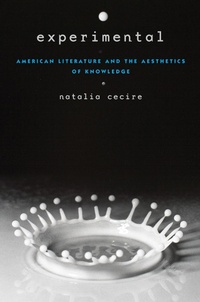
Experimental
American Literature and the Aesthetics of Knowledge
Published on 24. February 2020
320 pages
978-1-4214-3378-3 (ISBN)
Description

A compelling revision of the history of experimental writing from Pound and Stein to Language poetry, disclosing its uses and its limits.
In this bold new study of twentieth-century American writing and poetics, Natalia Cecire argues that experimental writing should be understood as a historical phenomenon before it is understood as a set of formal phenomena. This seems counterintuitive because, at its most basic level, experimental writing can be thought of as writing which breaks from established forms. Touching on figures who are not typically considered experimental, such as Stephen Crane, Jacob Riis, Busby Berkeley, Ursula K. Le Guin, and Gottlob Frege, Experimental offers a fresh look at authors who are often treated as constituting a center or an origin point of an experimental literary tradition in the United States, including Gertrude Stein, Ezra Pound, William Carlos Williams, and Marianne Moore. In responding to a crisis of legitimization in the production of knowledge, this tradition borrows and transforms the language of the sciences.
Drawing upon terminology from the history of science, Cecire invokes the epistemic virtue, which tethers ethical values to the production of knowledge in order to organize diverse turn-of-the-century knowledge practices feeding into "experimental writing." Using these epistemic virtues as a structuring concept for the book's argument, Cecire demonstrates that experimental writing as we now understand it does not do experiments (as in follow a method) but rather performs epistemic virtues. Experimental texts embody the epistemic virtues of flash, objectivity, precision, and contact, associated respectively with population sciences, neuroanatomy, natural history and toolmaking, and anthropology. Yet which virtues take precedence may vary widely, as may the literary forms through which they manifest.
Bringing it up to the 1980s, Cecire reveals the American experimental literary tradition as a concerted and largely successful rewriting of twentieth-century literary history. She shows how the Language poets, a group of primarily white experimental writers, restored to the canon what they saw as modernism's true legacy, whose stakes were simultaneously political and epistemological: it produced a poet who was an intellectual and a text that was experimental.
In this bold new study of twentieth-century American writing and poetics, Natalia Cecire argues that experimental writing should be understood as a historical phenomenon before it is understood as a set of formal phenomena. This seems counterintuitive because, at its most basic level, experimental writing can be thought of as writing which breaks from established forms. Touching on figures who are not typically considered experimental, such as Stephen Crane, Jacob Riis, Busby Berkeley, Ursula K. Le Guin, and Gottlob Frege, Experimental offers a fresh look at authors who are often treated as constituting a center or an origin point of an experimental literary tradition in the United States, including Gertrude Stein, Ezra Pound, William Carlos Williams, and Marianne Moore. In responding to a crisis of legitimization in the production of knowledge, this tradition borrows and transforms the language of the sciences.
Drawing upon terminology from the history of science, Cecire invokes the epistemic virtue, which tethers ethical values to the production of knowledge in order to organize diverse turn-of-the-century knowledge practices feeding into "experimental writing." Using these epistemic virtues as a structuring concept for the book's argument, Cecire demonstrates that experimental writing as we now understand it does not do experiments (as in follow a method) but rather performs epistemic virtues. Experimental texts embody the epistemic virtues of flash, objectivity, precision, and contact, associated respectively with population sciences, neuroanatomy, natural history and toolmaking, and anthropology. Yet which virtues take precedence may vary widely, as may the literary forms through which they manifest.
Bringing it up to the 1980s, Cecire reveals the American experimental literary tradition as a concerted and largely successful rewriting of twentieth-century literary history. She shows how the Language poets, a group of primarily white experimental writers, restored to the canon what they saw as modernism's true legacy, whose stakes were simultaneously political and epistemological: it produced a poet who was an intellectual and a text that was experimental.
More details
Series
Language
English
Place of publication
Baltimore
United States
Target group
Professional and scholarly
Illustrations
14 s/w Abbildungen
14 Illustrations, black and white
File size
3,61 MB
ISBN-13
978-1-4214-3378-3 (9781421433783)
DOI
10.1353/book.71554
Copyright in bibliographic data and cover images is held by Nielsen Book Services Limited or by the publishers or by their respective licensors: all rights reserved.
Schweitzer Classification
Other editions
Additional editions
Book
02/2020
Johns Hopkins University Press
€99.50
Article not available at the moment
Book
02/2020
Johns Hopkins University Press
€37.00
Shipment within 10-20 days
Person
Natalia Cecire is a lecturer in English and American studies at the University of Sussex.
Content
Preface
Acknowledgments
1. Experimental
2. Flash
3. Objectivity
4. Precision
5. Contact
Coda. Future Texts
Notes
Bibliography
Index
Acknowledgments
1. Experimental
2. Flash
3. Objectivity
4. Precision
5. Contact
Coda. Future Texts
Notes
Bibliography
Index
