

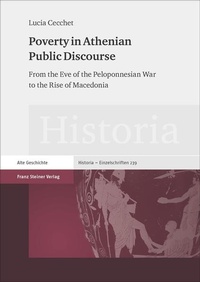
Poverty in Athenian Public Discourse
Description

While previous research has focused on the public discourse of wealth, little attention has thus far been paid to the perception of poverty and attitudes toward it in classical Athens. This e-book argues that a public discourse of poverty in Athens can be reconstructed from sources dating from the 430s to the 330s BC. Athenian democracy promoted ideas about poverty that could substantially contribute to the stability of the political system, while simultaneously differentiating between destitution and "good poverty" - the latter being a legitimate condition for a citizen and beneficial to the polis. After a preliminary discussion of the debate over the definition of poverty in the social sciences, Lucia Cecchet explores the web of beliefs and the collective imaginary of poverty that emerge from classical Athenian sources addressed to large audiences: drama and oratory. The frequency with which images and ideas about "the poor" occur in these sources testifies to an ongoing discussion of the causes and effects of poverty and even possible solutions to this social problem. These sources allow us to investigate how these topics were used in drama, in the Assembly and in the jury courts to arouse emotions and influence public decisions.
More details
Other editions
Additional editions
Person
ISNI:
Content
- Intro
- TABLE OF CONTENTS
- ACKNOWLEDGEMENTS
- LIST OF ABBREVIATIONS
- INTRODUCTION
- 1. THE DEBATE OVER THE DEFINITION OF POVERTY IN THE SOCIAL SCIENCES
- 2. ATHENIAN DEMOCRACY AND THE CONCEPT OF "ACTIVE POVERTY"
- 3. POVERTY IN ATHENIAN PUBLIC DISCOURSE: SCOPE AND METHODOLOGY OF THE PRESENT STUDY
- 4. TERMINOLOGICAL CONSIDERATIONS
- CHAPTER ONE: THE BACKGROUND OF PUBLIC IMAGERY: PERSPECTIVES ON DESTITUTION IN THE ODYSSEY
- 1. THE BEGGAR ODYSSEUS: WHAT A DISGUISE CAN TELL US
- 2. UNDISGUISED BEGGARS: PTÔCHOI PANDÊMIOI AND PTÔCHOI ALÊTAI
- 3. INDIVIDUAL RESPONSIBILITY AND TRAGIC FATE: WHY IS A PTÔCHOS A PTÔCHOS?
- 4. FINAL REMARKS: FROM THE ODYSSEY TO CLASSICAL DRAMA
- CHAPTER TWO: BEGGARS ON STAGE: ACTING OUT THE IMAGINARY OF POVERTY IN ATHENIAN DRAMA
- 1. PTÔCHOPOIEIN IN EURIPIDES' TRAGEDIES
- 2. VETERANS AS BEGGARS
- 3. POVERTY AND THE GOOD CITIZENS OF THE POLIS: VOICES OF A DEBATE IN EURIPIDES' TRAGEDIES
- 4. GENERALS AND BEGGARS IN THE CITY AT WAR: POLITICAL ARGUMENTS IN ARISTOPHANES' ACHARNIANS
- 5. FINAL REMARKS: DRAMA AND PUBLIC DISCOURSE
- CHAPTER THREE: WAS POVERTY A REAL ISSUE IN FOURTH-CENTURY ATHENS?
- 1. THE DEMOGRAPHIC QUESTION
- 2. THE LOSS OF THE EMPIRE AND THE RESTRUCTURING OF THE ECONOMY
- 3. IMPOVERISHMENT OF SMALL FARMERS?
- 4. EMPLOYMENT OPPORTUNITIES OUTSIDE THE AGRICULTURAL SECTOR
- 5. POLITICAL STABILITY AND THE DISTRIBUTION OF WEALTH
- 6. MAJOR INVOLVEMENT OF THE LANDLESS IN POLITICS?
- 7. FINAL REMARKS: WIDESPREAD POVERTY IN THE FOURTH CENTURY?
- CHAPTER FOUR: POVERTY AS AN ARGUMENT IN FOURTH-CENTURY PUBLIC SPEECHES
- 1. FROM POOR TO RICH AND FROM RICH TO POOR: A RECURRING THEME IN PUBLIC PROSECUTIONS AND POLITICAL SPEECHES
- 2. WAR TO ESCAPE POVERTY OR POVERTY AS THE RESULT OF WAR? ALTERNATIVES TO PUBLIC DISCOURSE
- 3. BUT WHO ARE "THE POOR"? WARNINGS AGAINST CONCEPTUAL CONFUSION IN ARISTOPHANES' PLUTUS
- 4. FINAL REMARKS: THE USE AND ABUSE OF POVERTY IN ASSEMBLY SPEECHES
- CHAPTER FIVE: KALOS KAI PENÊS: THE RHETORIC OF GOOD POVERTY
- 1. A LAW AGAINST IDLENESS? THE NOMOS ARGIAS
- 2. ACTIVE POVERTY VERSUS INACTIVE WEALTH IN COURT SPEECHES
- 3. POOR LITURGISTS: THE RHETORIC OF POVERTY IN ACTION
- 4. EØ?S ?I????? ?AS?? A?Ø?O???S: ASSESSING POVERTY FOR A FAIR VERDICT
- 5. REAL POOR AND FALSE POOR IN INHERITANCE LITIGATION
- 6. FINAL REMARKS: RADICALISED VIEWS OF POVERTY IN COURT SPEECHES
- CONCLUSIONS
- 1. EMOTIONS, RADICALISED EMOTIONS AND STEREOTYPES ABOUT POVERTY IN PUBLIC DISCOURSE
- 2. ECONOMIC, SOCIAL AND MORAL PERCEPTIONS OF POVERTY
- 3. WHY A PUBLIC DISCOURSE ON POVERTY IN DEMOCRATIC ATHENS?
- BIBLIOGRAPHY
- GENERAL INDEX
- INDEX OF SOURCES
