

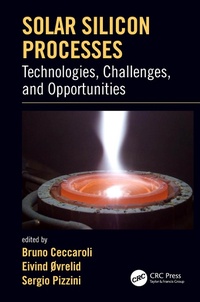
Solar Silicon Processes
Technologies, Challenges, and Opportunities
Published on 3. October 2016
272 pages
978-1-4987-4266-5 (ISBN)
Description

Polycrystalline silicon (commonly called "polysilicon") is the material of choice for photovoltaic (PV) applications. Polysilicon is the purest synthetic material on the market, though its processing through gas purification and decomposition (commonly called "Siemens" process) carries high environmental risk. While many current optoelectronic applications require high purity, PV applications do not and therefore alternate processes and materials are being explored for PV grade silicon. Solar Silicon Processes: Technologies, Challenges, and Opportunities reviews current and potential future processing technologies for PV applications of solar silicon. It describes alternative processes and issues of material purity, cost, and environmental impact. It covers limits of silicon use with respect to high-efficiency solar cells and challenges arising from R&D activities. The book also defines purity requirements and purification processes of metallurgical grade silicon (MG-Si) and examines production of solar grade silicon by novel processes directly from MG-Si and/or by decomposition of silane gas in a fluidized bed reactor (FBR). Furthermore, the book:
Analyzes past research and industrial development of low-cost silicon processes in view of understanding future trends in this field.
Discusses challenges and probability of success of various solar silicon processes.
Covers processes that are more environmentally sensitive.
Describes limits of silicon use with respect to high-efficiency solar cells and challenges arising from R&D activities.
Defines purity requirements and purification processes of MG-Si.
Examines production of solar grade silicon directly from MG-Si.
Analyzes past research and industrial development of low-cost silicon processes in view of understanding future trends in this field.
Discusses challenges and probability of success of various solar silicon processes.
Covers processes that are more environmentally sensitive.
Describes limits of silicon use with respect to high-efficiency solar cells and challenges arising from R&D activities.
Defines purity requirements and purification processes of MG-Si.
Examines production of solar grade silicon directly from MG-Si.
Reviews / Votes
"I have never seen the story of alternative silicon feedstock being told so well, with the unique scientific as well as historical background of the authors. A highly recommended read for everybody interested in alternative silicon feedstock production."-Giso Hahn, University of Konstanz, Germany
"The book is a comprehensive overview of some of the most important work in the area of silicon for solar use. Although sufficiently detailed and rigorous, it is nevertheless pleasant to read, and therefore recommended for experts and less experienced scientists or technologists"
- Francesca Ferrazza, Eni S.p.A., Milan, Italy
More details
Language
English
Place of publication
London
United Kingdom
Publishing group
Taylor & Francis Ltd
Target group
College/higher education
Illustrations
30 Tables, color; 48 Tables, black and white; 10 Illustrations, color; 86 Illustrations, black and white
File size
5,12 MB
ISBN-13
978-1-4987-4266-5 (9781498742665)
Copyright in bibliographic data and cover images is held by Nielsen Book Services Limited or by the publishers or by their respective licensors: all rights reserved.
Schweitzer Classification
Other editions
Additional editions
Bruno Ceccaroli | Eivind Ovrelid | Sergio Pizzini
Solar Silicon Processes
Technologies, Challenges, and Opportunities
Book
12/2019
1st Edition
CRC Press
€120.07
Shipment within 15-20 days
Bruno Ceccaroli | Eivind Ovrelid | Sergio Pizzini
Solar Silicon Processes
Technologies, Challenges, and Opportunities
Book
10/2016
1st Edition
CRC Press
€393.68
Article not available at the moment
Persons
Bruno Ceccaroli holds a docteur es sciences degree in nuclear chemistry from the University of Strasbourg (France). He has served as researcher and manager in large corporate companies including Saint-Gobain (Paris), Elkem (Norway), and Renewable Energy Corporation (Norway and USA). Silicon materials have been his main field of research and activity since 1986. He is currently (2008-present) an independent advisor and a scientific entrepreneur through his company Marche AS. He has published a dozen review articles on silicon to solar cells.
Eivind Ovrelid is Research Director for the PV silicon department in SINTEF Materials and Chemistry and holds a position at the Norwegian University of Technology (NTNU) as associate professor. Dr. Ovrelid has been working with PV technology with crystal growing in industry since 1999. He has contributed to development of the Solsilc process for production of PV grade silicon by a metallurgical route based on clean raw materials. He is the author of more than 60 technical articles published in peer-reviewed international journals.
Sergio Pizzini is the author of more than 250 technical articles published in peer-reviewed international journals. He has authored or coauthored four books, including Silicon, Germanium, and Their Alloys: Growth, Defects, Impurities, and Nanocrystals (CRC Press, 2014), and has been chairman or co-chairman of a number of international symposia. Throughout his career, he has conducted scientific studies with the Joint Research Centre of the European Commission, served as an associate professor at the University of Milano, worked as a director of the Materials Department of the Corporate Research Centre of Montedison, acted as the CEO of two research companies, and been a full professor of Physical Chemistry at the University of Milano-Bicocca, Italy.
Eivind Ovrelid is Research Director for the PV silicon department in SINTEF Materials and Chemistry and holds a position at the Norwegian University of Technology (NTNU) as associate professor. Dr. Ovrelid has been working with PV technology with crystal growing in industry since 1999. He has contributed to development of the Solsilc process for production of PV grade silicon by a metallurgical route based on clean raw materials. He is the author of more than 60 technical articles published in peer-reviewed international journals.
Sergio Pizzini is the author of more than 250 technical articles published in peer-reviewed international journals. He has authored or coauthored four books, including Silicon, Germanium, and Their Alloys: Growth, Defects, Impurities, and Nanocrystals (CRC Press, 2014), and has been chairman or co-chairman of a number of international symposia. Throughout his career, he has conducted scientific studies with the Joint Research Centre of the European Commission, served as an associate professor at the University of Milano, worked as a director of the Materials Department of the Corporate Research Centre of Montedison, acted as the CEO of two research companies, and been a full professor of Physical Chemistry at the University of Milano-Bicocca, Italy.
Content
Purity Requirements for Silicon in Photovoltaic Applications. The MG Silicon Route. Conventional and Advanced Purification Processes of MG Silicon. Elkem Solar and the Norwegian PV Industry through 40 Years (1975-2015). From Conventional Polysilicon Siemens Process to Low-Energy Fluidized Bed Processes Using Silane. Thermodynamic Research for the Development of Solar Grade Silicon Refining Processes. Index.
