

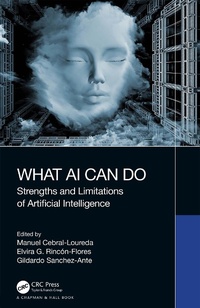
What AI Can Do
Strengths and Limitations of Artificial Intelligence
1st Edition
Published on 1. August 2023
458 pages
978-1-000-90899-2 (ISBN)
Description

The philosopher Spinoza once asserted that no one knows what a body can do, conceiving an intrinsic bodily power with unknown limits. Similarly, we can ask ourselves about Artificial Intelligence (AI): To what extent is the development of intelligence limited by its technical and material substrate? In other words, what can AI do? The answer is analogous to Spinoza's: Nobody knows the limit of AI.
Critically considering this issue from philosophical, interdisciplinary, and engineering perspectives, respectively, this book assesses the scope and pertinence of AI technology and explores how it could bring about both a better and more unpredictable future.
What AI Can Do highlights, at both the theoretical and practical levels, the cross-cutting relevance that AI is having on society, appealing to students of engineering, computer science, and philosophy, as well as all who hold a practical interest in the technology.
Critically considering this issue from philosophical, interdisciplinary, and engineering perspectives, respectively, this book assesses the scope and pertinence of AI technology and explores how it could bring about both a better and more unpredictable future.
What AI Can Do highlights, at both the theoretical and practical levels, the cross-cutting relevance that AI is having on society, appealing to students of engineering, computer science, and philosophy, as well as all who hold a practical interest in the technology.
More details
Edition
1. Auflage
Language
English
Place of publication
London
United Kingdom
Publishing group
Taylor & Francis Ltd
Target group
Professional and scholarly
Illustrations
19 Tables, black and white; 25 Line drawings, color; 15 Line drawings, black and white; 44 Halftones, color; 69 Illustrations, color; 15 Illustrations, black and white
ISBN-13
978-1-000-90899-2 (9781000908992)
Copyright in bibliographic data and cover images is held by Nielsen Book Services Limited or by the publishers or by their respective licensors: all rights reserved.
Schweitzer Classification
Other editions
Additional editions
Manuel Cebral-Loureda | Elvira G. Rincon-Flores | Gildardo Sanchez-Ante
What AI Can Do
Strengths and Limitations of Artificial Intelligence
Book
07/2025
1st Edition
Chapman & Hall/CRC
€78.00
Shipment within 10-20 days
Manuel Cebral-Loureda | Elvira G. Rincon-Flores | Gildardo Sanchez-Ante
What AI Can Do
Strengths and Limitations of Artificial Intelligence
Book
08/2023
1st Edition
Chapman & Hall/CRC
€111.70
Shipment within 10-20 days
Persons
Manuel Cebral-Loureda is a full-time professor and researcher at the Tecnologico de Monterrey, School of Humanities and Education, Campus Monterrey. He holds a PhD in Philosophy (University of Santiago de Compostela), with the thesis "The cybernetic revolution from the philosophy of Gilles Deleuze: a critical review of data mining and Big Data tools", and has a master's degree in Statistical Learning and Data Mining (UNED), as well as another in Art, Philosophy and Creativity (University of Valencia). His current interests focus on Digital Humanities (applying computational tools and methods to humanistic studies), the critical reflection on technology, and Posthumanism. Some of his most recent articles include "The beginnings of the COVID19 pandemic on Twitter. Computational analysis of public conversation in the Spanish language" (2021) or "Will and desire in modern philosophy: a computational approach" (2020). Since 2021, he is a member of the Mexican National System of Researchers (SNI).
Elvira G. Rincon-Flores holds a PhD in Education Sciences from the University of Salamanca, Cum Laude thesis. Actually, she is an Impact Measurement Research Scientist at the Institute for the Future of Education of the Tecnologico de Monterrey, and she is also a professor at the same institution. She belongs to the National System of Researchers of Mexico (SNI-Level 2), and the research groups: GRIAL and GIIE, the University of Salamanca, and Tecnologico de Monterrey, respectively. She is the leader of the following research projects: Adaptive Learning, Gamification in Higher Education, Student Mentoring, Wellbeing Students, and Educational Spaces. It also collaborates with the University of Lima in the development of a dynamic platform for Gamification called Gamit! Her lines of research are Educational Innovation Evaluation and Educational Gamification.
Gildardo Sanchez-Ante is a full-time professor and researcher at the Tecnologico de Monterrey School of Engineering and Sciences, Campus Guadalajara. Holds a PhD in Computer Science from Tecnologico de Monterrey in 2002. From 1999-2001 he was a Visiting Researcher at the Robotics Laboratory of Stanford University and from 2004-2005 he was a Research Fellow at the National University of Singapore. He is a Senior Member of the IEEE and the ACM. Member of the National System of Researchers (SNI). His research interests are in automatic learning and pattern recognition, as well as its application to robotics. He has recently worked in the computational modeling of nanomaterial properties to optimize their performance.
Elvira G. Rincon-Flores holds a PhD in Education Sciences from the University of Salamanca, Cum Laude thesis. Actually, she is an Impact Measurement Research Scientist at the Institute for the Future of Education of the Tecnologico de Monterrey, and she is also a professor at the same institution. She belongs to the National System of Researchers of Mexico (SNI-Level 2), and the research groups: GRIAL and GIIE, the University of Salamanca, and Tecnologico de Monterrey, respectively. She is the leader of the following research projects: Adaptive Learning, Gamification in Higher Education, Student Mentoring, Wellbeing Students, and Educational Spaces. It also collaborates with the University of Lima in the development of a dynamic platform for Gamification called Gamit! Her lines of research are Educational Innovation Evaluation and Educational Gamification.
Gildardo Sanchez-Ante is a full-time professor and researcher at the Tecnologico de Monterrey School of Engineering and Sciences, Campus Guadalajara. Holds a PhD in Computer Science from Tecnologico de Monterrey in 2002. From 1999-2001 he was a Visiting Researcher at the Robotics Laboratory of Stanford University and from 2004-2005 he was a Research Fellow at the National University of Singapore. He is a Senior Member of the IEEE and the ACM. Member of the National System of Researchers (SNI). His research interests are in automatic learning and pattern recognition, as well as its application to robotics. He has recently worked in the computational modeling of nanomaterial properties to optimize their performance.
Content
Conceptual Framework of AI Ethics. Philosophical Roots for AI Ethics Controversy. AI and Ethics: A Feminist Decolonial Critique. Algorithm as an Assemblage. Algorithms and Everyday. Auntiebot: Indigenous Protocols and AI in Practice. AI as a way to improve educational practices. Using AI for Educational Research in Multimodal Learning Analytics. The Dark Side of Smart Cities. AI in Biomedical Research and Clinical Practice. AI in Music. Violence control between the machine and the human. AI in the future of education. AI in Neuroscience: Helping to Understand How the Brain Represents Word Meanings. Building predictive models to efficiently generate new nanomaterials with antimicrobial activity. AI in Construction 4.0. Towards an automatic screening system to detect anomalies in retina images. Deep learning for energy savings in electric devices. Artificial Intelligence in Industry 4.0: a review of challenges. Artificial intelligence for mental health: Possibilities for accessible
massive therapy in the future. Classification Machine Learning applications for Energy Management Systems in Distribution Systems.
massive therapy in the future. Classification Machine Learning applications for Energy Management Systems in Distribution Systems.
