

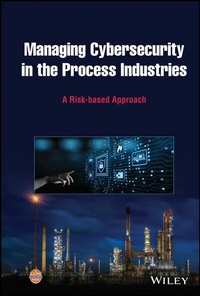
Managing Cybersecurity in the Process Industries
Description

The Center for Chemical Process Safety (CCPS) has been the world leader in developing and disseminating information on process safety management and technology since 1985. The CCPS, an industry technology alliance of the American Institute of Chemical Engineers (AIChE), has published over 100 books in its process safety guidelines and process safety concepts series, and over 30 training modules through its Safety and Chemical Engineering Education (SAChE) series. CCPS is supported by the contributions and voluntary participation of more than 200 companies globally.
More details
Other editions
Additional editions

Person
The Center for Chemical Process Safety (CCPS) has been the world leader in developing and disseminating information on process safety management and technology since 1985. The CCPS, an industry technology alliance of the American Institute of Chemical Engineers (AIChE), has published over 100 books in its process safety guidelines and process safety concepts series, and over 30 training modules through its Safety and Chemical Engineering Education (SAChE) series. CCPS is supported by the contributions and voluntary participation of more than 200 companies globally.
Content
List of Figures xi
List of Tables xiii
Acronyms and Abbreviations xvii
Glossary xxiii
Acknowledgments xxix
Preface xxxiii
Part 1: Introduction, Background, and History of Cybersecurity 1
1 Purpose of this Book 1
1.1 Target Audience 6
1.2 What is Cybersecurity? 6
1.3 What is Operational Technology (OT)? 10
1.4 Which industries have OT? 13
1.5 Scope 15
1.6 Organization of the Book 17
2 Types of Cyber-Attacks, Who Engages in Them and Why 19
2.1 Types of Cyber-Attacks 19
2.2 Who Commits Cybercrimes and Their Motives 26
2.3 Summary 30
3 Types of Risk Receptors / Targets 33
3.1 What is Cybersecurity Risk 35
3.2 What are Common Cybersecurity Targets? 38
3.3 Types of Cybersecurity Consequences 43
3.4 Summary 45
4 Threat Sources and Types of Attacks 47
4.1 Non-Targeted Attacks 49
4.2 Targeted Attacks 53
4.3 Advanced Persistent Threats (APT) 58
4.4 Summary 62
5 Who Could Create a Cyber Risk? Insider vs Outsider Threats 65
5.1 Insider Cybersecurity Risk 65
5.2 Outsider Cybersecurity Risk 69
5.3 Summary 71
6 Case Histories 73
6.1 Maroochy Shire 73
6.2 Stuxnet 77
6.3 German Steel Mill 81
6.4 Ukrainian Power Grid 84
6.5 NotPetya 91
6.6 Triton 95
6.7 Düsseldorf Hospital Ransomware 99
6.8 SolarWinds 101
6.9 Florida Water System 105
6.10 Colonial Pipeline Ransomware 107
6.11 Summary 110
Part 2: Integrating Cybersecurity Management into the Process Safety Framework 113
7 General Model for Understanding Cybersecurity Risk 113
7.1 Cybersecurity Lifecycle 113
7.2 Integrated Cybersecurity and Safety Lifecycle 121
7.3 NIST Cybersecurity Framework 129
7.4 Summary 138
8 Designing a Secure Industrial Automation and Control System 141
8.1 The Disconnect between IT and OT Risk Management 141
8.2 Inherently Safer vs Inherently More Secure 146
8.3 Defense-in-Depth 149
8.4 Network Segmentation 153
8.5 System Hardening 173
8.6 Security Monitoring 176
8.7 Risk Compatibility Assessment 180
8.8 Summary 182
9 Hazard Identification and Risk Analysis (HIRA) 183
9.1 Use of Process Safety Tools to Identify and Manage Cybersecurity Risk 185
9.2 Qualitative Methods 187
9.3 Quantitative Methods 217
9.4 How to Prioritize Risk Reduction Measures? 231
9.5 Revalidation/Reassessment 232
9.6 Summary 233
10 Manage the Risk 235
10.1 Management Approach 235
10.2 Initial Steps 236
10.3 Cybersecurity Culture 240
10.4 Compliance with Standards 242
10.5 Cybersecurity Competency 246
10.6 Workforce Involvement 248
10.7 Stakeholder Outreach 251
10.8 Process Knowledge Management 252
10.9 Operating Procedures 256
10.10 Safe Work Practices 259
10.11 Management of Change 262
10.12 Asset Integrity and Reliability 266
10.13 Contractor Management 272
10.14 Training and Performance Assurance 275
10.15 Operational Readiness 278
10.16 Conduct of Operations 281
10.17 Emergency Management 285
10.18 Incident Investigation 290
10.19 Measurements and Metrics 295
10.20 Auditing 300
10.21 Management Review and Continuous Improvement 304
10.22 Summary 307
11 Implementing a Holistic Approach to Safety and Cybersecurity 311
11.1 Cybersecurity Management Systems (CSMS) 312
11.2 Integrating CSMS with Process Safety Management 327
11.3 Summary 334
Part 3: Where Do We Go from Here? 337
12 What's Next? A Look at Future Development Opportunities 337
12.1 Cybersecurity Adoption Trends 338
12.2 Emerging Technologies 350
12.3 Summary 353
13 Available Resources 355
13.1 Local, Regional, and Global Topics 355
13.2 Cybersecurity Incident Repositories 362
13.3 Competency Requirements and Training Availability 363
13.4 Administration vs Accountability Functions 368
13.5 Summary 370
Appendix A Excerpt from NIST Cybersecurity Framework 371
Appendix B Detailed Cybersecurity PHA and LOPA Example 377
B.1 System Basis 377
B.2 Initial Risk Assessment 382
B.3 Detailed Risk Assessment (Cyber PHA/HAZOP) 387
B.4 LOPA/ Semi-Quantitative SL Verification 405
Appendix c Example Cybersecurity Metrics 411
Appendix D Cybersecurity Sample Audit Question List 413
Appendix E Management System Review Examples 419
References 421
Index 437
1
Purpose of this Book
Cybersecurity has quickly become an essential component in maintaining the safe and continued operations of industrial facilities. A survey of industrial control system operators in 2019 showed that 59% had experienced a cybersecurity incident in the past year [5]. The increase of cybersecurity incidents is not a phenomenon limited to a few specific companies or only the largest corporations. Over the last ten years, numerous attacks on automation systems such as those listed in Figure 1-1 continue to demonstrate that industrial facilities of all types and sizes are vulnerable to cybersecurity attack, and that these cyber-attacks can have significant financial, environmental, and process safety related consequences [6].
Figure 1-1 Major Industrial Cybersecurity Events in the Last Decade
Over the past 20 years, the conversation has moved from "Who could possibly target control systems for a cybersecurity attack?" to a continuing discussion of the many recent breaches and attacks. What has led to this drastic increase in cybersecurity attacks on industrial control systems? The following list provides several factors that could account for this increase:
- Increased interconnectivity of industrial control systems
- Increased convergence of OT and IT systems
- Increased use of Internet Protocol in OT applications
- Increased requirements for remote access
- Increased number of readily available hacking tools
- Desire to target critical infrastructure for political motives
- Increase in number of threat agents with skills to target control systems
- Better identification of cybersecurity attacks
- Increase in known software vulnerabilities
- Increase in known vulnerabilities in legacy systems
- Lack of sufficient cybersecurity awareness and training
- Potential for significant financial gain
- Desire to gain recognition of skills by targeting control systems
While no single cause drives the increase in cybersecurity attacks, it is likely that many of the factors in this list are contributing to the continually evolving cybersecurity landscape.
The purpose of this book is to introduce a risk-based approach for Managing Cybersecurity in the Process Industries and to help organizations design and implement more effective cybersecurity management system programs that are aligned with existing process safety management systems. This approach includes methods for:
- Understanding cybersecurity risk for the process industry,
- Integrating cybersecurity management into the existing process safety framework, and
- Developing a path forward for the future of cybersecurity for the process industry.
The risk-based approach helps to provide an optimum comparison between cybersecurity risk and process risk so that informed decisions can be made. Not all hazards and risks are equal, and it is important to focus time and resources on the higher risks. Cybersecurity risk for the process industry can vary greatly, from potential business impact arising from denial of service or ransomware to the devastating real-world impact of a targeted attack that compromises process control and safety systems. The potential of cybersecurity attacks on the process industry to result in safety consequences represents a fundamental shift in approach from traditional IT cybersecurity concerns. Adopting this approach for cybersecurity will help all industries that manufacture, use, or handle hazardous chemicals or energy to:
- Develop their approach to cybersecurity incident prevention.
- Continuously improve their management system effectiveness.
- Employ cybersecurity management for non-regulatory processes using risk-based design principles.
- Integrate the cybersecurity business case into an organization's business processes.
- Focus their resources on higher risk activities.
This approach for cybersecurity management builds on the Guidelines for Risk Based Process Safety (RBPS) [7] and the RBPS Management System Accident Prevention Pillars:
Table 1-1 RBPS Accident and Cybersecurity Event Prevention Pillars
RBPS Accident Prevention Pillars Cybersecurity Event Prevention Pillars Commit to process safety Commit to cybersecurity Understand hazards and risk Understand cybersecurity hazards and risk Manage risk Manage cybersecurity risk Learn from experience Learn from experienceThese pillars remain central for preventing cybersecurity incidents. Leveraging existing risk assessment and management techniques to address cybersecurity reduces the time required to deploy a robust cybersecurity program and improves the alignment between process safety risk management and cybersecurity risk management. The following considerations for cybersecurity outline key steps for addressing cybersecurity risk through the RBPS pillars.
Top management commitment to cybersecurity is a pre-requisite to successful implementation. Without strong leadership and clear organizational commitment to improving cybersecurity, it is very difficult to make improvements. In addition to driving cybersecurity initiatives, management support is also helpful for establishing a robust cybersecurity culture. Cybersecurity culture is based on awareness (understanding of the cybersecurity impacts of employee actions) and hygiene (understanding of basic security best practices); with these two components in place, conscientious cybersecurity behavior can be promoted. After cybersecurity culture has been established, ongoing management support is critical for sustaining focus on cybersecurity excellence.
Organizations that understand cybersecurity hazards and risk are better able to allocate limited resources in the most effective way. Due to the many misconceptions about cybersecurity for the process industry, developing an accurate understanding of the potential risks is particularly important. This is a necessary step for incorporating cybersecurity risk into the business plan to lower the overall risk level of the organization and maintain safe and continuous operations.
Managing cybersecurity risk consists of multiple phases including the identification and analysis of cybersecurity risk, designing of cybersecurity protections, implementation of cybersecurity detection systems and procedures for responding to cybersecurity incidents, and recovering from cybersecurity incidents. Strategies such as implementing a cybersecurity lifecycle can help organizations to reduce unexpected downtime and decrease the potential for adverse cybersecurity impacts.
Learning from experience requires monitoring and acting on internal and external challenges. Common internal challenges include previous cybersecurity incidents and near misses, while external challenges include events at similar facilities, industries, technologies, and increased threat activity. Despite an organization's best efforts in implementing cybersecurity management, with the continually evolving threat landscape, cybersecurity attacks are more a question of "when" than "if." Responding effectively to these situations and improving defenses in the future are critical aspects of cybersecurity management. An effective approach for learning from real world experience is to:
- Apply industry best practices
- Correct deficiencies identified from internal incidents
- Apply lessons learned from other organizations
Monitoring Key Performance Indicators (KPIs) for cybersecurity throughout the life of the facility can provide useful information about how an organization's cybersecurity approach changes over time. In addition to tracking KPIs, periodic audits/assessments of the current level of cybersecurity drive continuous improvement and sustained results.
The pillars of the risk-based approach for cybersecurity are shown in Figure 1-2:
Figure 1-2 Cybersecurity Management System Pillars
Adapted from [7]
Focusing on the pillars of the risk-based approach for cybersecurity should enable an organization to improve its cybersecurity effectiveness, reduce the frequency and severity of cybersecurity incidents, and improve its long-term safety, environmental, and business performance. If the process control system is not secure, it cannot be operated safely. The risk-based approach helps avoid gaps and inconsistencies in the security approach to prevent common cause failures of the control and safety systems.
1.1 Target Audience
This risk-based approach for Managing Cybersecurity in the Process Industries is written for practitioners of the process safety lifecycle including process safety practitioners, process control engineers, instrumentation engineers, maintenance engineers, and process engineers, and others. For simplicity, these roles are referred to as process safety professionals throughout the remainder of this book. Additionally, this book is written for key stakeholders whose decisions can impact the implementation of the process safety lifecycle. The goal...
