

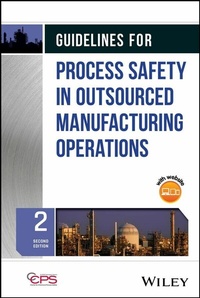
Guidelines for Process Safety in Outsourced Manufacturing Operations
Description

This book contains guidelines for clients who outsource manufacturing, brokers who aid in outsourcing, and manufacturers who develop and/or execute outsourced manufacturing on how to improve process safety performance by understanding and managing the risk associated with the process and learning from experience of outsourced operations.
This book focuses on the outsourced manufacturing process and roles the affected parties assume. It applies the elements of risk based process safety to minimize the potential of process safety events. The book illustrates how the twenty Elements of the CCPS Risk Based Process Safety (RBPS) management approach can be used as the framework for a consistent, structured method to safely execute outsourced manufacturing. Additionally, ten case studies are provided detailing how breakdowns in the transfer of information in the various outsourced manufacturing process steps and failure for affected parties to understand their role in the process have led to process safety incidents.More details
Other editions
Additional editions
Person
The Center for Chemical Process Safety (CCPS) has been the world leader in developing and sharing information on process safety management and technology since 1985. The CCPS, an industry technology alliance of the American Institute of Chemical Engineers (AIChE), has published over one hundred books in its process safety guidelines and process safety concepts series. Also, CCPS has helped develop over thirty training courses in its Safety and Chemical Engineering Education (SAChE) process safety series. Through AIChE, CCPS is involved with the Annual Safety in Ammonia Plants & Related Facilities Symposium. CCPS is supported by the contributions and voluntary participation of more than 250 companies globally.
Content
List of Figures xiii
List of Tables xv
Acronyms and Abbreviations xvii
Glossary xxi
Acknowledgements xxvii
Dedication xxix
How to Use this Book and Accompanying Online Materials xxxi
Foreword xxxiii
Chapter 1 Introduction 1
1.1 Challenges of Managing Process Safety in Outsourced Operations 2
1.2 Historical Context 2
1.3 Types of Outsourced Manufacturing 3
1.4 Scope 4
1.5 Audience 5
1.6 Why Outsource Manufacturing? 5
1.7 Disadvantages and Challenges of Outsourced Manufacturing 6
1.8 Joint and Individual Company Responsibilities in Outsourced Manufacturing 7
1.9 Process Safety Management Systems 8
1.10 Role of Leadership in Process Safety 12
1.11 Format of This Book 15
1.12 References 16
Chapter 2 Overview of the Outsourced Manufacturing Workflow 17
2.1 Introduction 17
2.2 Develop and Validate the Business Case for Outsourcing 19
2.3 Complete Applicable R&D 19
2.4 Perform Initial Screening of CMs and Brokers 20
2.5 Select Broker and CM 20
2.6 Perform Technology Transfer 21
2.7 Perform Final Assessment and Implement Manufacturing Contract 22
2.8 Pre-startup Activities and First Run 23
2.9 Managing Process Safety in Contract Operations 23
2.10 Key Concepts of RBPS in Outsourced Manufacturing 24
2.11 References 25
Chapter 3 Develop and Validate the Business Case for Outsourcing 27
3.1 Introduction 28
3.2 Evaluate the Need to Outsource and Develop the Scope of Work 28
3.3 Determine Scope of Work 31
3.4 Determine Initial Risk Based Process Safety (RBPS) Concerns 32
3.5 Perform Regulatory Checks/Reviews 32
3.6 Develop Expectations for Broker and CM 33
3.7 Summary 33
3.8 References 34
Chapter 4 Special Focus on Research and Development (R&D) 35
4.1 Introduction 35
4.2 Research and Evaluate Process Alternatives 39
4.3 Collection and Development of PSI 41
4.4 Lab-Scale Experimental Studies to Define Conceptual Process Design/Unit Operation Selection 50
4.5 Inherently Safer Design Analysis and Process Selection 52
4.6 Pilot-Scale Studies 54
4.7 Preliminary Technology Package 56
4.8 Process Development and Optimization 57
4.9 Technology Transfer Package 58
4.10 Continuous Improvement 59
4.11 Summary 59
4.12 References 60
Chapter 5 Initial Screening of CMs and Brokers 61
5.1 Introduction 62
5.2 Initial Search for a CM 65
5.3 Self-Evaluations 70
5.4 Screening Technology Package 71
5.5 Summary 72
5.6 References 73
Chapter 6 Broker and CM Evaluation 75
6.1 Introduction 76
6.2 Final Evaluation of Brokers 78
6.3 Final Evaluation of CMs 78
6.4 Broker and CM Evaluation of Client 85
6.5 Evaluating Recommended Changes from RFP Specifications 87
6.6 RBPS Elements to Consider 88
6.7 Performance Review 89
6.8 Going Forward with Selected CM 90
6.9 Summary 90
6.10 References 91
Chapter 7 Information and Technology Transfer 93
7.1 Introduction 93
7.2 Process Description 95
7.3 Hazards 96
7.4 Process Safety Information: Technology and Equipment Hazards 105
7.5 Process Safety Information: Unique Hazards 107
7.6 Process Safety Information & Knowledge Management Evaluation 108
7.7 Conceptual Design HIRA 109
7.8 Process Safety Events 111
7.9 Manufacturing: Steps and Process Flow 111
7.10 Supplemental information 112
7.11 Research and Development: Technology Transfer 112
7.12 Technology Transfer and Verification of Understanding 113
7.13 Summary 113
7.14 References 114
Chapter 8 Assessment and Final Contract 115
8.1 Introduction 115
8.2 Site Visit and Gap Assessment 117
8.3 HIRA, HSE, and Governance Assessment Activities 118
8.4 Final Contract 121
8.5 Summary 122
8.6 References 122
Chapter 9 Pre-Startup Activities and First Run 123
9.1 Introduction 123
9.2 Write or Revise Procedures 125
9.3 Competency Development and Training 134
9.4 Finalizing the HIRA for First Run 135
9.5 Security Assessments 135
9.6 Equipment Pre-commissioning 136
9.7 Pre-startup Safety Review (PSSR) 138
9.8 Joint Project Review 139
9.9 Equipment Commissioning and First Run 140
9.10 Summary 143
9.11 References 144
Chapter 10 Managing Process Safety in Contract Operations 145
10.1 Introduction 146
10.2 Manage Risk 149
10.3 Learn from Experience and Continuous Improvement 156
10.4 Governance 162
10.5 Idling and Decommissioning 163
10.6 Summary 169
10.7 References 169
Chapter 11 Call to Action: Outsourced Manufacturing Without PS Process Safety Accidents 171
11.1 The Opportunity 171
11.2 Conclusion 173
11.3 References 176
Appendix A Analysis of case studies 177
Appendix B Outsourced Manufacturing Project Checklist 181
Appendix C Example Technology Transfer Checklists 183
Appendix D CM Assessment and Self-Evaluation Checklists 201
Appendix E HIRA Scope Checklists for Outsourced Manufacturing 217
E.1 Introduction 217
E.2 HIRA Scope Checklist Overview 217
E.3 HIRA Scope Checklist 220
Appendix F Selected Additional Resources 225
Appendix G An Optimal Outcome for the Optima Belle Case 233
G.1 Background 233
G.2 Developing the Business Case for Outsourcing 234
G.3 Client Self-Evaluation 234
G.4 Perform Initial Screening of Brokers and CMs 236
G.5 Complete Applicable R&D 239
G.6 Select CM 242
G.7 Perform Technology Transfer 243
G.8 Perform Final Assessment and Implement Contract 244
G.9 Pre-startup, Startup, and First Run 246
G.10 Manage Contract Operations 248
G.11 References 250
Index 251
Glossary
The following terms are used extensively in this book. For the definitions of other process safety terms, please refer to the CCPS Process Safety Glossary which can be accessed at https://www.aiche.org/ccps/resources/glossary.
Term Definition Broker An intermediary who connects clients and contract manufacturers (CMs). Brokers can facilitate the relationship between the client and the CM, serve as project managers, make introductions, or provide other contracted services. Catastrophic release An uncontrolled loss of containment of flammable, toxic, or reactive materials from a process that has the potential for causing onsite or offsite acute health effects, significant environmental effects, or significant on-site or off-site property damage. Chemical reactivity hazard A situation with the potential for an uncontrolled chemical reaction that can result directly or indirectly in serious harm to people, property, or the environment. The uncontrolled chemical reaction might be accompanied by a temperature increase, pressure increase, gas evolution, or other form of energy release. Client The company issuing the outsourced manufacturing (and potentially development) contract to the contract manufacturer (CM). Combustible dust A finely divided combustible particulate solid that presents a flash fire hazard or explosion hazardwhen suspended in air or the process specific oxidizing medium over a range of concentrations. Combustible dust hazard package A subset of the process safety information provided in the technology transfer package that focuses on the combustibility and explosibility of dusts involved in the process. Contract development and manufacturing
Contract development and manufacturing (continued) A form of outsourced manufacturing where a client hires another company to develop a process and produce complete products or components based on the client's specifications. The client provides the product specifications. The CDMO develops the process on behalf of the client and takes on the responsibility for production, procurement, quality control, and sometimes even logistics. Contract development and manufacturing organization (CDMO) The company that develops the process on behalf of the client and produces the outsourced product, or materials, or provides other contracted services. Contract manufacturing A form of outsourced manufacturing where a company hires another company to produce complete products or components based on the hiring company's specifications. The client provides the product specifications and process. The CMO takes on the responsibility for production, procurement, quality control, and sometimes even logistics. Contract manufacturing organization (CMO) The company that produces the outsourced product, or materials, or provides other contracted services. Distributor A company that buys chemicals in bulk from manufacturers and then sells them to smaller businesses or end customers. Governance review A routine evaluation of the efficacy of a company's governance structures, policies, and practices specifically including the management of process safety. The process safety portion of this review aims to ensure that the company adequately manages risks associated with chemical processes to protect workers, the environment, and the community. Hazard identification and risk analysis (HIRA) CCPS RBPS Element 07: A collective term that encompasses all activities involved in identifying hazards and evaluating risk at facilities, throughout their life cycle, to make certain that risks to employees, the public, or the environment are consistently controlled within the organization's risk tolerance. Management review and continuous improvement CCPS RBPS Element 20: This Element is used to evaluate whether the process safety program's
management systems are performing and producing the results as intended. It is an ongoing due diligence review by management that fills the gap between day-to-day work activities and periodic formal audits. Mock batch A simulated or practice execution of a production process (using water or other less hazardous material). It is designed to replicate the steps, conditions, and equipment of an actual run without necessarily using process materials or producing a final, usable product. Non-disclosure Agreement (NDA) An agreement that allows a client to release information that would ordinarily be considered proprietary to a third party, (broker or CM) and vice versa. (Also known as confidentiality agreement or confidentiality disclosure agreement.) Outsourced manufacturing A system in which a contractor provides manufacturing services for a fee to a company that issues a contract for those services. Services can include reaction processes, formulation, blending, mixing or size reduction, separation, agglomeration, packaging, repackaging, and others, or a combination of the above. Outsourced manufacturing project (OMP) An undertaking requiring concerted effort and coordination by a client, CM, and potentially, a broker, to provide chemical manufacturing, process development, or other services for a fee by a CM to a client issuing under a contract. Pilot A key step in scaling a chemical or pharmaceutical process between lab and commercial production, testing process, analytics, and equipment to confirm scalability, safety, and fit, while assessing safeguards to meet acceptable risk levels. Positive energy isolation The method of physically blocking or securing all sources of hazardous energy to prevent accidental startup or release of stored energy during maintenance or operational activities. This includes strategies such as physically breaking and capping lines, installation of a slip blind, lockout/tagout or using a double block and bleed. Process chemistry Stoichiometry, heat of reaction, kinetics, and stability information for all intended, side, and potential unintended reactions under operating and upset conditions. Process flow diagram (PFD) A diagram that shows the material flow from one piece of equipment to the other in a process. It usually provides information about the pressure, temperature, composition, and flow rate of the various streams, heat duties of exchangers, and other information pertaining to understanding and conceptualizing the process. Process hazard analysis (PHA) An organized effort to identify and evaluate hazards associated with processes and operations to enable their control. This review normally involves the use of qualitative techniques to identify and assess the significance of hazards. Conclusions and appropriate recommendations are developed. PHA is the portion of the hazard identification and risk analysis element in which hazards and hazardous consequence scenarios are systematically identified. Process knowledge management CCPS RBPS Element 06. The system used to develop, document, and maintain the process knowledge required to perform process safety activities. It includes work activities to gather, organize, maintain, and provide information to other PSM program elements. Process safety knowledge primarily consists of written documents such as hazard information, process technology information, and equipment-specific information. Process safety knowledge is the product of this element. Process safety information Physical, chemical, and toxicological information related to the chemicals, process, and equipment. It is used to document the configuration of a process, its characteristics, its limitations, and as data for process hazard analyses. See also: Process knowledge management Process safety management system A management system that is focused on prevention of, preparedness for, mitigation of, response to, and restoration from catastrophic releases of chemicals or energy from a process associated with a facility. Such a system includes a comprehensive set of policies, procedures, and practices designed to ensure that safeguards to episodic incidents are in place, in use, and effective. RACI chart A project management tool for identifying task assignments. Each task is listed vertically in the left -hand column of the table, and each project participant is listed horizontally in the top row. In the cell below each participant's name, s/he is identified as either A (Accountable), R (Responsible), C (Consulted with), or I (Informed). Reactivity hazard package A part of the process safety information provided in the technology transfer package that focuses on the...
