

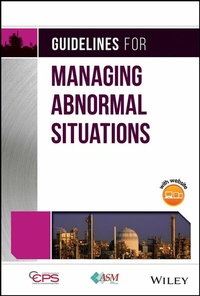
Guidelines for Managing Abnormal Situations
Description

Management principles that can be established before an issue occurs are presented while case studies are used to illustrate the impact that an abnormal situation can have on an operating facility. The impact of plant design are detailed, with separate focus points on new plant design and retrofits to existing plants. A section on writing plant procedures and plant policies so that they incorporate the principles of managing abnormal situations is also included.
Training content is provided on how to manage deviant situations, with guidance on presenting the information to specific target populations, such as front-line operators, operations managers, plant engineers, and process safety engineers. Readers are also shown tools that are currently available for recognizing and responding to abnormal situations, and actions that process safety engineers can use during Hazard Identification and Risk Analysis (HIRA).
More details
Other editions
Additional editions
Person
The Center for Chemical Process Safety (CCPS) has been the world leader in developing and disseminating information on process safety management and technology since 1985. The CCPS, an industry technology alliance of the American Institute of Chemical Engineers (AIChE), has published over 100 books in its process safety guidelines and process safety concepts series, and over 30 training modules through its Safety in Chemical Engineering Education (SAChE) series. CCPS is supported by the contributions and voluntary participation of more than 200 companies globally.
Content
List of Figures xi
List of Tables xiii
List of Example Incidents xv
Acronyms and Abbreviations xvii
Glossary xxi
Acknowledgments xxxi
Preface xxxv
Dedication xxxvi
1 Introduction 1
1.1 Purpose and Scope of the Book 1
1.2 What Are Abnormal Situations? 2
1.3 The Business Case for Managing Abnormal Situations 4
1.4 Content and Organization of the Book 5
2 Process Safety and Management of Abnormal Situations 9
2.1 Impact on Process Safety 9
2.2 The Case for Positive Management of Abnormal Situations 11
2.3 Adverse Outcomes of Abnormal Situations 13
2.4 Importance of Training for Abnormal Situations 22
2.5 Safety Culture and the Management of Abnormal Situations 23
3 Abnormal Situations and Key Relevance to Process Plant Operations 27
3.1 Focus Areas for Abnormal Situation Management 27
3.1.1 ASM Research Areas 27
3.1.2 Additional Focus Areas 30
3.2 Abnormal Situations Affecting Process Plant Operations 32
3.2.1 Process Control Systems -the First Line of Defense 40
3.2.2 Frontline Operators 44
3.3 Management of Abnormal Situations and Links to Risk Based Process Safety 48
3.3.1 Commitment to Process Safety 50
3.3.2 Understand Hazards and Risk 50
3.3.3 Manage Risk 50
3.3.4 Learn from Experience 51
3.3.5 Additional RBPS Elements Related to Management of Abnormal Situations 52
3.4 Procedures and Operating Modes for Managing Abnormal Situations 53
3.4.1 General Principles for Procedure Development 53
3.4.2 Operating Modes 58
3.4.3 Types of Material Being Processed 78
4 Education for Managing Abnormal Situations 85
4.1 Educating the Trainer 85
4.2 Primary Target Populations for Training 86
4.2.1 Front-line Operators 87
4.2.2 Operations Management 89
4.2.3 Plant Engineers/Technicians 90
4.2.4 Process Safety Engineers 91
4.2.5 Design Engineers 91
4.2.6 Environmental Health, Safety and Security (EHSS) Personnel 100
4.2.7 Technical Experts 100
4.2.8 Other Parties 102
4.3 Guidance for Organizing and Structuring Training 102
4.3.1 Organization of Training 102
4.3.2 Structure of Training Topics 103
4.3.3 Skills and Competencies of Trainers 106
4.4 Summary 106
5 Tools and Methods for Managing Abnormal Situations 107
5.1 Tools and Methods for Control of Abnormal Situations 108
5.2 Predictive Hazard Identification 112
5.2.1 Hazard Recognition for Abnormal Situations 113
5.2.2 HIRA Approach to Hazard Prediction 113
5.3 Process Control Systems 115
5.3.1 Process Trend Monitoring 117
5.3.2 Alarm Management 119
5.3.3 Big Data 122
5.3.4 Advanced Diagnostics and Artificial Intelligence 123
5.4 Policies and Administrative Procedures 124
5.4.1 Expectations of Policies and Administrative Procedures 126
5.4.2 The Relationship of Policies to Abnormal Situation Management 126
5.4.3 Process Metrics 129
5.5 Operating Procedures 130
5.5.1 Standard Operating Procedures 131
5.5.2 Emergency Procedures 132
5.5.3 Transient Operation Procedures 133
5.5.4 Preparing Written Procedures 134
5.6 Training and Drills 135
5.7 Ergonomics and Other Human Factors 139
5.7.1 HMI (Human Machine Interface) System 140
5.7.2 Control Room Ergonomics/ Human Factor Assessment 142
5.7.3 Crew Resource Management 143
5.8 Learning from Abnormal Situation Incidents 147
5.9 Change Management 149
5.9.1 Management of Change Guideline Tools 150
5.9.2 Management of Organizational Change 153
5.9.3 Pre-Startup Safety Review 154
6 Continuous Improvement for Managing Abnormal Situations 155
6.1 General 155
6.2 Landscape of Available Metrics for Improvement 156
6.3 Abnormal Situations and Incident Investigations 158
6.4 Auditing 159
6.5 Management Review and Continuous Improvement 162
6.6 Summary 163
7 Case Studies/lessons Learned 165
7.1 Case Study 7.1 - Air France, 2009 166
7.1.1 Background 166
7.1.2 Incident Overview - Air France AF 447 169
7.1.3 Speed Measurement on A330 Aircraft 169
7.1.4 A330 Flight Control Systems 171
7.1.5 Airbus Pitot Tube History 173
7.1.6 The Incident - Air France AF 447 173
7.1.7 Lessons Learned Relevant to Abnormal Situation Management 178
7.1.8 Epilogue 182
7.2 Case Study 7.2 - Texaco Refinery, Milford Haven, Wales, July 1994 184
7.2.1 Background 184
7.2.2 Incident Overview - Texaco Milford Haven 185
7.2.3 Outline Process Description of Milford Haven Refinery 186
7.2.4 Controls and Instrumentation 188
7.2.5 Some Relevant History at the Refinery 189
7.2.6 The Incident 190
7.2.7 Immediate Cause 193
7.2.8 Lessons Learned Relevant to Abnormal Situation Management 193
7.2.9 Epilogue 198
7.3 Case Study 7.3 - The Hickson And Welch Fire, 1992, Castleford, UK 199
7.3.1 Background 199
7.3.2 Incident Overview - Hickson and Welch fire 200
7.3.3 Outline Process Description of Meissner Plant 201
7.3.4 History of Meissner Plant Prior to Incident 203
7.3.5 The Incident 205
7.3.6 Immediate Causes 206
7.3.7 Lessons Learned Relevant to Abnormal Situation Management 207
7.3.8 Epilogue 210
Appendix A Managing Abnormal Situations - Training Materials 211
Appendix B ASM Joint Research and Development Consortium: Background 213
References 215
Index 225
GLOSSARY
- Abnormal Situation
-
A disturbance in an industrial process with which the basic process control system of the process cannot cope.
Note: In the context of a hazard evaluation, synonymous with deviation.
- Abnormal Situation Management
- Abnormal Situation Management, or Managing Abnormal Situations, refers to a comprehensive process for improving performance which addresses the entire plant population. It promotes effective utilization of all available resources-i.e., hardware, software, and people, including the proactive or reactive intervention activities of members of the operations team, to achieve safe and efficient operations. Abnormal Situation Management is achieved through prevention, early detection, and mitigation of abnormal situations.
- Advanced Process Control
- Advanced process control refers to techniques including multi-variable control, inferential control, feedforward, and decoupling. Multiple single-loop controllers are adjusted in unison, to satisfy constraints and attain optimization objectives while adhering to safe operating limits. Advanced process control techniques often use model-based software to direct the process operation. These applications require that the process model created accurately represents the process dynamics.
- Asset Integrity Management
- A process safety management system for ensuring the integrity of assets throughout their life cycle.
- Boiling Liquid Expanding Vapor Explosion (BLEVE)
- A type of rapid phase transition in which a liquid contained above its atmospheric boiling point is rapidly depressurized, causing a nearly instantaneous transition from liquid to vapor with a corresponding energy release. A BLEVE of flammable material is often accompanied by a large aerosol fireball, since an external fire impinging on the vapor space of a pressure vessel is a common cause. However, it is not necessary for the liquid to be flammable to have a BLEVE occur.
- Bow Tie Model
- A risk diagram showing how various threats can lead to a loss of control of a hazard and allow this unsafe condition to develop into a number of undesired consequences. The diagram can also show all the barriers and degradation controls deployed.
- Conduct of Operations
- The embodiment of an organization's values and principles in management systems that are developed, implemented, and maintained to (1) structure operational tasks in a manner consistent with the organization's risk tolerance, (2) ensure that every task is performed deliberately and correctly, and (3) minimize variations in performance.
- Distributed Control System
- A system which divides process control functions into specific areas interconnected by communications (normally data highways), to form a single entity. It is characterized by digital controllers and typically by central operation interfaces. Distributed control systems consist of subsystems that are functionally integrated but may be physically separated and remotely located from one another. Distributed control systems generally have at least one shared function within the system. This may be the controller, the communication link or the display device. All three of these functions maybe shared. A system of dividing plant or process control into several areas of responsibility, each managed by its own CPU, with the whole interconnected to form a single entity usually by communication buses of various kinds.
- Failure Modes and Effects Analysis
- A systematic method of evaluating an item or process to identify the ways in which it might potentially fail, and the effects of the mode of failure upon the performance of the item or process and on the surrounding environment and personnel.
- Hazard and Operability Study
- A systematic qualitative technique to identify process hazards and potential operating problems using a series of guide words to study process deviations. A HAZOP is used to question every part of a process to discover what deviations from the intention of the design can occur and what their causes and consequences may be. This is done systematically by applying suitable guide words. This is a systematic detailed review technique, for both batch and continuous plants, which can be applied to new or existing processes to identify hazards.
- Hazard Identification
- Part of the Hazard Identification and Risk Analysis (HIRA) method in which the material and energy hazards of the process, along with the siting and layout of the facility, are identified so that a risk analysis can be performed on potential incident scenarios.
- Hazard Identification and Risk Analysis
- Hazard Identification and Risk Analysis (HIRA): A collective term that encompasses all activities involved in identifying hazards and evaluating risk at facilities, throughout their life cycle, to make certain that risks to employees, the public, and/or the environment are consistently controlled within the organization's risk tolerance.
- Highly Managed Alarm
- An alarm belonging to a class with additional requirements (e.g., regulatory requirements) above general alarms.
- Human Machine Interface
- The means by which human interaction with the control system is accomplished
- Human Reliability Analysis
- A method used to evaluate whether system-required human actions, tasks, or jobs will be completed successfully within a required time period. Also used to determine the probability that no extraneous human actions detrimental to the system will be performed.
- Inspection, Testing and Preventive Maintenance
- Scheduled proactive maintenance activities intended to (1) assess the current condition and/or rate of degradation of equipment, (2) test the operation/functionality of equipment, and/or (3) prevent equipment failure by restoring equipment condition.
- Integrity Operating Window
- An Integrity Operating Window (IOW) is a set of limits used to determine the different variables that could affect the integrity and reliability of a process unit. An IOW is the set of limits under which a process, piece of equipment, or unit operation can operate safely. Working outside of IOWs may cause otherwise preventable damage or failure.
- Lagging Metric
- A retrospective set of metrics based on incidents that meet an established threshold of severity.
- Layer of Protection Analysis (LOPA)
- An approach that analyzes one incident scenario (cause-consequence pair) at a time, using predefined values for the initiating event frequency, independent protection layer failure probabilities, and consequence severity, in order to compare a scenario risk estimate to risk criteria for determining where additional risk reduction or more detailed analysis is needed. Scenarios are identified elsewhere, typically using a scenario-based hazard evaluation procedure such as a HAZOP Study.
- Leading Metric
- A forward-looking set of metrics that indicate the performance of the key work processes, operating discipline, or layers of protection that prevent incidents.
- Loss of Primary Containment
- An unplanned or uncontrolled release of material from primary containment, including non-toxic and non-flammable materials (e.g., steam, hot condensate, nitrogen, compressed CO2 or compressed air).
- Management of Change
- A management system to identify, review, and approve all modifications to equipment, procedures, raw materials, and processing conditions, other than replacement in kind, prior to implementation to help ensure that changes to processes are properly analyzed (for example, for potential adverse impacts), documented, and communicated to employees affected.
- Management of Organizational Change
- Management of organizational change (MOOC) is a framework for managing the effect of new business processes, changes in organizational structure or cultural changes within an enterprise. MOOC addresses the people side of change management.
- Normalization of Deviance
- A gradual erosion of standards of performance as a result of increased tolerance of nonconformance.
- Pressure Safety Valve
- A pressure relief device which is designed to reclose and prevent the further flow of fluid after normal conditions have been restored.
- Pre-Startup Safety Review
- A systematic and thorough check of a process prior to the introduction of a highly hazardous chemical to a process. The PSSR must confirm the following: Construction and equipment are in accordance with design specifications; Safety, operating, maintenance, and emergency procedures are in place and are adequate; A process hazard analysis has been performed for new facilities and recommendations have been resolved or implemented before startup, and modified facilities meet the management of change requirements; and training of each employee involved in operating a process has been completed.
- Process Hazard Analysis
- An organized effort to identify and evaluate hazards associated with processes and operations to enable their control. This review normally involves the use of qualitative techniques to identify and assess the significance of hazards. Conclusions and appropriate recommendations are developed. Occasionally, quantitative methods are used to help...
