

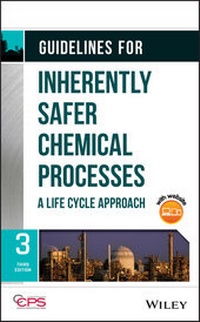
Guidelines for Inherently Safer Chemical Processes
Description

The new edition builds on the same philosophy as the first two editions, but further clarifies the concept with recent research, practitioner observations, added examples and industry methods, and discussions of security and regulatory issues. Inherently Safer Chemical Processes presents a holistic approach to making the development, manufacture, and use of chemicals safer. The main goal of this book is to help guide the future state of chemical process evolution by illustrating and emphasizing the merits of integrating inherently safer design process-related research, development, and design into a comprehensive process that balances safety, capital, and environmental concerns throughout the life cycle of the process.
It discusses strategies of how to: substitute more benign chemicals at the development stage, minimize risk in the transportation of chemicals, use safer processing methods at the manufacturing stage, and decommission a manufacturing plant so that what is left behind does not endanger the public or environment.
More details
Other editions
Additional editions
Person
The Center for Chemical Process Safety (CCPS) was founded in 1985 to develop technology and management practices that mitigate or eliminate process safety incidents in the chemical and petrochemical industries. Since that time, CCPS has published more than 100 books and held dozens of international conferences, each representing the most advanced thinking in process safety. CCPS is supported by the contributions and voluntary participation of more than 200 companies globally. CCPS is also the world's largest provider of undergraduate engineering curriculum materials through its SAChE program, with more than 160 universities participating from around the world.
Content
Preface vii
Acknowledgements ix
Figures xxiii
Tables xxvi
1. Introduction 1
1.1 Objectives, Intended Audience, and Scope of this Book 1
1.1.1 Objectives 1
1.1.2 Intended Audience 2
1.1.3 Scope 2
1.2 Integration of this Guidance with Other CCPS Guidance 2
1.3 Organization of this Book 3
1.4 History of Inherent Safety 4
1.5 References 9
2. The Concept of Inherent Safety 12
2.1 Inherent Safety and Process Risk Management 12
2.2 Inherent Safety Defined 15
2.3 Shared characteristics 16
2.4 Inherently Safer Strategies 18
2.5 Inherent safety throughout the process Life cycle 22
2.6 Inherently Safer Approaches 24
2.6.1 Orders of Inherent Safety 27
2.7 Layers of Protection 30
2.8 Integrating Inherent Safety in Process Risk Management Systems 32
2.9 Summary 40
2.10 References 40
3. Minimize - An Inherently Safer Strategy 44
3.1 Minimize 44
3.2 Reactors 47
3.3 Continuous Stirred Tank Reactors 48
3.4 Tubular Reactors 49
3.5 Loop Reactors 49
3.6 Reactive Distillation 51
3.7 Storage of Hazardous Materials 54
3.8 Process Piping 57
3.9 Process Equipment 58
3.10 Limitation of Effects 60
3.11 References 61
4. Substitute - An Inherently Safer Strategy 64
4.1 Reaction Chemistry 64
4.2 Green Chemistry 72
4.3 Solvents 73
4.4 Refrigerants 75
4.5 Firefighting Agents 76
4.6 Heat Transfer Media 76
4.7 Informed Substitution 77
4.8 References 83
5. Moderate - An Inherently Safer Strategy 87
5.1 Dilution 87
5.2 Refrigeration 88
5.3 Less Energetic Process Conditions 91
5.4 Secondary Containment - Dikes and Containment Buildings 94
5.5 Segregation 98
5.6 References 100
6. Simplify - An Inherently Safer Strategy 103
6.1 Leaving Things Out 104
6.2 Eliminating Unnecessary Spares 105
6.3 Inherently Robust Process Equipment 107
6.4 Preventing Runaway Reactions 110
6.5 Simplifying Heat Transfer 113
6.6 Simplifying Liquid Transfer 114
6.7 Reactor Geometry 116
6.8 Optimizing Catalyst Selectivity 116
6.9 Separation of Process Steps 116
6.10 Limitation of Available Energy 119
6.11 Simplification of the Human-Machine Interface 120
6.11.1 Overview 120
6.11.2 Equipment Layout, Accessibility, and Operability 121
6.11.3 Maintainability 121
6.11.4 Error Prevention 123
6.11.5 Design of Equipment and Controls - Making Status Clear 123
6.12 Summary 124
6.13 References 124
7. Applying Inherent Safety Strategies to Protection Layers 126
7.1 Operating Procedures 128
7.2 Maintenance Procedures 129
7.3 Relocation 129
7.4 Containment 130
7.5 More Robust Process Equipment and Design 131
7.6 Simplified Process Equipment and Design 132
7.7 Distributed Control Systems 133
7.8 Summary 134
7.9 References 134
8. Life Cycle Stages 136
8.1 General Principles Across All Life cycle Stages 136
8.2 Concept 137
8.3 Research 139
8.3.1 Inherently Safer Synthesis 141
8.3.2 Types of Hazards Associated with Research 142
8.3.3 Hazards Identification Methods 148
8.4 Design Development 159
8.4.1 Unit Operations - General 160
8.4.2 Unit Operations - Specific 161
8.5 Detailed Engineering Design 169
8.5.1 Process Design Basis 170
8.5.2 Equipment 171
8.5.3 Process Controls 175
8.5.4 Utility & Supporting Systems 179
8.5.5 Batch Processes 180
8.5.6 Other Design Considerations 182
8.6 Procurement, Construction, and Commissioning 183
8.7 Operations & Maintenance 185
8.7.1 Preservation of Inherent Safety 185
8.7.2 Inherent Safety - Continuous Improvement 187
8.8 Change Management 191
8.9 Decommissioning 192
8.10 Transportation 195
8.10.1 Location Relative to Raw Materials 197
8.10.2 Shipping Conditions 198
8.10.3 Transportation Mode and Route Selection 199
8.10.4 Improved Transportation Containers 200
8.10.5 Administrative Controls 201
8.10.6 Management of Transportation Containers On-site 202
8.11 References 203
9. Inherent Safety and Security 212
9.1 Introduction 212
9.2 Chemical Security Risk 213
9.3 Security Strategies 217
9.4 Countermeasures 219
9.5 Assessing Security Vulnerabilities 220
9.6 Inherent Safety and Chemical Security 221
9.7 Limitations to Implementing IS Concepts in Security Management 226
9.8 Conclusion 228
9.9 References 229
10. Implementing Inherently Safer Design 230
10.1 Introduction 230
10.2 Management System Approach for IS 231
10.3 Education and awareness 232
10.3.1 Making IS a Corporate Philosophy 232
10.3.2 IS in Education 233
10.4 Organizational culture 234
10.4.1 Multiple Demands of IS in the PSM program 235
10.4.2 Incorporating IS into Normal Design Process 236
10.5 Inherent Safety Reviews 241
10.5.1 Inherent Safety Review Objectives 242
10.5.2 Good Preparation is Required for Effective Inherent Safety Reviews 243
10.5.3 Inherent Safety Review Timing 244
10.5.4 Inherent Safety Review Team Composition 246
10.5.5 Inherent Safety Review Process Overview 246
10.5.6 Focus of Inherent Safety Reviews at Different Stages 250
10.5.7 Stage in the Process Life Cycle 252
10.6 Reactive Chemicals Screening 256
10.7 Inherent Safety Review Training 258
10.8 Documentation of the Inherently Safer Design Features of a Process 260
10.8.1 IS Review Documentation 261
10.8.2 Time Required for an Inherent Safety Review 263
10.9 Summary 264
10.10 References 265
11. Inherent Safety & the Elements of a RBPS Program 268
11.1 Process Safety Culture 270
11.2 Compliance with Standards 271
11.3 Workforce Involvement 272
11.4 Process Knowledge Management 272
11.5 Hazard Identification and Risk Analysis 273
11.6 Safe Work Practices 280
11.7 Asset Integrity and Reliability 282
11.8 Contractor Management 284
11.9 Training and Performance Assurance / Process Safety Competency 285
11.10 Management of Change / Operational Readiness 286
11.11 Conduct of Operations / Operating Procedures 290
11.11.1 Minimization 291
11.11.2 Simplification 294
11.12 Emergency Management 296
11.13 Incident Investigation 297
11.14 Measurements and Metrics / Auditing / Management Review and Continuous Improvement 297
11.15 Summary 299
11.16 References 299
12. Tools for IS Implementation 302
12.1 IS Review Methods - Overview 302
12.1.1 Three Approaches 302
12.1.2 Formal IS Reviews 303
12.1.3 IS Review Methods 304
12.1.4 Research & Development Application 304
12.1.5 PHA - Incorporation into HAZOP or other PHA Techniques 305
12.1.6 "What-If?" Method 307
12.1.7 Checklist Method 308
12.1.8 Consequence-Based Methods 311
12.1.9 Other Methods 312
12.2 Summary 317
12.3 References 318
13. Inherently Safer Design Conflicts 320
13.1 Introduction 320
13.2 Examples of inherent safety conflicts 324
13.2.1 Continuous vs. batch reactor 324
13.2.2 Reduced toxicity vs. reactive hazard 327
13.2.3 Reduced inventory vs. dynamic stability 328
13.2.4 Risk transfer vs. risk reduction 329
13.2.5 Inherent safety and security conflicts 331
13.3 Inherent safety - Environmental Hazards 332
13.3.1 PCBs 332
13.3.2 CFCs 332
13.4 Inherent Safety and Health Conflicts 333
13.4.1 Water Disinfection 333
13.5 Inherent safety and economic conflicts 334
13.5.1 Existing plants - operational vs. re-investment economics in a capital-intensive industry 334
13.5.2 Often more economical, but not necessarily 336
13.6 Tools for understanding and resolving conflicts 337
13.6.1 Tools for understanding and resolving conflicts 339
13.7 Measuring inherent safety characteristics 343
13.7.1 Dow Fire and Explosion Index 344
13.7.2 Dow Chemical Exposure Index 344
13.7.3 Mond Index 344
13.7.4 Proposed Inherent Safety indices 345
13.8 Summary 346
13.9 References 347
14. Inherent Safety Regulatory Initiatives 350
14.1 Inherent Safety Regulatory Developments and Issues 350
14.2 Experience with Inherent Safety Provisions in United States Regulations 351
14.2.1 Inherently Safer Regulatory Requirements - Contra Costa County, California, USA 352
14.2.2 New Jersey Toxic Catastrophe Prevention Act (TCPA) and Prescriptive Order for Chemical Plant Security 370
14.2.3 Inherently Safer Systems Requirements - California Accidental Release Prevention (CalARP) Regulations 378
14.2.4 Safer Technology & Alternatives Analysis - Revised US EPA Risk Management Program (RMP) Rule 380
14.3 Issues in Regulating Inherent Safety 382
14.3.1 Consistent Understanding of Inherent Safety 383
14.3.2 Needed Tools 384
14.4 Summary 385
14.5 References 386
15. Worked Examples and Case Studies 388
15.1 Introduction 388
15.2 Application of an Inherent Safety Strategic Approach to a Process 388
15.3 Case studies from carrithers 394
15.3.1 An Exothermic Batch Reaction 395
15.3.2 Refrigeration of Monomethylamine 398
15.3.3 Elimination of a Chlorine Water Treatment System 399
15.3.4 Reduction of Chlorine Transfer Line Size 400
15.3.5 Substitution of Aqueous Ammonia for Anhydrous Ammonia 400
15.3.6 Limitation of Magnitude of Deviations for Aqueous Ammonia 403
15.3.7 A Vessel Entry Example 408
15.4 Process Route Selection - Early R&D Example 411
15.5 Example of an Inherently Safer Study of a Steam Production Facility 412
15.5.1 Facility Description 412
15.5.2 Initial Design Proposal (Liquid Anhydrous Ammonia) 412
15.5.3 Aqueous Ammonia Design Proposal 413
15.5.4 Final Round of Option Selection 415
15.5.5 Consequence Analysis 416
15.5.6 Conclusion and Action 417
15.5.7 Conclusion 419
15.6 Case Study: Bhopal 419
15.6.1 Minimization 420
15.6.2 Substitution 420
15.6.3 Moderation 420
15.6.4 Simplification 421
15.7 Example: Inherently Safer Process for Production of Trialkyl Phosphate Esters 421
15.8 Summaries in brief: Examples by IS Strategy 422
15.8.1 Minimize 423
15.8.2 Substitute 425
15.8.3 Moderate 427
15.8.4 Simplify 429
15.9 Additional literature giving examples of inherently Safer Operations 430
15.10 References 431
16. Future Initiatives 433
16.1 Incorporating Inherently Safer Design into Process Safety Management 433
16.2 Encouraging Invention within the Chemical and Chemical Engineering Community 434
16.3 Including Inherent Safety into the Education of Chemists and Chemical Engineers 434
16.4 Developing Inherently Safer Design Databases and Libraries 434
16.5 Developing Tools to Apply Inherently Safer Design 435
16.5.1 The Broad View and Life Cycle Cost of Alternatives 435
16.5.2 Benefits of Reliability Analysis 436
16.5.3 Potential Energy 436
16.5.4 A Table of Distances and Consequence/Risk-Based Siting 437
16.5.5 Quantitative Measures of Inherent Safety 437
16.5.6 Other Suggestions 438
16.6 References 439
Appendix A. Inherently Safer Technology (IST) Checklist 442
A.1 IST Checklist Procedure 442
A.2 IST Checklist Questions 444
Appendix B. Inherent Safety Analysis Approaches 455
B.1 Inherent Safety Analysis - Guided Checklist Process Hazard Analysis (PHA) 459
B.2 Inherent Safety Analysis - Independent Process Hazard Analysis (PHA) 464
B.3 Inherent Safety Analysis - Integral to Process Hazard Analysis (PHA) 467
Glossary 469
Index 497
1
Introduction
1.1 OBJECTIVES, INTENDED AUDIENCE, AND SCOPE OF THIS BOOK
1.1.1 Objectives
The primary objective of this book is to provide a tool that can be used by any industrial company that handles hazardous chemicals to better understand inherent safety concepts and provide guidelines on how to implement them. The goal of this book is to provide practical guidelines for illustrating and emphasizing the merits of integrating research, development, and design into a comprehensive approach that balances safety, capital, and environmental concerns throughout the life cycle of the process. The authors hope that this book will help influence the next generation of engineers, chemists, and current practitioners and managers in the field of chemical processing.
Inherent safety is a powerful and effective means of reducing hazards and risk, versus managing risk by adding layers of protection. A hazard eliminated is one that then doesn't need to be addressed, which may have many direct and indirect benefits. Responsible companies understand the concept and apply it wherever and whenever it may be useful throughout the life cycle of the process. Companies who have an internal motivation to apply inherent safety routinely to the fullest capacity "as a way of doing business" recognize that doing so is beneficial.
In 1996, the Center for Chemical Process Safety (CCPS) published the first edition of its inherent safety concept book. Lessons learned in the ensuing years, combined with the fact that inherently safer design (ISD) was becoming more widely accepted, prompted CCPS to update the concept book in 2009. In the subsequent years, inherent safety has been of greater interest to industry, government, and the public as a concept to reduce hazards. In fact, several governmental entities have mandated consideration of inherently safer design for certain facilities. In the United States, for example, specific regulations exist now for Contra Costa County in California, the State of New Jersey, and the U.S. Environmental Protection Agency.
Clearly, there is an ongoing need for more guidance, especially in practical, step-wise approaches to conduct inherently safer design studies. This edition builds on the philosophy provided in the first two concept books. It also provides guidelines and approaches to using these concepts with recent research, practitioner observations, new examples and industry methods.
1.1.2 Intended Audience
This book is written for those interested in the application of inherent safety strategies to process safety in industry. It is intended for facility site managers, process safety experts, engineers, chemists, regulators, research and development groups, process development teams, engineering educators and others responsible for workplace safety.
1.1.3 Scope
This book includes key principles on inherent safety and guidelines for how to implement them. It also includes guidance on how to conduct inherent safety studies as well as how to apply inherent safety to an organization's process safety management processes. It also briefly covers the history, research, and basic concepts of inherent safety. The methods described in this book may be widely applicable to inherent safety as it relates to process safety, environmental, and security issues.
1.2 INTEGRATION OF THIS GUIDANCE WITH OTHER CCPS GUIDANCE
Inherent safety is an integral component of process risk management. It is a foundation topic to managing chemical risks and has been referenced in other CCPS guideline books including:
- Guidelines for Safe Storage and Handling of Reactive Materials, 1995.
- Layer of Protection Analysis, Simplified Process Risk Assessment, 2001.
- Guidelines for Identifying and Analyzing the Security Vulnerabilities of Fixed Chemical Sites, 2003.
- Guidelines for Risk-Based Process Safety, 2007.
- Guidelines for Hazard Evaluation Procedures, Third Edition, with Worked Examples, 2007.
- Guidelines for Engineering Design for Process Safety, Second Edition, 2012, includes a section (Chapter 5.2) on inherently safer design.
- Guidelines for Implementing Process Safety Management Systems, Second Edition, 2016.
- Guidelines for Siting and Layout of Facilities, Second Edition, 2018.
- Guidelines for Integrating Process Safety into Engineering Projects, 2019.
1.3 ORGANIZATION OF THE BOOK
The book is written with the key principles for inherent safety in the body of the book. Tools for implementing the approach, as well as indicative examples and checklists, are included in the appendices. The guidelines begin with an explanation of the concept of Inherent Safety (IS) and then explain its role in Process Risk Management.
Chapter 2 introduces the topic of inherent safety. The key terms and the philosophy behind inherent safety are described. The different ways in which inherent safety is applied can be categorized into "strategies." These strategies-minimize, substitute, moderate, and simplify-are discussed in detail in Chapters 3 through 6. Human factors are an extremely important subset of the simplify strategy, and Chapter 6.11 of this book presents a detailed discussion of human factors as related to inherently safer design for the human-machine interface. Chapter 7 outlines how each of the four IS strategies can be applied to traditional protection layers.
"Inherently safer" is a way of thinking and, to successfully implement it, this thinking must be well-understood and continually employed wherever possible. Improved understanding of the process may result in a better, more reliable, and even more productive and profitable process that produces higher quality products. Processes should be reviewed for hazards and risks periodically throughout their life cycle. Chapters 8 discusses review methods to do this. Chapter 9 discusses the role of inherent safety in chemical process security. Chapter 10 presents available methods for implementing inherently safer strategies. These can either be independent, special studies, done periodically or before a major project or change is undertaken, or opportunistically applied into day-to-day process risk management strategies. Chapter 11 describes the relationship between the four main IS strategies, i.e., Substitution, Minimization, Moderation, and Simplification and each element of a PSM/Risk-Based Process Safety (RBPS) program. Chapter 12 addresses tools available to assist with implementing these IS strategies.
Chapter 13, entitled "Inherently Safer Design Conflicts," describes the conflicts that often develop between the various attributes of safety, operability, cost, as well as other risk parameters and the ways to understand and make decisions considering those constraints. With the advent of regulations requiring inherent safety consideration or implementation, Chapter 14 was written to help guide regulators and industry through the various considerations and challenges of IS.
Chapter 15 contains worked examples of IS study methods and case studies to show a step-wise process that can be followed for an IS evaluation. It also gives practical examples of successful implementation.
Lastly, Chapter 16 describes potential future IS initiatives, including needs, research, expected practice issues, and regulatory issues.
1.4 HISTORY OF INHERENT SAFETY
Inherent Safety is a modern term for an age-old concept: to progress towards eliminating or reducing hazards rather than accepting and managing them. This concept goes back to prehistoric times. For example, building villages near a river on high ground, rather than managing flood risk with dikes and walls, is an inherently safer design concept.
There are many examples of milestones in the application of inherently safer design. For example, in the United States back in 1866, following a series of explosions involving the handling of nitroglycerine, which was being shipped to California for use in mines and construction, state authorities quickly passed laws forbidding its transportation through San Francisco and Sacramento. This action made it virtually impossible to use the material in the construction of the Central Pacific Railroad.
The railroad desperately needed the explosive to maintain its construction schedule in the mountains. Fortunately, a British chemist, James Howden, approached Central Pacific and offered to manufacture nitroglycerine at the construction site. This is an early example of an inherently safer design principle - minimize the transport of a hazardous material by in-situ manufacture at the point of use. While nitroglycerine still represented a significant hazard to the workers who manufactured, transported, and used it at the construction site, the hazard to the general public from nitroglycerine transport was eliminated. At one time, Howden was manufacturing 100 pounds of nitroglycerine per day at railroad construction sites in the Sierra Nevada Mountains. The Central Pacific Railroad's experience with the use of nitroglycerine was quite good, with no further fatalities directly attributed to use of the explosive during the Sierra Nevada construction (Ref 1.22 Rolt), (Ref 1.2 Bain).
By today's standards, little about 19th Century railroad construction would qualify as safe, but the in-situ...
