

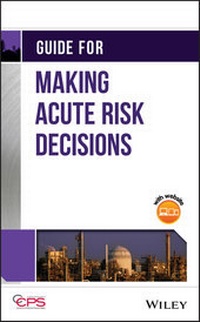
Guide for Making Acute Risk Decisions
Description

Topics Include: Identifying Risk Decisions, A Risk Decision Strategy for Process Safety, Case Studies in Risk Decision Making Failures, Guidance on Selecting Decision Aids, Templates for Decision Making in Risk-Based Process Safety, Understanding Process Hazards & Worst Possible Consequences, Management of Change as an Exercise in Risk Identification, Inherently Safer Design as an Exercise in Risk Tradeoff Analysis, Using LOPA and Risk Matrices in Risk Decisions, Using CPQRA and Safety Risk Criteria in Risk Decisions, Group Decision Making, Avoiding Decision Traps, Documentation of Process Safety Risk Decisions
More details
Other editions
Additional editions
Person
The Center for Chemical Process Safety (CCPS) was founded in 1985 to develop technology and management practices that mitigate or eliminate chemical process accidents. Since that time, CCPS has published more than 100 books and held dozens of international conferences, each representing the most advanced thinking in process safety. CCPS is supported by the contributions and voluntary participation of more than 160 companies globally. CCPS is also the world's largest provider of undergraduate engineering curriculum materials through its SACHE program, with more than 160 universities around the world participating.
Content
Contents v
List of Tables xi
List of Figures xiii
Acronyms and Abbreviations xv
Glossary xix
Acknowledgements xxxi
Preface xxxiii
Introduction 35
1.1 History of Approaches to Process Safety Management 35
1.2 The Paradigm of Risk-Based Process Safety Management 36
1.2.1 Risk Based Process Safety (RBPS) Management 36
1.2.2 Risk Decisions Characteristics 39
1.3 A Risk Decision Making Method 40
1.4 Road Map and Relationship of this Book with Other Material 41
1.5 Risk Decisions during Process Life Cycle 43
1.6 Pros and cons 44
1.7 Summary 44
Key Concepts in Risk Management 47
2.1 Risk Management Process 47
2.2 Risk Identification - Risk Scenario 47
2.2.1 Risk Identification 49
2.3 Risk Analysis - Consequences and Frequency 49
2.3.1 Consequences and Impacts 50
2.3.2 Frequency 50
2.3.3 Risk Estimation 51
2.4 Risk Evaluation 56
2.4.1 Decision criteria 56
2.4.2 Qualitative, Semi-Quantitative and Quantitative Risk Criteria 59
2.4.3 Risk Reduction Factor 61
2.5 Summary 62
Understanding Process Hazards, Consequences and Risks 63
3.1 Process Hazards 63
3.1.1 Acute Toxicity 63
3.1.2 Flammability and Explosivity 67
3.1.3 Chemical Reactivity 70
3.1.4 Significant or Large Environmental Release Hazards 72
3.1.5 Other Process Hazards 72
3.2 Risk Identification 73
3.3 Consequences and Impacts 73
3.4 Frequency 74
3.5 Risk 76
Risk Decisions and Strategies 79
4.1 Objectives and attributes 79
4.1.1 Objectives 79
4.1.2 Attributes 79
4.2 Process Life Cycle and Alternatives 81
4.3 The Decision Process 82
4.3.1 Define the Problem 82
4.3.2 Evaluate the Baseline Risk 83
4.3.3 Identify the Alternatives 83
4.3.4 Screen the Alternatives 84
4.3.5 Make the Decision 84
4.4 Objectives and Outcomes 84
4.5 Tradeoffs 85
4.6 Uncertainty 87
4.7 Risk Tolerance 90
4.8 Linked Decisions 91
4.9 Decision trees 92
Decision Making 95
5.1 Defining the Decision Problem 95
5.1.1 Types of Decisions 95
5.2 Selecting a Decision Tool 97
5.2.1 Progression of Risk Analysis Tools 97
5.2.2 Factors in Decision Tool Selection 98
5.3 Assembling the Appropriate Assessment Resources 101
5.3.1 Team Members 101
5.3.2 Opening Meeting 104
5.3.2 Tools/Methods 104
5.3.3 Time 105
5.4 Define decision criteria 105
5.4.1 Process Safety Risk Criteria 105
5.4.2 Other Criteria 107
5.5 Making the decision 107
5.5.1 Characteristics of Decision Aids 107
5.5.2 Appling the Decision Tools, Aids, and Criteria 108
5.5.3 Recognizing and Dealing with Uncertainties 111
5.5.4 Recognizing the Need to Escalate the Decision 113
5.6 Finalizing decision and the approval process 114
5.7 Communicating, Documenting, and implementing the Decision 114
5.7 Summary 116
Potential Decision Traps 117
6.1 Introduction 117
6.2 Anchoring Trap 117
6.2.1 Anchoring Trap Example, Titanic 118
6.2.2 Countering the Anchoring Trap 118
6.3 Status-Quo Trap 119
6.3.1 Status Quo Examples 119
6.3.2 Countering the Status-Quo Trap 120
6.4 Sunk-cost and escalation of commitment trap 120
6.4.1 Countering the Sunk-Cost Trap 121
6.5 Confirming-Evidence Trap 121
6.5.1 Countering the Confirming Evidence Trap 122
6.6 Framing Trap 122
6.6.1 Framing Example 123
6.6.2 Countering the Framing Trap 123
6.7 Estimating and Forecasting Trap 123
6.7.1 Overconfidence 123
6.7.2 Prudence 126
6.7.3 Recallability 127
6.7.4 Countering Estimating and Forecasting Traps 127
6.8 Groupthink Trap 128
6.8.1 Groupthink Example, Flixborough, UK Explosion 128
6.8.2 Countering the Groupthink Trap 128
6.9 Summary 129
Inherently Safer Design 131
7.1 Introduction to inherently safer design 131
7.2 Inherently Safer Design Strategies 131
7.3 Hierarchy of Risk Management Controls 132
7.4 ISD examples to illustrate decision Process 133
7.4.1 Example with minimization 135
7.4.2 Example with moderation 136
7.4.3 Example with simplification 137
7.4.3 Other tradeoffs 137
Make versus buy 138
Substitution 138
7.5 Summary 138
Management of Change 139
8.1 Introduction 139
8.2 Decision Approval level 143
8.3 Examples of Decision Process Applied to Changes 144
8.3.1 Equipment Change 144
8.3.2 Procedural Change 145
8.3.3 Process Parameter Change 146
8.3.4 Organizational Change 147
8.3.5 Raw Material Change 148
8.3.6 Vendor Change 149
8.4 Summary 150
Using LOPA and Risk Matrices in Risk Decisions 151
9.1 Introduction 151
9.2 Risk Matrices 151
9.2.1 Risk Matrix Format 152
9.3 Layer of Protection Analysis 155
9.3.1 Independent Protection Layers 158
9.3.2 LOPA Format 159
9.4 Phosgene Handling Process for Risk Decision Example 159
9.4.1 Description 159
9.4.2 Risk Matrix for Phosgene Handling Example 161
9.5 Phosgene Example Decision Process Using Risk Matrix 164
9.6 Decision Process for Phosgene Example Using LOPA 165
9.7 Summary 172
Using QRA and Safety Risk Criteria in Risk Decisions 173
10.1 Introduction to CPQRA 173
10.1.1 Calculate Frequencies 173
10.1.2 Calculate Consequences 178
10.1.3 Quantitative Risk Analysis (QRA) 179
10.2 Safety Risk Criteria 179
10.2.1 Scope of Risk Criteria 179
10.2.2 Individual and Societal Risk 180
10.2.3 Continual Improvement 184
10.3 High Consequence Low Probability (HCLP) Events 185
10.4 Examples 188
10.4.1 Comparing Design Options: Bromine Handling Facility 188
10.4.2 Compliance and Continual Improvement: Organic Acid Vent System 192
10.4.3 Special Case: The Domino Effect 193
10.5 Summary 195
Decision Implementation 197
11.1 Introduction 197
11.2 Implementation 197
11.3 Documentation 197
11.3.1 Importance of a decision document 197
11.3.2 Writing recommendations 197
11.3.3 Advice of legal counsel 198
11.3.4 Contents of the decision document 199
11.3.5 Retention of the decision document 199
11.4 Revalidation 200
11.4.1 Time based 200
11.4.2 Situation based 200
11.5 Summary 201
Summary and Lessons 203
12.1 Introduction 203
12.2 Case Studies in Risk: Decision Making Failures 203
12.2.1 Failure to Define the Problem 203
12.2.2 Failure to Establish Baseline Risk and Identify Alternatives 204
12.2.3 Make the Decision - Failure to consider tradeoffs 205
12.2.4 Make the Decision - Failure to understand uncertainty 206
12.2.5 Make the Decision - Failure to do risk identification and Failure to probe risk tolerance 206
12.2.6 Make the Decision - Failure to recognize linked decisions 207
12.3 Lessons and Summary 207
References 211
Index 219
GLOSSARY
- Acute Toxicity
- The adverse (acute) effects resulting from a single dose or exposure to a substance. Importance: Ordinarily used to denote effects in experimental animals.
- Asset integrity
- A PSM program element involving work activities that help ensure that equipment is properly designed, installed in accordance with specifications, and remains fit for purpose over its life cycle. Also see asset integrity and reliability.
- Atmospheric Storage Tank
- A storage tank designed to operate at any pressure between ambient pressure and 0.5 psig (3.45kPa gage).
- Boiling-Liquid-Expanding-Vapor Explosion (BLEVE)
- A type of rapid phase transition in which a liquid contained above its atmospheric boiling point is rapidly depressurized, causing a nearly instantaneous transition from liquid to vapor with a corresponding energy release. A BLEVE of flammable material is often accompanied by a large aerosol fireball, since an external fire impinging on the vapor space of a pressure vessel is a common cause. However, it is not necessary for the liquid to be flammable to have a BLEVE occur.
- Bow Tie Diagram
- A diagram for visualizing the types of preventive and mitigative barriers which can be used to manage risk. These barriers are drawn with the threats on the left, the unwanted event at the center, and the consequences on the right, representing the flow of the hazardous materials or energies through its barriers to its destination. The hazards or threats can be proactively addressed on the left with specific barriers (safeguards, layers of protection) to help prevent a hazardous event from occurring; barriers reacting to the event to help reduce the event's consequences are shown on the right.
- Checklist Analysis
- A hazard evaluation procedure using one or more pre-prepared lists of process safety considerations to prompt team discussions of whether the existing safeguards are adequate.
- Combustible Dust
- Any finely divided solid material that is 420 microns or smaller in diameter (material passing through a U.S. No. 40 standard sieve) and presents a fire or explosion hazard when dispersed and ignited in air or other gaseous oxidizer.
- Conduct of Operations (COO)
- The embodiment of an organization's values and principles in management systems that are developed, implemented, and maintained to (1) structure operational tasks in a manner consistent with the organization's risk tolerance, (2) ensure that every task is performed deliberately and correctly, and (3) minimize variations in performance.
- Consequence
- The undesirable result of a loss event, usually measured in health and safety effects, environmental impacts, loss of property, and business interruption costs.
- Consequence Analysis
- The analysis of the expected effects of incident outcome cases, independent of frequency or probability.
- Dispersion Models
- Mathematical models that characterize the transport of toxic/flammable materials released to the air and/or the water.
- Domino Effects
- The triggering of secondary events, such as toxic releases, by a primary event, such as an explosion, such that the result is an increase in consequences or area of an effect zone. Generally only considered when a significant escalation of the original incident results.
- Emergency Response Planning Guidelines
- A system of guidelines for airborne concentrations of toxic materials prepared by the AIHA. For example, ERPG-2 is the maximum airborne concentration below which it is believed nearly all individuals could be exposed for up to one hour without experiencing or developing irreversible or other serious health effects or symptoms that could impair an individual's ability to take protective action.
- Event Tree Analysis
- A method used for modeling the propagation of an initiating event through the sequence of possible incident outcomes. The event is represented graphically by a tree with branches from the initiating cause through the success or failure of independent protection layers.
- Explosion
- A release of energy that causes a pressure discontinuity or blast wave.
- Failure Mode and Effects Analysis
- A hazard identification technique in which all known failure modes of components or features of a system are considered in turn, and undesired outcomes are noted.
- Fault Tree Analysis
- A method used to analyze graphically the failure logic of a given event, to identify various failure scenarios (called cut-sets), and to support the probabilistic estimation of the frequency of the event.
- F-N Curve
- A plot of cumulative frequency versus consequences (often expressed as number of fatalities).
- Flammable Liquids
- Any liquid that has a closed-cup flash point below 100 °F (37.8 °C), as determined by the test procedures described in NFPA 30 and a Reid vapor pressure not exceeding 40 psia (2068.6 mm Hg) at 100°F (37.8 °C), as determined by ASTM D 323, Standard Method of Test for Vapor Pressure of Petroleum Products (Reid Method). Class IA liquids shall include those liquids that have flash points below 73 °F (22.8 °C) and boiling points below 100 °F (37.8 °C). Class IB liquids shall include those liquids that have flash points below 73°F (22.8 °C) and boiling points at or above 100 °F (37.8 °C). Class IC liquids shall include those liquids that have flash points at or above 73 °F (22.8 °C), but below 100 °F (37.8 °C). (NFPA 30).
- Frequency
- Number of occurrences of an event per unit time (e.g., 1 event in 1000 yr. = 1 × 10⁻³ events/yr.).
- Frequency Modeling
- Development of numerical estimates of the likelihood of an event occurring.
- Hazard
- An inherent chemical or physical characteristic that has the potential for causing damage to people, property, or the environment.
- Hazard Analysis
- The identification of undesired events that lead to the materialization of a hazard, the analysis of the mechanisms by which these undesired events could occur and usually the estimation of the consequences.
- Hazard and Operability Study (HAZOP)
- A systematic qualitative technique to identify process hazards and potential operating problems using a series of guide words to study process deviations. A HAZOP is used to question every part of a process to discover what deviations from the intention of the design can occur and what their causes and consequences may be. This is done systematically by applying suitable guide words. This is a systematic detailed review technique, for both batch and continuous plants, which can be applied to new or existing processes to identify hazards
- Hazard Identification
- The inventorying of material, system, process and plant characteristics that can produce undesirable consequences through the occurrence of an incident.
- Hazard Identification and Risk Analysis (HIRA)
- A collective term that encompasses all activities involved in identifying hazards and evaluating risk at facilities, throughout their life cycle, to make certain that risks to employees, the public, or the environment are consistently controlled within the organization's risk tolerance.
- Hot Work
- Any operation that uses flames or can produce sparks (e.g., welding).
- Impact
- A measure of the ultimate loss and harm of a loss event. Impact may be expressed in terms of numbers of injuries and/or fatalities, extent of environmental damage and/or magnitude of losses such as property damage, material loss, lost production, market share loss, and recovery costs.
- Inertion
- A technique by which a combustible mixture is rendered non-ignitable by addition of an inert gas or a noncombustible dust.
- Incident
- An event, or series of events, resulting in one or more undesirable consequences, such as harm to people, damage to the environment, or asset/business losses. Such events include fires, explosions, releases of toxic or otherwise harmful substances, and so forth.
- Independent Protection Layer (IPL)
- A device, system, or action that is capable of preventing a scenario from proceeding to the undesired consequence without being adversely affected by the initiating event or the action of any other protection layer associated with the scenario. A protection layer meets the requirements of being an IPL when it is designed and managed to achieve the following seven core attributes: Independent; Functional; Integrity; Reliable; Validated, Maintained and Audited; Access Security; and Management of Change
- Individual Risk
- The risk to a person in the vicinity of a hazard. This includes the nature of the injury to the individual, the likelihood of the injury occurring, and the time period over which the injury might occur.
- Inherent Safety
- A condition in which the hazards associated with the materials and operations used in the process have been reduced or eliminated, and this reduction or elimination is permanent and inseparable from the process. Inherently safer technology (IST) is also used interchangeably with inherent safety in the book.
- Inherently Safer Design
- A way of thinking about the design of chemical processes and plants that focuses on the elimination or reduction of hazards, rather than on their management and control.
- Interlock
- A protective response which is initiated by an out-of-limit...
