

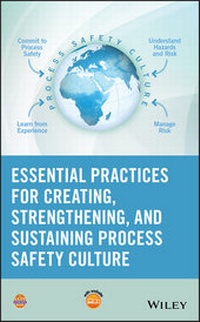
Essential Practices for Creating, Strengthening, and Sustaining Process Safety Culture
Description

Essential Practices for Developing, Strengthening and Implementing Process Safety Culture presents a much-needed guide for understanding an organization's working culture and contains information on why a good culture is essential for safe, cost-effective, and high-quality operations. The text defines process safety culture and offers information on a safety culture's history, organizational impact and benefits, and the role that leadership plays at all levels of an organization. In addition, the book outlines the core principles needed to assess and strengthen process safety culture such as: maintain a sense of vulnerability; combat normalization of deviance; establish an imperative for safety; perform valid, timely, hazard and risk assessments; ensure open and frank communications; learn and advance the culture.
This important guide also reviews leadership standards within the organizational structure, warning signs of cultural degradation and remedies, as well as the importance of using diverse methods over time to assess culture. This vital resource:
* Provides an overview for understanding an organization's working culture
* Offers guidance on why a good culture is essential for safe, cost-effective, and high quality operations
* Includes down-to-earth advice for recognizing, assessing, strengthening and sustaining a good process safety culture
* Contains illustrative examples and cases studies, and references to literature, codes, and standards
Written for corporate, business and line managers, engineers, and process safety professionals interested in excellent performance for their organization, Essential Practices for Developing, Strengthening and Implementing Process Safety Culture is the go-to reference for implementing and keeping in place a culture of safety.
More details
Other editions
Additional editions
Person
The Center for Chemical Process Safety (CCPS) was founded in 1985 to develop technology and management practices that mitigate or eliminate chemical and petrochemical industry process safety incidents. Since that time, CCPS has published more than 100 books and held dozens of international conferences, each representing the most advanced thinking in process safety. CCPS is supported by the contributions and voluntary participation of more than 200 companies globally. CCPS is also the world's largest provider of undergraduate engineering curriculum materials through its Safety and Chemical Engineering Education (SAChE) program, with more than 160 universities around the world participating.
Content
Supplemental Material Available on the Web XIII
Acronyms and Abbreviations XV
Glossary XVII
Acknowledgements XIX
Preface XXIII
Nomenclature XXVII
Executive Summary XXIX
1 Introduction 1
1.1 Importance of Process Safety Culture 1
1.2 Definition of Process Safety Culture 2
1.3 Warning Signs of Poor Process Safety Culture 11
1.4 Leadership and Management Roles and Responsibilities 13
1.5 Organizational Culture, Process Safety Culture, and Business Success 15
1.6 Corporate Climate and Chemistry 17
1.7 Summary 17
1.8 References 20
2 Process Safety Culture Core Principles 23
2.1 Establish an Imperative for Process Safety 25
2.2 Provide Strong Leadership 29
2.3 Foster Mutual Trust 32
2.4 Ensure Open and Frank Communications 35
2.5 Maintain a Sense of Vulnerability 42
2.6 Understand and Act Upon Hazards/Risks 49
2.7 Empower Individuals to Successfully Fulfill their Process Safety Responsibilities 54
2.8 Defer to Expertise 57
2.9 Combat the Normalization of Deviance 59
2.10 Learn to Assess and Advance the Culture 67
2.11 Summary 72
2.12 References 73
3 Leadership for Process Safety Culture within the Organizational Structure 77
3.1 Definition of Process Safety Leadership 77
3.2 Characteristics of Leadership and Management in Process Safety Culture 83
3.3 Leadership Vs. Management 96
3.4 Consistency of Process Safety Messages 97
3.5 Turnover of Leadership, Succession Planning, and Organizational Management of Change 98
3.6 Summary 103
3.7 References 104
4 Applying the Core Principles of Process Safety Culture 107
4.1 Human Behavior and Process Safety Culture 107
4.2 Process Safety Culture and Compensation 109
4.3 Process Safety Culture and Ethics 113
4.4 External Influences on Culture 124
4.6 Summary 153
4.7 References 154
5 Aligning Culture with PSMS Elements 157
5.1 Senior Leader Element Grouping 160
5.2 Risk Management-Related Element Grouping 170
5.3 Process-Related Element Grouping 181
5.4 Worker-Related Element Grouping 190
5.5 References 201
6 Where Do You Start? 203
6.1 Introduction 203
6.2 Assess the Organization's Process Safety Culture 204
6.3 Improving the Process Safety Culture of the Organization 225
6.4 Summary 236
6.5 References 237
7 Sustaining Process Safety Culture 239
7.2 Sustainability of Process Safety Culture 241
7.3 Process Safety Culture and Operational Excellence 248
7.4 Summary 251
7.5 References 253
Appendices 255
Appendix A: Echo Strategies White Paper 257
Appendix B: Other Safety & Process Safety Culture Frameworks 259
B.1 The Seven Basic Rules of the USA. Naval Nuclear Propulsion Program 259
B.2 Advancing Safety in the Oil and Gas Industry -Statement on Safety Culture (Canadian National Energy Board) 261
B.3 References 271
Appendix C: As Low as Reasonably Practicable 273
C.1 ALARP Principle 273
C.2 References 275
Appendix D High Reliability Organizations 277
D.1 The HRO Concept 277
D.2 References 286
Appendix E: Process Safety Culture Case Histories 287
E.1 Minimalist PSMS 287
E.2 - Peer Pressure to Startup 288
E.3 Taking a Minimalist Approach to Regulatory Applicability 290
E.4 Not Taking a Minimalist Approach to Process Safety Applicability 291
E.5 What Gets Measured Can Get Corrupted 291
E.6 KPIs That Always Satisfy 293
E.7 Abusing ITPM Extensions/Deferrals 295
E.8 The VPP Defense 296
E.9 Double Jeopardy 297
E.10 Best Case Consequences 298
E.11 New Kid in Town 299
E.12 The Blame Game 299
E.13 Conflicts of Interest 300
E.14 No Incidents? Not Always Good News 301
E.15 Check-the-Box Process Safety Management Systems 302
E.16 There's No Energy for That Here 302
E.17 Not Invented Here 303
E.18 PHA Silos 304
E.19 Knowing What You Don't Know 305
E.20 Bad News is Bad 306
E.21 The Co-Employment Trap 306
E.22 Stop Work Authority/Initiating an Emergency Shutdown 307
E.23 SWPs by the Numbers 308
E.24 Incomplete MOC 309
E.25 Post-MOCs 310
E.26 Mergers & Acquisitions 310
E.27 Poor Understanding of Hazard/Risk Leads to an Even Worse Normalization of Deviance 311
E.28 How Many Explosions Does It Take to Create a Sense of Vulnerability? 313
E.29 Disempowered to Perform Safety Responsibilities by "Omniscient" Software 315
E.30 What We Have Here is a Failure to Communicate 316
E.31 Becoming the Best 317
E.32 High Sense of Vulnerability to One Dangerous Material Overwhelms the Sense of Vulnerability to Others 319
E.33 Not Empowered to Fulfill Safety Responsibilities? Maybe You Were All Along 321
E.34 Normalization of Ignorance 323
E.35 - Spark and Air Will Find Fuel 324
E.36 Operating Blind 325
E.37 Playing Jenga® with Process Safety Culture 327
E.38 Failure of Imagination? 328
E.39 Playing the Odds 329
E.40 Shutdown and Unsafe 331
E.41 Who, me? Yeah, you. Couldn't be. Then who? 332
E.42 Blindness to Chemical Reactive Hazards Outside the Chemical Industry 334
E.43 Dominos, Downed-Man "Nos" 336
E.44 Mr. Potato Head Has Landed 337
E.45 Sabotage, Perhaps. But of the Plant or the Culture? 338
E.46 This is the Last Place I Thought We'd Have an Incident 339
E.47 References 341
Appendix F: Process Safety Culture Assessment Protocol 343
F.1 Introduction 343
F.2 Culture Assessment Protocol 343
F.3 References 380
Appendix G: Process Safety Culture & Human Behavior 381
1
INTRODUCTION
1.1 IMPORTANCE OF PROCESS SAFETY CULTURE
The 2014 FIFA World Cup semifinal between Germany and Brazil featured two of the most technically proficient teams to contest a match. Within a half-hour, however, the difference between the two emerged, as Germany scored five goals on a shell-shocked Brazil on the way to a 7-1 rout.
The difference? Neymar da Silva Santos, the captain, leader, and culture-setter of the Brazilian side, had suffered a fractured vertebra in the previous match, and could not even cheer his teammates on from the sidelines. With their culture-leader absent, Brazil failed to execute their usually formidable game plan and suffered a catastrophic loss.
PSMS = Process Safety Management System
Similarly, process safety cannot succeed without culture leadership. Investigation of numerous incidents in major hazard operations has clearly revealed culture deficiencies. The data show that without a healthy process safety culture, even the most well-intentioned, well-designed process safety management system (PSMS) will be ineffective. For example, Union Carbide was known as a process safety technology leader in the early 1980s. However, weak culture at its Bhopal facility allowed many "Normalization of Deviance" failures leading to the December 3, 1984 tragedy. Simply stated, a strong, positive process safety culture enables the facility's PSMS to perform at its best. This gives the facility its best chance to prevent catastrophic fires, explosions, toxic releases, and major environmental damage.
Like all cultures, process safety culture starts with strong, committed, and consistent leadership. Just as commanding officers set the cultures of their troops, senior leaders of facilities and companies set the process safety culture of their organizations. Senior leaders set the underlying tone for how an organization functions and motivates the individuals within the organization to maximize the impact of their collective talent (Ref. 1.1).
Without leadership's direct, continuing, and strong participation in setting process safety culture, the culture will suffer gaps in one or more of the ten cultural principals (see chapter 2). This leadership should cascade through the organization, with each leader helping their subordinates, peers, and managers maintain focus on achieving the desired culture.
Leadership of culture should survive economic downturns and keep pace with upturns and technology changes. Culture leadership should persist through acquisitions and divestitures. Perhaps hardest of all, it should survive changes of personnel. Altogether, leadership should be committed to establishing and maintaining a sound process safety culture and should establish the proper philosophical tone for the culture. This tone should emphasize the true importance of process safety and the faithful execution of the PSMS. The importance of strong leadership will be further discussed in section 1.4 and in Chapter 3.
1.2 DEFINITION OF PROCESS SAFETY CULTURE
Many experts have defined culture as what people do when their boss is not around. A group of people with a common purpose (e.g., co-workers, teammates, and families) develops a set of beliefs, customs, and behaviors that become embedded in how the group thinks and works. With continued practice, these beliefs and behaviors become reinforced and integrated into the group's value system (12,13). As time goes on, the group's actions reflect common and deeply held values. The group expects newcomers to adopt or "buy into" these values to become accepted into the group.
Unfortunately, negative cultures can also exist, where common values result in attitudes and actions with negative consequences. In such cultures, peer pressure can reinforce negative behaviors. This may happen for example, if a new co- worker berated for following the approved procedure instead of the common but unsafe shortcut.
The International Nuclear Safety Advisory Group (INSAG) of the International Atomic Energy Agency (IAEA) made one of the first definitions of safety culture in the investigation of the aftermath of the Chernobyl accident in 1986 (Ref 1.4).
"Safety Culture is that assembly of characteristics and attitudes in organizations and individuals which establishes that, as an overriding priority, nuclear plant safety issues receive the attention warranted by their significance."
The preceding definition describes the result of the culture, but not the culture itself (Ref 1.5). In the wake of the Challenger and Columbia disasters, NASA (16,17) began to recognize that key personnel defined organizational culture, and that change in personnel can lead to negative culture change:
"Organizational culture refers to the basic values, norms, beliefs, and practices that characterize the functioning of a particular institution. At the most basic level, organizational culture defines the assumptions that employees make as they carry out their work; it defines "the way we do things here." An organization's culture is a powerful force that persists through reorganizations and the departure of key personnel."
Describing groundbreaking CCPS work in 2005, Jones and Kadri (18) adapted these published definitions to process safety and recognized the link of culture to management:
"For process safety management purposes, we propose the following definition for process safety culture: The combination of group values and behaviors that determine the way process safety is managed." (emphasis added)
In the wake of its investigation of a refinery explosion in Texas City, TX, USA, the US Chemical Safety Board (CSB) leveraged the CCPS work Jones and Kadri described (Ref 1.9). CSB recommended that the company conduct an independent assessment of process safety culture at their five U.S. Refineries and at the Corporate level. The resulting Baker Panel report (Ref 1.10 identified numerous culture gaps and improvement opportunities. They then went on to say, "We are under no illusion that deficiencies in process safety culture, management, or corporate oversight are limited to the company." This statement proved to motivate many process safety culture improvements in refining and chemical companies globally.
Additional study led CCPS to define process safety culture based on the critical role of leadership and management. CCPS's Vision 20/20 (Ref 1.11) CCPS stated that a committed culture consists of:
- Felt leadership from senior executives. Felt leadership means more than a periodic mention of process safety in speeches and town hall meetings. It means that executives feel a deep personal commitment and remain personally involved in process safety activities.
- Maintaining a sense of vulnerability.
- Operational discipline, the performance of all tasks correctly every time.
This sums up several definitions of culture from other sources as it applies to environmental, health, or safety programs and issues:
- (Ref 1.12): "Safety and health are (or have become) part of the company culture-and frequently part of the management system. 'Culture' is traditionally defined as 'a shared set of beliefs, norms, and practices, documented and communicated through a common language.' The key word here is 'shared.' Companies have found that if safety and health values are not consistently (and constantly) shared at all levels of management and among all employees, any gains that result from declaring safety and health excellence a 'priority' are likely to be short-lived."
- (Ref 1.13): "The attitudes, beliefs and perceptions shared by natural groups as defining norms and values, which determine how they act and react in relation to risks and risk control systems."
- Canadian National Energy Board (Ref 1.14): "Safety culture means 'the attitudes, values, norms and beliefs, which a particular group of people shares with respect to risk and safety'."
- UK Health and Safety Executive (Ref 1.15): "The safety culture of an organization is the product of individual and group values, attitudes, perceptions, competencies and patterns of behaviour that determine the commitment to, and the style and proficiency of, an organization's health and safety management."
These definitions share common themes and terms. For something to become embedded in the culture of an organization of group, it is believed by its members. The belief becomes a common or shared belief, a value, or a norm. These norms result in certain repeated actions or behaviors.
The shared beliefs...
