

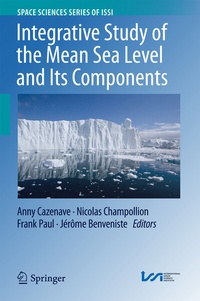
Integrative Study of the Mean Sea Level and Its Components
Description

This volume presents the most recent results of global mean sea level variations over the satellite altimetry era (starting in the early 1990s) and associated contributions, such as glaciers and ice sheets mass loss, ocean thermal expansion, and land water storage changes. Sea level is one of the best indicators of global climate changes as it integrates the response of several components of the climate system to external forcing factors (including anthropogenic forcing) and internal climate variability. Providing long, accurate records of the sea level at global and regional scales and of the various components causing sea level changes is of crucial importance to improve our understanding of climate processes at work and to validate the climate models used for future projections. The Climate Change Initiative project of the European Space Agency has provided a first attempt to produce consistent and continuous space-based records for several climate parameters observable from space, among them sea level. This book presents current knowledge of the sea level budget over the altimetry era and 20th century.
Previously published in Surveys in Geophysics , Volume 38, Issue 1, 2017More details
Other editions
Additional editions
Persons
Nicolas Champollion completed his PhD at the Laboratoire de Glaciologie et de Geophysique de l'Environnement (LGGE) in Grenoble, France, in 2013. His thesis is about the evolution of the snow surface on the Antarctica plateau from in situ and remote sensing observations. He continues his research work at the International Space Science Institute (ISSI) in Bern, Switzerland, focusing on sea level budget and its components. An important part of his work at ISSI has been the organization of an international workshop on various themes, with among them water resources, sea level, clouds, and imaging spectroscopy technique.
Frank Paul has a diploma in meteorology from the University of Hamburg and a Ph.D. degree in physical geography from the University of Zurich, where he is currently working as a senior research scientist and group leader. He has worked in several national and international research projects related to glacier mapping and monitoring from space-borne optical sensors, distributed mass-balance modeling of glaciers, as well as geomorphometric analysis of DEMs and their application in glaciological studies. He was PI of the ESA Project GlobGlacier and is currently science leader of the follow-up project Glaciers_cci. He served as a lead author in Working Group I of the Fifth Assessment Report (AR5) of the Intergovernmental Panel on Climate Change (IPCC) in the cryosphere Chapter. He is guest editor of a special issue of the journal "Remote Sensing' on the topic 'Remote sensing of glaciers' and member of the editorial board of the journal 'Remote Sensing of Environment'
Jérôme Benveniste received his PhD in Oceanography from Space from the University of Toulouse, France, in 1989. After a Post-Doc in space data assimilation in ocean models at MIT, Boston, USA, he moved to the European Space Agency. He has been at the Earth Observation data centre near Rome since 1992, where he is in charge of the ERS-1, ERS-2, ENVISAT, CryoSat and Sentinel-3 radar altimetry data exploitation. He interacts with ESA Principal Investigators, organises scientific symposia, and often launches Research and Development projects, including GOCE data exploitation. He was recognised as senior advisor at ESA in 2008. He is co-editor of a Springer book on Coastal Zone Radar Altimetry, published in 2011 and on Inland Water Altimetry, to be published in 2017. Jérôme Benveniste monitors the six-year Climate Change Initiative Sea Level Project, launched in 2009.
