

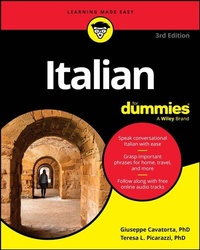
Italian For Dummies
Description

The Dummies language learning method makes it easy to speak Italiano
Italian For Dummies is your quick-start guide to the Italian language. It offers friendly and clear instruction on Italian grammar and pronunciation, and even some cultural background to spice things up. You'll also get ample practice opportunities, so you can quickly build your skill in conversational Italian. Traveling to an Italian-speaking country? This book has you covered, with useful travel phrases and a guide to the common words and expressions you're likely to hear. With a mini-dictionary and other helpful resources, Italian For Dummies will show you why Dummies language guides are popular with students and travelers alike.
- Learn the basics of Italian grammar and start speaking the language right away
- Prepare to travel to Italian-speaking countries for work, school, or pleasure
- Work through authentic conversations in Italian to learn how the language is really spoken, plus follow along with online audio
- Master Italian pronunciation so you can communicate effectively
For anyone wanting to grasp the basics of conversational Italian-even if you have no prior experience-Italian For Dummies will get you started with this beautiful language.
More details
Other editions
Additional editions
Persons
Giuseppe Cavatorta, PhD, is a professor of Italian at the University of Arizona. He has written, edited, and translated several works across disciplines focusing mainly on Italian and American poetry.
Teresa L. Picarazzi, PhD, has taught Italian language, literature, and cinema for more than 20 years. She's also written several For Dummies books, including Italian Workbook For Dummies.
Content
Introduction 1
About This Book 1
Conventions Used in This Book 1
Foolish Assumptions 3
Icons Used in This Book 3
Beyond This Book 4
Where to Go from Here 4
Part 1: Getting Started with Italian 5
Chapter 1: Saying Italian Like It Is 7
You Already Know Some Italian! 8
Cognates 9
Sounding Italian: The Essentials 9
The alphabet 10
Vowels 11
Consonants 13
Kickstarting your Italian with keywords 17
Stressing Words Properly 18
Chapter 2: Jumping Into the Basics of Italian 19
Setting Up Simple Sentences 19
Dealing with Gender and Number (Articles, Nouns, and Adjectives) 20
Gender and number 20
Indefinite articles 22
Definite articles 22
Adjectives 23
Talking about Pronouns 25
Personal pronouns 25
Saying "you": Formal and informal 26
Being inclusive? Still a long way to go 26
Exploring Verbs 27
Introducing regular and irregular verbs 27
Having to, wanting to, being able to 35
Presenting the Simple Tenses: Past, Present, and Future 36
Chapter 3: Buongiorno Italia! 41
Looking at Common Greetings and Farewells 41
Replying to a greeting 42
Reuniting not sure when 43
Making Introductions 44
Introducing yourself 44
Introducing other people 46
Getting Acquainted 48
Finding out whether someone speaks English 49
Talking about where you come from 50
Extending and responding to invitations 54
Chapter 4: Getting Your Numbers and Time Straight 57
Practicing Using Numbers 57
Identifying Times of Day and Days of the Week 61
Using the Calendar 63
Asking about and Giving Dates 64
Telling Time 65
Asking for the time 65
Asking what time something begins 66
Chatting about the Weather 67
Familiarizing Yourself with the Metric System 72
Temperature 73
Length and distance 73
Weight 74
Part 2: Italian in Action 79
Chapter 5: Casa Dolce Casa (Home Sweet Home) 81
Practicing Ordinal Numbers 81
Living in Your Home 83
Hunting for a place to live 83
Sprucing up your residence 88
Furnishing your new pad 89
Housekeeping in Style 91
Cooking at Home 93
Doing Household Chores 95
Chapter 6: Where Is the Colosseum? Asking Directions 99
Finding Your Way: Asking for Specific Places 99
Knowing Where You Are and Following Directions 102
Identifying distances when walking 102
Recognizing where you're headed 103
Giving and receiving directions 103
Getting a Move on It: Verbs You Can Use 106
When You Don't Understand: What to Say 109
Looking For a Specific Location 110
Chapter 7: Food Glorious Food - and Don't Forget the Drinks 115
Drinking Italian Style 116
Expressing your love for espresso 116
Enjoying beverages with more of a kick 118
Dining Out: The Beginning and the Ending 120
Making reservations 120
Paying for your meal 122
Having Breakfast 123
Eating Lunch 124
Enjoying Dinner 126
Shopping for Food 129
At the butcher shop 129
At the fish shop 130
At the bakery 131
At the market 132
Chapter 8: Shopping Italian Style 135
Figuring Out What to Shop 135
Deciding between department stores and boutiques 136
Finding your way around stores 136
Knowing What You're Buying 139
This one or that one? Demonstrative adjectives and pronouns 140
Decoding Italian sizes 140
Focusing on colors 142
Accessorizing 144
Stepping out in style 145
Chapter 9: Having Fun Out on the Town 149
Diving Into the Culture 150
Going to the movies 152
Going to the theater 155
Going to a museum 158
Going to a local festival 159
Going to a concert 160
Going to a party or other event 162
Chapter 10: From Ring to Ping: Phones, Texts, Emails, & More 169
Communicating Made Simple 169
Connecting via cellphones, texts, and WhatsApp 170
Calling for business or pleasure 172
Making Arrangements over the Phone 174
Handling Missed Calls and Messages 175
What Did You Do Last Weekend? - Talking about the Past 178
Using avere 179
Using essere 181
Discussing Your Job 183
The human element 183
Office equipment 184
Chapter 11: Recreation and the Outdoors 187
Enjoying the Great Outdoors 187
Speaking Reflexively 191
Playing Sports 194
Talking about Hobbies and Interests 198
Part 3: Italian on the Go 205
Chapter 12: Planning a Trip 207
Deciding When and Where to Go 207
Taking a Tour 208
Booking a Trip/Traveling to a Foreign Country 209
Arriving and Leaving: The Verbs "Arrivare" and "Partire" 212
Going to the Beach or to the Spa 213
Using the Simple Future Tense 214
Chapter 13: Money, Money, Money 217
Going to the Bank 217
Changing Money 219
Using Credit Cards 221
Looking at Various Currencies 224
Chapter 14: Getting Around: Planes, Trains, Taxis, & Buses 229
Getting through the Airport 229
Checking in 230
Dealing with excess baggage 232
Waiting to board the plane 232
Going through customs 233
Dealing With Lost Luggage 235
Renting a Car 238
Navigating Public Transportation 240
Calling a taxi 240
Moving by train 241
Going by bus, tram, or subway 244
Reading maps and schedules 247
Leaving Early or Arriving Late 248
Chapter 15: Finding a Place to Stay 251
Choosing a Place to Stay 251
Reserving a Room 252
Checking In 255
Settling in for your hotel stay 255
Requesting something during your stay 256
Yours, Mine, and Ours: Possessive Adjectives and Pronouns 259
Speaking with Authority: The Imperative 262
Chapter 16: Handling Emergencies 267
Asking for Help: A Quick Overview 267
Talking to Doctors 268
Describing what ails you 269
Understanding professional medical vocabulary 273
Getting what you need at the pharmacy 274
Braving the dentist 275
Reporting an Accident to the Police 276
I've Been Robbed! Knowing What to Do and Say When the Police Arrive 277
Dealing with Car Trouble 280
When You Need a Lawyer: Protecting Your Rights 282
Reporting a Lost or Stolen Passport 283
Chapter 17: Making Small Talk 287
Discovering Interrogative Pronouns 287
Using interrogative pronouns 288
Asking simple questions 289
Taking Care of Basic Needs 290
Talking about Yourself and Your Family - More about Possessives 294
Speaking Perfectly about the Past with the Imperfect 297
Talking Shop 299
Part 4: the Part of Tens 305
Chapter 18: Ten Ways to Pick Up Italian Quickly 307
Read Italian Food Labels 307
Ask for Food in Italian 307
Listen to Italian Music and Podcasts 308
Read Italian Publications 308
Watch Italian Movies and TV Programs with Italian Subtitles 308
Switch Your Apps and Phone to Italian 309
Follow Italian Social Media Accounts 309
Share Your Interest 309
Surf the Net 309
Cook like an Italian 310
Chapter 19: Ten Things to Know When Traveling to Italy 311
Ciao Isn't for Everyone 311
Modesty Sometimes Matters 312
Weigh Your Fruit and Vegetables While Wearing Gloves 312
Bag It Yourself and Pay for the Bags 312
Free Water? Not Here! 312
Pepperoni, Cheese on Pasta, and Meatballs 313
Tables Are for Diners 313
The Cappuccino Conundrum 313
Chapter 20: Ten Favorite Italian Expressions 315
Mamma mia! 315
Dai! 316
Uffa! 316
Che ne so!/Boh! 316
Magari! 316
Ti sta bene! 316
Non te la prendere! 317
Non vedo l'ora! 317
Non mi va! 317
mi raccomando! 317
Part 5: Appendixes 319
Appendix A: Italian-English Mini Dictionary 321
Appendix B: Verb Tables 335
Appendix C: Answer Keys 347
Index 357
Chapter 1
Saying Italian Like It Is
IN THIS CHAPTER
Discovering Italian you already know
Using basic expressions to get you by and cognates
Introducing basic Italian pronunciation
You probably know that Italian is a Romance language, which means that Italian, just like Spanish, French, Portuguese, and some other languages, is a "child" of Latin. There was a time when Latin was the official language in a large part of Europe because the Romans ruled so much of the area. Before the Romans came, people spoke their own languages, and the mixture of these original tongues with Latin produced many of the languages and dialects still in use today.
If you know one of these Romance languages, you can often understand parts of another. But just as members of the same family can look very similar but have totally different personalities, so it is with these languages. People in different areas speak in very different ways due to historical or social reasons, and even though Italian is the official language, Italy has a rich variety of dialects. Some dialects differ so much from standard Italian that people from different regions can't understand each other.
Despite the number of different accents and dialects, you'll be happy to discover that everybody understands the Italian you speak and you'll understand theirs. (Italians don't usually speak in their dialect with people outside their region.) This chapter introduces you to the world of Italian.
You Already Know Some Italian!
Although Italians are very proud of their language, they have allowed some English words such as gadget, jogging, weekend, and shock to enter it. They often use the word okay, and since computers have entered their lives, they say "cliccare sul mouse" (kleek-kah-reh soohl mouse) (to click the mouse). Finally, there's lo zapping (loh zapping), which means continuously switching TV channels with the remote. These are only a few of the flood of English words that have entered the Italian language.
In the same way, many Italian words are known in English-speaking countries. Can you think of some? Consider the following words:
- pizza (peet-tsah)
- pasta (pah-stah)
- spaghetti (spah-geht-tee)
- tortellini (tohr-tehl-lee-nee)
- mozzarella (moht-tsah-rehl-lah)
- espresso (eh-sprehs-soh)
- cappuccino (kahp-pooh-chee-noh)
- panino (pah-nee-noh): For one sandwich: for two or more, the word is panini (pah-nee-nee)
- biscotti (bee-skoht-tee) (cookies): One cookie is a biscotto (bee-skoht-toh)
- tiramisù (tee-rah-mee-sooh)
Incidentally, did you know that tiramisù literally means pull me up? The name comes from the boost of energy you get from the strong Italian espresso and eggs in it. You may have heard words not directly related to food, such as the following:
- amore (ah-moh-reh): This is the word for love that so many Italian songs talk about.
- avanti (ah-vahn-tee): You use this word as come in!, come on!, or get a move on!
- bambino (bahm-bee-noh): This means child or boy. The word for girl is bambina (bahm-bee-nah).
- bravo! (brah-voh): Say this to a man. For a woman, use brava! (brah-vah), and for a group, bravi! (brah-vee) or brave! (brah-veh) if it's all women.
- ciao! (chow): Ciao means hello and good-bye.
- scusi (skooh-zee): This word stands for excuse me and sorry and is addressed to persons you don't know or to whom you speak formally. You say "scusa" (skooh-zah) to people you know and to children.
You've heard at least some of these words, haven't you? This is just a little taste of all the various words and expressions you'll get to know in this book.
Cognates
In addition to the words that have crept into the language directly, Italian and English have many cognates. A cognate is a word in one language that has the same origin as a word in another one and may sound similar. The following words can give you an immediate sense of what cognates are:
- aeroporto (ah-eh-roh-pohr-toh) (airport)
- attenzione (aht-tehn-tsyoh-neh) (attention)
- comunicazione (koh-mooh-nee-kah-tsyoh-neh) (communication)
- importante (eem-pohr-tahn-teh) (important)
- incredibile (een-kreh-dee-bee-leh) (incredible)
You understand much more Italian than you think you do. Italian and English are full of cognates. To demonstrate, read this little story with some Italian words and see how easy it is for you to understand.
It seems impossibile (eem-pohs-see-bee-leh) to him that he is now at the aeroporto (ah-eh-roh-pohr-toh) in Rome. When he goes out on the street, he first calls a taxi (tah-ksee). He opens his bag to see if he has the medicine (meh-dee-chee-neh) that the dottore (doht-toh-reh) prescribed for him. Going through this terribile traffico (tehr-ree-bee-leh trahf-fee-koh), he passes a cattedrale (kaht-teh-drah-leh), some monumenti (moh-nooh-mehn-tee), and many palazzi (pah-laht-tsee). He knows that this is going to be a fantastico (fahn-tah-stee-koh) journey.
Sounding Italian: The Essentials
Italian gives your tongue plenty of chances to do acrobatics - and that's part of the fun. The language introduces you to some new and exciting sounds. In this section, we walk you through some basic pronunciation guidelines to help you speak Italian like a native speaker.
Throughout this book, you find the pronunciation of Italian words in parentheses. The next few sections contain helpful hints on how to read and use these pronunciations - in other words, how to pronounce Italian words. Here's the deal: We need to agree on what letters stand for which sounds, so stick with this pronunciation code as you go through the book.
In the pronunciations, we separate the syllables with a hyphen, like this: casa (kah-zah) (house). The stressed syllable, that is, the part of the word where you place the emphasis is italicized. If you acquire the correct pronunciation, starting with the alphabet, you may even be able to forgo the pronunciation spelling provided, and read it like a real Italian.
The alphabet
What better way is there to start speaking a language than to familiarize yourself with its alphabet! Table 1-1 shows you all the letters as well as how each of them sounds. It's essential to learn how to pronounce the Italian alphabet so that you'll be able to pronounce all of the new words you will be learning. Listen to and repeat what you hear in Track 1 of the audio files as many times as you need to in order to get down the right sounds. In the long run, this will help you be understood when you communicate in Italian. Note that there are only 21 letters in the Italian alphabet: Missing are j, k, w, x, and y (which have crept into some Italian words).
TABLE 1-1 The Italian Alphabet (ahl-fah-beh-toh)
Letter
Pronunciation
Letter
Pronunciation
a
ah
b
bee
c
chee
d
dee
e
eh
f
ehf-feh
g
jee
h
ahk-kah
i
ee
j
ee...
