

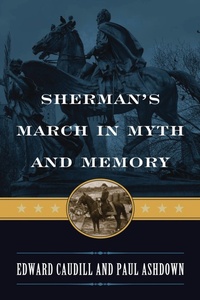
Sherman's March in Myth and Memory
Published on 16. September 2009
1 pages
979-8-216-21343-7 (ISBN)
Description

General William Tecumseh Sherman's devastating "March to the Sea" in 1864 burned a swath through the cities and countryside of Georgia and into the history of the American Civil War. As they moved from Atlanta to Savannah-destroying homes, buildings, and crops; killing livestock; and consuming supplies-Sherman and the Union army ignited not only southern property, but also imaginations, in both the North and the South. By the time of the general's death in 1891, when one said "The March," no explanation was required. That remains true today.
Legends and myths about Sherman began forming during the March itself, and took more definitive shape in the industrial age in the late-nineteenth century. Sherman's March in Myth and Memory examines the emergence of various myths surrounding one of the most enduring campaigns in the annals of military history. Edward Caudill and Paul Ashdown provide a brief overview of Sherman's life and his March, but their focus is on how these myths came about-such as one description of a "60-mile wide path of destruction"-and how legends about Sherman and his campaign have served a variety of interests.
Caudill and Ashdown argue that these myths have been employed by groups as disparate as those endorsing the Old South aristocracy and its "Lost Cause," and by others who saw the March as evidence of the superiority of industrialism in modern America over a retreating agrarianism.
Sherman's March in Myth and Memory looks at the general's treatment in the press, among historians, on stage and screen, and in literature, from the time of the March to the present day. The authors show us the many ways in which Sherman has been portrayed in the media and popular culture, and how his devastating March has been stamped into our collective memory.
Legends and myths about Sherman began forming during the March itself, and took more definitive shape in the industrial age in the late-nineteenth century. Sherman's March in Myth and Memory examines the emergence of various myths surrounding one of the most enduring campaigns in the annals of military history. Edward Caudill and Paul Ashdown provide a brief overview of Sherman's life and his March, but their focus is on how these myths came about-such as one description of a "60-mile wide path of destruction"-and how legends about Sherman and his campaign have served a variety of interests.
Caudill and Ashdown argue that these myths have been employed by groups as disparate as those endorsing the Old South aristocracy and its "Lost Cause," and by others who saw the March as evidence of the superiority of industrialism in modern America over a retreating agrarianism.
Sherman's March in Myth and Memory looks at the general's treatment in the press, among historians, on stage and screen, and in literature, from the time of the March to the present day. The authors show us the many ways in which Sherman has been portrayed in the media and popular culture, and how his devastating March has been stamped into our collective memory.
More details
Other editions
Additional editions
Edward Caudill | Paul Ashdown
Sherman's March in Myth and Memory
Book
10/2009
Rowman & Littlefield Publishers
€39.90
Shipment within 10-20 days
Persons
Edward Caudill and Paul Ashdown are professors of journalism and electronic media at the University of Tennessee. They are co-authors of The Myth of Nathan Bedford Forrest (2005) and The Mosby Myth: A Confederate Hero in Life and Legend (2002). Caudill is author of Darwinian Myths: The Legends and Misuses of a Theory (1997) and co-author of The Scopes Trial: A Photographic History (2000). Ashdown is editor of James Agee: Selected Journalism (1985, 2004) and author of A Cold Mountain Companion (2004).
Content
Chapter 1: Sherman
Chapter 2: Industrial Strength Sherman: the Man, the Idea, the Myth
Chapter 3: Sherman Among the Historians
Chapter 4: Still Marching: Sherman in Literature
Chapter 5: Long Remember: Sherman on Stage and Screen, in Song and Poetry
Chapter 6: In Sherman's Tracks
Chapter 7: The March and Its Myth
Chapter 2: Industrial Strength Sherman: the Man, the Idea, the Myth
Chapter 3: Sherman Among the Historians
Chapter 4: Still Marching: Sherman in Literature
Chapter 5: Long Remember: Sherman on Stage and Screen, in Song and Poetry
Chapter 6: In Sherman's Tracks
Chapter 7: The March and Its Myth
