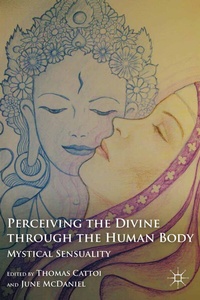
Perceiving the Divine through the Human Body
Description

Reviews / Votes
'This collection of essays emerges from a lively collaborative project among scholars of mysticism who employ diverse critical approaches to explore the theme of embodied spirituality in various religious traditions both East and West, as well as some contemporary esoteric movements. Framed by the editors' own insightful analyses, these essays make a convincing argument that we must quite literally 'come to our senses' in order to understand humanity's persistent quest for knowledge of divine reality.' Arthur Holder, Dean, Graduate Theological Union
'Perceiving the Divine through the Human Body is an ambitious effort to reenergize the doctrine of the spiritual senses for the twenty-first century. By historical investigation, theological reflection across several religious traditions, and attention to the current frontiers of spiritual exploration, contributors team up to mend the rift between body and soul, narrow the gap between God and creation, and draw the academic and spiritual worlds back into conversation. A welcome contribution to the necessary new study of mysticism.' - Francis X. Clooney, SJ, Director of the Center for the Study of World Religions, Harvard University
'This volume brings together current research on the spiritual senses for the discipline of religious studies and theology. It provides an accessible, insightful analysis of spirituality and spiritual senses in different mystical traditions, and it forges the way for a new approach to the question of embodied spirituality.' - Patrizia Granziera, Universidad Autónoma del Estado de Morelos, Cuernavaca- Mexico
'Religious traditions throughout the world have taught that the body, the senses, and the emotions are not only bases of suffering, sin, or confusion but also potential vehicles of salvation, liberation, and enlightenment. Although the intellect's soteriological role is often seen as crucial, it is the totality of embodied existence that is the very substance of ultimate transformation and liberation in the history of religions. Modern theology and religious studies in the West lost sight of this. The richly developed studies in this volume provide an important corrective for our time.' - John Makransky, Associate Professor of Buddhism and Comparative Theology, Boston College
More details
Other editions
Additional editions