

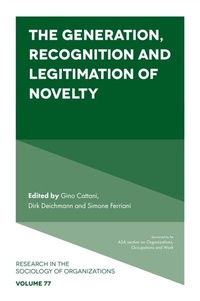
The Generation, Recognition and Legitimation of Novelty
1st Edition
Published on 20. January 2022
360 pages
978-1-80117-999-7 (ISBN)
Description

This volume brings together researchers from a diverse array of academic disciplines - including sociology, organization theory, strategy and psychology - to address the question of what organizations can do to better recognize novel ideas and support their proponents in implementing those ideas.
The contributors draw from different theoretical perspectives and empirical papers use both qualitative and/or quantitative methods in their analysis. All contributions speak to a common set of phenomena at the intersection of creativity, innovation, and social evaluation in a variety of cultural fields. In the first section of the volume - searching for novelty - the papers discuss different conceptualizations of novelty and examine the conditions that foster the creation of new ideas or product offerings. In the second section of the volume - seeing novelty - the papers discuss how novelty is evaluated and recognized both within and outside organizations. Papers in the third and final section - sustaining novelty - explore how these evaluations affect the support that novelty receives in its journey to gain legitimacy.
Setting an agenda for a more holistic theory on the emergence, evaluation, and legitimation of novelty, this volume showcases how novelty generation, recognition, and legitimation correspond to distinct phases of the journey of novelty, from the moment it makes its appearance in the world to the moment it takes root and propagates.
The contributors draw from different theoretical perspectives and empirical papers use both qualitative and/or quantitative methods in their analysis. All contributions speak to a common set of phenomena at the intersection of creativity, innovation, and social evaluation in a variety of cultural fields. In the first section of the volume - searching for novelty - the papers discuss different conceptualizations of novelty and examine the conditions that foster the creation of new ideas or product offerings. In the second section of the volume - seeing novelty - the papers discuss how novelty is evaluated and recognized both within and outside organizations. Papers in the third and final section - sustaining novelty - explore how these evaluations affect the support that novelty receives in its journey to gain legitimacy.
Setting an agenda for a more holistic theory on the emergence, evaluation, and legitimation of novelty, this volume showcases how novelty generation, recognition, and legitimation correspond to distinct phases of the journey of novelty, from the moment it makes its appearance in the world to the moment it takes root and propagates.
More details
Series
Language
English
Place of publication
Bingley
United Kingdom
Target group
Professional and scholarly
File size
10,06 MB
ISBN-13
978-1-80117-999-7 (9781801179997)
Copyright in bibliographic data and cover images is held by Nielsen Book Services Limited or by the publishers or by their respective licensors: all rights reserved.
Schweitzer Classification
Other editions
Additional editions
Gino Cattani | Dirk Deichmann | Simone Ferriani
The Generation, Recognition and Legitimation of Novelty
Book
01/2022
Emerald Publishing Limited
€168.90
Shipment within 3-4 weeks
Persons
Gino Cattani is Professor of Strategy and Organization Theory at the Stern School of Business, New York University.
Dirk Deichmann is Associate Professor of Innovation Management at Rotterdam School of Management, Erasmus University.
Simone Ferriani is Professor of Entrepreneurship and Innovation at the University of Bologna and at City, University of London.
Dirk Deichmann is Associate Professor of Innovation Management at Rotterdam School of Management, Erasmus University.
Simone Ferriani is Professor of Entrepreneurship and Innovation at the University of Bologna and at City, University of London.
Content
Chapter 1. Novelty: Searching for, Seeing, and Sustaining It; Gino Cattani, Dirk Deichmann, and Simone Ferriani
Chapter 2. Nothing New Under The Sun: Novelty Constructs and Measures in Social Studies; Davide Bavato
Chapter 3. Bustin' Out: The Evolution of Novelty and Diversity in Recorded Music; Giacomo Negro, Balazs Kovacs, and Glenn R. Carroll
Chapter 4. Emerging Novelty Through Imitation? Discovering Emulation in Processes of Creating; Alikeness Konstantin Hondros and Lukas Vogelgsang
Chapter 5. What is Social Status and How Does It Impact the Generation of Novel Ideas; Matthew Bothner, Frederic Godart, Noah Askin, and Wonjae Lee
Chapter 6. How "mms" Trigger Novel Ideas: An Inductive Field Study of Conversational Interaction Dynamics in Agile Meetings; Friederike Redlbacher, Nale Lehmann-Willenbrock, and Jetta Frost
Chapter 7. Variety Is The Spice of Life: Heterogeneity in Evaluator Engagement and The Valuation of Atypicality; Brian P. Reschke and Ming D. Leung
Chapter 8. How a Strong Present Focus Fosters Radical Idea Recognition; Denise Falchetti
Chapter 9. Bias in Creative Adoption Decision Points; Wayne R. Johnson
Chapter 10. Seeing Value Through The Eyes of Others: Perception of Value and Rebidding in Online Auctions; Daniel Sands
Chapter 11. Take a Look at Me Now: Consecration and the Phil Collins Effect; Andre Spicer, Pinar Cankurtaran, and Michael B. Beverland
Chapter 12. The Legitimation of Peripheral Producers' Novelty by External Audiences: The Contingent Role of Consultants; Leonardo Corbo, Raffaele Corrado, and Vincenza Odorici
Chapter 13. The Role of Materiality in the Evaluation of Novel Ideas: Evidence from Gastronomy and Performing Arts; Ignasi Capdevila, Pilar Opazo, and Barbara Slavich
Chapter 2. Nothing New Under The Sun: Novelty Constructs and Measures in Social Studies; Davide Bavato
Chapter 3. Bustin' Out: The Evolution of Novelty and Diversity in Recorded Music; Giacomo Negro, Balazs Kovacs, and Glenn R. Carroll
Chapter 4. Emerging Novelty Through Imitation? Discovering Emulation in Processes of Creating; Alikeness Konstantin Hondros and Lukas Vogelgsang
Chapter 5. What is Social Status and How Does It Impact the Generation of Novel Ideas; Matthew Bothner, Frederic Godart, Noah Askin, and Wonjae Lee
Chapter 6. How "mms" Trigger Novel Ideas: An Inductive Field Study of Conversational Interaction Dynamics in Agile Meetings; Friederike Redlbacher, Nale Lehmann-Willenbrock, and Jetta Frost
Chapter 7. Variety Is The Spice of Life: Heterogeneity in Evaluator Engagement and The Valuation of Atypicality; Brian P. Reschke and Ming D. Leung
Chapter 8. How a Strong Present Focus Fosters Radical Idea Recognition; Denise Falchetti
Chapter 9. Bias in Creative Adoption Decision Points; Wayne R. Johnson
Chapter 10. Seeing Value Through The Eyes of Others: Perception of Value and Rebidding in Online Auctions; Daniel Sands
Chapter 11. Take a Look at Me Now: Consecration and the Phil Collins Effect; Andre Spicer, Pinar Cankurtaran, and Michael B. Beverland
Chapter 12. The Legitimation of Peripheral Producers' Novelty by External Audiences: The Contingent Role of Consultants; Leonardo Corbo, Raffaele Corrado, and Vincenza Odorici
Chapter 13. The Role of Materiality in the Evaluation of Novel Ideas: Evidence from Gastronomy and Performing Arts; Ignasi Capdevila, Pilar Opazo, and Barbara Slavich
