

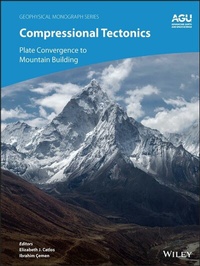
Compressional Tectonics
Description

Major mountain belts on Earth, such as the Alps, Himalayas, and Appalachians, have been built by compressional tectonic processes during continent-continent and arc-continent collisions. Understanding their formation and evolution is important because of the hazards associated with convergent and collisional plate boundaries, and because these mountain belts contain resources such as precious metals, rare earth elements, oil, gas, and coal.
Compressional Tectonics: Plate Convergence to Mountain Building reviews our present-day knowledge of the tectonic evolution of the Alpine-Himalayan and Appalachian belts.
Volume highlights include:
* Overview of terminology relating to compressional and contractional tectonics
* Discussion of subduction zone dynamics
* Debates over the timing of the collision and convergence of particular subduction and suture zones
* Examples of the different stages in the development of orogenic belts
This book is one of a set of three in the collection Tectonic Processes: A Global View.
The American Geophysical Union promotes discovery in Earth and space science for the benefit of humanity. Its publications disseminate scientific knowledge and provide resources for researchers, students, and professionals.
More details
Other editions
Additional editions
Persons
Elizabeth J. Catlos, The University of Texas at Austin, USA
Ibrahim Çemen, The University of Alabama, USA
Content
List of Contributors vii
Preface ix
Part I Plate Convergence
1 When Plates Collide 3 Elizabeth J Catlos and Ibrahim Çemen
2 Subduction and Obduction Processes: The Fate of Oceanic Lithosphere Revealed by Blueschists, Eclogites, and Ophiolites 21 Philippe Agard, Mathieu Soret, Guillaume Bonnet, Dia Ninkabou, Alexis Plunder, Cécile Prigent, and Philippe Yamato
3 Lateral Heterogeneity in Compressional Mountain Belt Settings 47 Bibek Giri and Mary Hubbard
4 A Review of the Dynamics of Subduction Zone Initiation in the Aegean Region 87 Elizabeth J Catlos and Ibrahim Çemen
Part II Alpine-Himalayan Collision
5 Genesis of Himalayan Stratigraphy and the Tectonic Development of the Thrust Belt 121 Delores M Robinson and Aaron J Martin
6 Records of Himalayan Metamorphism and Contractional Tectonics in the Central Himalayas (Darondi Khola, Nepal) 155 Elizabeth J Catlos
7 Tectonics of the Southeast Anatolian Orogenic Belt 203 Yücel Yilmaz, Erdinç Yigitbas, and Ibrahim Çemen
8 Tectonics of Eastern Anatolian Plateau: Final Stages of Collisional Orogeny in Anatolia 223 Yücel Yilmaz, Ibrahim Çemen, and Erdinç Yigitbas
9 When and Why the NeoTethyan Subduction Initiated Along the Eurasian Margin: A Case Study From a Jurassic Eclogite in Southern Iran 245 Bo Wan, Yang Chu, Ling Chen, Zhiyong Zhang, Songjian Ao, and Morteza Talebian
Part III North America Mountain Building
10 Stratigraphic and Thermal Maturity Evidence for a Break- Back Thrust Sequence in the Southern Appalachian Thrust Belt, Alabama, USA 263 Jack C Pashin
11 Strain Partitioning in Foreland Basins: An Example From the Ouachita Fold- Thrust Belt Arkoma Basin Transition Zone in Southeastern Oklahoma and Western Arkansas 281 Ibrahim Çemen and Donald J Yezerski
12 Extensional Collapse of Orogens: A Review and Example From the Southern Appalachian Orogen 301 David A Foster, Chong Ma, Ben D Goscombe, and Paul A Mueller
Index 321
