

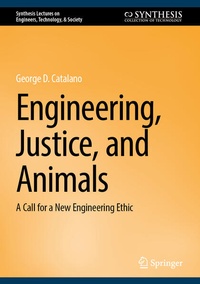
Engineering, Justice, and Animals
Description

Moving forward into the 21st century, the distinction between living systems and machines is rapidly eroding, this in turn has led to the birth of a new discipline in engineering: synthetic biology engineering. Synthetic biology engineering is a multidisciplinary field that combines principles from biology, chemistry, computer science, and engineering to design and construct new biological parts, devices, and systems. It enables the intentional design and manufacture of living cells and biological processes to create new products. Engineers in this field aim to redesign organisms for useful purposes, allowing them to perform complex tasks.
While engineers and scientists in the field of synthetic biology are increasingly aware of the ethical challenges posed by their work, they are ill-prepared to deal with the actual dilemmas of conscience that continue to arise. The purpose of this text is to address the lack of professional ethical training for 21st-century engineers who will be developing devices at the intersection of engineering and biology. The book introduces a design algorithm that will give engineers the opportunity to consider their work in the context of a living world, one filled with life forms, many of which exhibit behaviors not far different than our own.
The author's approach in developing the design algorithm incorporates a sense of collective responsibility to the animals with whom we share this planet and capabilities, including bodily health and integrity, emotions, play, and control over one's environment. The design algorithm can be applied to specific cases in order to fully explore the matters of conscience that engineers confront in the 21st century.
More details
Other editions
Additional editions
Person
George D. Catalano is a Distinguished Professor Emeritus of biomedical engineering at SUNY Binghamton. Previously, he was a professor of mechanical and aerospace engineering at the United States Military Academy and at Louisiana State University. He earned a PhD and a MSc from the University of Virginia and a BSc degree from Louisiana State University, all in aerospace engineering. He was a Fulbright Scholar at the Polytechnic Institute in Turin, Italy and at the Technical Institute in Erlangen, Germany. He is also listed in the Philosopher's Index.
Dr. Catalano's research areas include engineering education, engineering ethics, environmental ethics, and turbulent fluid mechanics. He is the author of ten books and over 150 technical articles in fields of engineering education, engineering and environmental ethics, turbulent fluid mechanics and low-speed and high-speed aerodynamics.
Content
Chapter 1 Introduction.- Chapter 2 Wildlife and Habitat Disruption.- Chapter 3 Surveillance and Monitoring.- Chapter 4 Human-Wildlife Conflict.- Chapter 5 Domestic Animals and Pets.- Chapter 6 Climate Change.- Chapter 7 Artificial Intelligence and Robotics.- Chapter 8 Case Studies and Real-Life Examples.- Chapter 9 Justice for Animals.- Chapter 10 Technological Interventions: biotechnology & synthetic biological engineering.- Chapter 11 Philosophical Perspectives.- Chapter 12 Conservation and Human Responsibility.- Chapter 13 Technological Determinism.- Chapter 14 Interconnectedness.
