

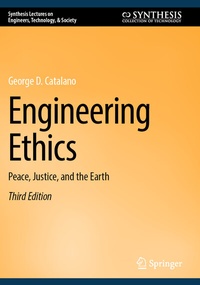
Engineering Ethics
Description

In the original two editions of Engineering Ethics : Peace, Justice, and the Earth , a response of the engineering profession to the challenges of security, poverty and underdevelopment, environmental sustainability, and native cultures was described. Ethical codes, which govern the behavior of engineers, were examined from a historical perspective linking the prevailing codes to models of the natural world. A new ethical code based on a recently introduced model of Nature as an integral community was provided and discussed. Applications of the new code were described using a case study approach.
The proposed third edition will build on the foundational material included in the previous two editions. Over the course of the last decade new and profoundly challenging ethical issues (synthetic biology, artificial intelligence, climate change and the sixth extinction) have arisen in the engineering profession. The notion of an integral community has been more fully developed. The proposed book will include an exploration of these issues as well as provide the reader with a better understanding of the historical development of ethical reasoning and consider future possibilities. Implications of the innovative ideas in ethics and design on engineering education are also considered.
More details
Other editions
Additional editions
Previous edition
Person
Dr. Catalano's research areas include engineering education, engineering ethics, environmental ethics, and turbulent fluid mechanics. He is the author of ten books and over 150 technical articles in fields of engineering education, engineering and environmental ethics, turbulent fluid mechanics and low-speed and high-speed aerodynamics.
Content
Chapter 1: Introduction.- Chapter 2: Engineering Ethics.- Chapter 3: Models of the Earth.- Chapter 4: Ethics and Scientific Paradigms.- Chapter 5: A New Story.- Chapter 6: Implications of the New Story: Case Studies.- Chapter 7: Implications for Engineering and Engineering Education.- Chapter 8: Final Reflections.
