

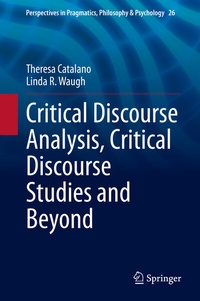
Critical Discourse Analysis, Critical Discourse Studies and Beyond
Description

This book explores the problem-oriented interdisciplinary research movement comprised of Critical Discourse Analysis (CDA) and Critical Discourse Studies (CDS) for scholars, teachers, and students from many backgrounds. Beginning with a Preface by renowned CDA/CDS scholar Ruth Wodak, it introduces CDA/CDS through examples of what its research looks like, delineates various precursors to CDA/CDS and important foundational concepts and theories, and traces its development from its early years until it became established. After the relationship between CDA and CDS is discussed, seven commonly cited approaches to CDA/CDS are outlined, including their connections and differences, their origins and development, major and associated scholars, research focus(es), and central concepts and distinguishing features. After a summary of critiques of CDA/CDS and responses by CDA/CDS scholars, the book provides an overview of its salient connections to other interdisciplinary areas of scholarship such as critical applied linguistics, education, anthropology/ ethnography, sociolinguistics, gender studies, queer linguistics, pragmatics and ecolinguistics. The final chapter describes how scholars use their knowledge of CDA/CDS to make a difference in the world.
Reviews / Votes
"This collection will provide readers not only with a detailed understanding of what CDA/S is about but also raise critical awareness about contemporary social changes . . This book is worthwhile reading and reflecting on, especially for those scholars and students showing great interest in the sphere of CDA/S." (Junfang Mu and Lixin Zhang, Journal of Language and Politics, Vol. 21 (5), 2022)More details
Other editions
Additional editions
Persons
Theresa Catalano is Associate Professor in Second Language Education/ Applied Linguistics at the University of Nebraska-Lincoln and also serves as coordinator of the dual language endorsement and world language secondary education programs. Her research focuses on education and migration, language teacher education, multimodal critical discourse studies, and cognitive linguistics. She has published across a wide variety of journals including Critical Inquiry in Language Studies, Bilingual Research Journal, Visual Communication, Critical Discourse Studies , Journal of Language and Politics , Social Semiotics , and Discourse & Society . Her second book, Talking about Global Migration (Multilingual Matters, 2016) was nominated for two national book awards.
Linda R. Waugh is Professor Emerita of French, English, Linguistics, Anthropology, and Language, Reading and Culture, and the Interdisciplinary Doctoral Program in Second Language Acquisition andTeaching at the University of Arizona, where she went in 2000 after teaching at Cornell University (starting in 1971). She has (co-)authored many journal articles and book chapters, in addition to 12 books and monographs. She is finishing a co-edited book (
Cambridge History of Linguistics
) with a co-authored chapter on 20th century linguistics. She has many research interests, including French linguistics, phonology, semiotics, semantics, pragmatics, and (multimodal critical) discourse analysis/studies.
