

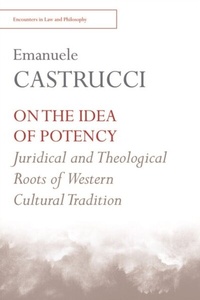
On the Idea of Potency
Juridical and Theological Roots of the Western Cultural Tradition
1st Edition
Published on 4. August 2016
200 pages
978-1-4744-1186-8 (ISBN)
Description

Sweeping through the history of Western philosophy of law, Emanuele Castrucci deals with the metaphysical idea of potency as defined by Spinoza and Nietzsche, upsetting entrenched theories of jurisprudence. From classical Greek philosophy to Jewish biblical exegesis, via Christianity; from Aristotle''s Metaphysics to its Arabic interpretations; from the genesis of natural law theory (Augustine, Aquinas, Duns Scotus, Ockham), to Kant and Enlightenment natural law theory, to Carl Schmitt, Castrucci shows how philosophical rationalism has failed to contain absolute power in a juridical sense.
More details
Other editions
Additional editions
Emanuele Castrucci
On the Idea of Potency
Juridical and Theological Roots of the Western Cultural Tradition
Book
07/2016
Edinburgh University Press
€141.50
Shipment within 15-20 days
Content
- Intro
- Title page
- Copyright
- Contents
- Preface
- I The Logos of Potency: A Theoretical Introduction
- II Logos of 'Potentia Dei'
- III 'Potentia Ordinata' vs 'Potentia Absoluta'
- IV Political Theology Reconsidered
- V Genealogies of Constituent Potency: Schmitt, Nietzsche, Spinoza
- Threshold
- Corollaries
- Corollary I On the Origins of Conventionalist Political Philosophy in the Seventeenth Century
- Corollary II The Problem of a Political Theology
- Corollary III Rhetoric of Ethical Universalism: Jürgen Habermas and the Dissolution of Political Realism
- Notes
- Bibliography
- Index
