

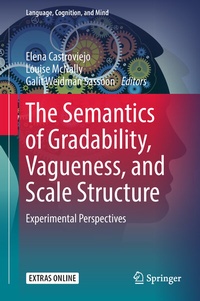
The Semantics of Gradability, Vagueness, and Scale Structure
Description

This volume is the first to focus specifically on experimental studies of the semantics of gradability, scale structure and vagueness. It presents support for and challenges to current formal analyses of these phenomena in view of experimentally collected data, highlighting the ways semantic and pragmatic theory can benefit from experimental methodologies. The papers in the volume contribute to an explicit and detailed account of the use, representation, and online processing of gradable and vague expressions using various kinds of controlled speaker judgment tasks, eye tracking, and ERP. The aim is to strengthen the foundations of experimental semantics and promote interaction between linguists, psycholinguists, psychologists, and philosophers who are interested in the semantics of natural language. Using data representing different languages and a variety of nominal and adjectival constructions, including degree modification and comparatives, the contributions address scale-based classifications of gradable predicates, such as the absolute vs. relative distinction; the nature of the standards for applicability of gradable expressions and the ways in which standards are determined; the nature of dimensions and multidimensionality in the meaning of scalar expressions; and the role of embodiment, subjectivity, and sociolinguistic considerations in the use and understanding of gradable expressions.
More details
Other editions
Additional editions
Content
Gradability, Vagueness, and Scale Structure: From the Armchair to the Lab, Elena Castroviejo, Louise McNally, Galit W. Sassoon.- Are Gaps Preferred to Gluts? A closer look at borderline contradictions, Paul Egré, Jérémy Zehr.- Multidimensionality, subjectivity and scales: Experimental evidence, Stephanie Solt.- Online processing of "real" and "fake": The cost of being too strong, Petra Schumacher, Patrick Brandt, Hanna Weiland-Breckle.- Education as a source of vagueness in criteria and degree, Steven Verheyen, Gert Storms.- Intensification, gradability and social perception: The case of totally, Andrea Beltrama.- Perceived Informativity and Referential Effects of Contrast in Adjectivally Modified NPs, Helena Aparicio, Chris Kennedy, Ming Xiang.- Modified fractions, granularity and scale structure, Chris Cummins.- Decomposition and processing of negative adjectival comparatives, Barbara M. Tomaszewicz, Daniel Tucker, Alexis Wellwood.- Cumulative comparison: Experimental evidence for degree cumulation, Rick Nouwen, Jakub Dotlacil.
