

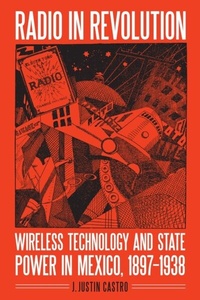
Radio in Revolution
Wireless Technology and State Power in Mexico, 1897-1938
1st Edition
Published on 1. July 2016
288 pages
978-0-8032-8874-4 (ISBN)
Description

Long before the Arab Spring and its use of social media demonstrated the potent intersection between technology and revolution, the Mexican Revolution employed wireless technology in the form of radiotelegraphy and radio broadcasting to alter the course of the revolution and influence how political leaders reconstituted the government.
Radio in Revolution, an innovative study of early radio technologies and the Mexican Revolution, examines the foundational relationship between electronic wireless technologies, single-party rule, and authoritarian practices in Mexican media. J. Justin Castro bridges the Porfiriato and the Mexican Revolution, discussing the technological continuities and change that set the stage for LAzaro CArdenas's famous radio decree calling for the expropriation of foreign oil companies.
Not only did the nascent development of radio technology represent a major component in government plans for nation and state building, its interplay with state power in Mexico also transformed it into a crucial component of public communication services, national cohesion, military operations, and intelligence gathering. Castro argues that the revolution had far-reaching ramifications for the development of radio and politics in Mexico and reveals how continued security concerns prompted the revolutionary victors to view radio as a threat even while they embraced it as an essential component of maintaining control.
Radio in Revolution, an innovative study of early radio technologies and the Mexican Revolution, examines the foundational relationship between electronic wireless technologies, single-party rule, and authoritarian practices in Mexican media. J. Justin Castro bridges the Porfiriato and the Mexican Revolution, discussing the technological continuities and change that set the stage for LAzaro CArdenas's famous radio decree calling for the expropriation of foreign oil companies.
Not only did the nascent development of radio technology represent a major component in government plans for nation and state building, its interplay with state power in Mexico also transformed it into a crucial component of public communication services, national cohesion, military operations, and intelligence gathering. Castro argues that the revolution had far-reaching ramifications for the development of radio and politics in Mexico and reveals how continued security concerns prompted the revolutionary victors to view radio as a threat even while they embraced it as an essential component of maintaining control.
Reviews / Votes
"Radio in Revolution offers a clearly written, meticulously researched, and previously untold chronicle of the role that radio technologies played in revolutionary Mexico."-Joy Elizabeth Hayes, Hispanic American Historical Review "Radio in Revolution is a well-researched and engaging book that covers an understudied aspect of Mexican historiography."-Sarah Foss, Jhistory, H-Net Reviews "In Radio in Revolution, the author uncovers the essential role of radio technologies in the consolidation of state power in Mexico between the late 1890s and the 1930s. . . . Castro compels readers to remember the importance of the technology behind state power, something as consequential in our own times as it was during the early twentieth century."-Historian "This book should be of great interest to historians of Mexico and Latin America, to students of comparative nation-building projects, and of course to historians of radio itself. It is well worth a careful read."-Edward Beatty, Pacific Historical Review "Radio in Revolution adeptly addresses a glaring oversight in the historiography of twentieth-century Mexico: the interplay between radio technology and the Mexican Revolution (1910-40)."-JUErgen Buchenau, coauthor of Mexico's Once and Future Revolution: Social Upheaval and the Challenge of Rule since the Late Nineteenth Century"This work has the potential to cause scholars to rethink the importance of technological savvy and acquisition, mainly radio, for Mexico during its revolution and postrevolutionary era. Castro's decision to tackle radio developments during the Porfiriato and through the revolution renders a very rich analysis."-Celeste GonzAlez de Bustamante, author of Muy Buenas Noches: Mexico, Television, and the Cold War
"Radio in Revolution fills a major gap in the historiography of Mexico's telecommunications and early broadcasting industries. Castro raises the bar for studies of media and nation building during Mexico's tumultuous revolution."-JosE Luis Ortiz Garza, author of Una radio entre dos reinos "Radio in Revolution adeptly addresses a glaring oversight in the historiography of twentieth-century Mexico: the interplay between radio technology and the Mexican Revolution (1910-40)."-JUErgen Buchenau, coauthor of Mexico's Once and Future Revolution: Social Upheaval and the Challenge of Rule since the Late Nineteenth Century
"This work has the potential to cause scholars to rethink the importance of technological savvy and acquisition, mainly radio, for Mexico during its revolution and postrevolutionary era. Castro's decision to tackle radio developments during the Porfiriato and through the revolution renders a very rich analysis."-Celeste GonzAlez de Bustamante, author of Muy buenas noches: Mexico, Television, and the Cold War
"Castro depicts a significant continuity from Porfirio DIaz to Plutarco ElIas Calles in governmental use of radio technology to consolidate centralization. The Mexican Revolution, prototype for all twentieth-century social revolutions, was also the first war in which radio served a major military purpose."-Robert H. Claxton, author of From "Parsifal" to Peron: Early Radio in Argentina, 1920-1944
More details
Series
Language
English
Place of publication
Lincoln
United States
Target group
Professional and scholarly
College/higher education
Illustrations
21 illustrations, 1 map, 4 graphs
File size
7,07 MB
ISBN-13
978-0-8032-8874-4 (9780803288744)
Copyright in bibliographic data and cover images is held by Nielsen Book Services Limited or by the publishers or by their respective licensors: all rights reserved.
Schweitzer Classification
Other editions
Additional editions
Book
07/2016
University of Nebraska Press
€68.00
Shipment within 10-20 days
Book
07/2016
University of Nebraska Press
€29.00
Shipment within 10-20 days
Person
J. Justin Castro is an assistant professor of history at Arkansas State University.
Content
List of IllustrationsAcknowledgmentsIntroduction: A Tale of Two Revolutions1. Porfirian Radio, Imperial Designs, and the Mexican Nation2. Radio in Revolution3. Rebuilding a Nation at War4. Growth and Insecurity5. Invisible Hands6. Broadcasting State Culture and Populist PoliticsConclusion: Early Radio and Its LegaciesNotesBibliographyIndex
