

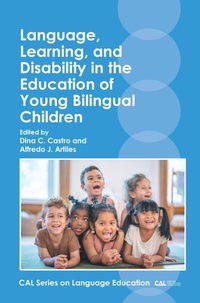
Language, Learning, and Disability in the Education of Young Bilingual Children
Published on 27. April 2021
232 pages
978-1-80041-186-9 (ISBN)
Description

Using an interdisciplinary perspective to discuss the intersection of language development and learning processes, this book summarizes current knowledge and represents the most critical issues regarding early childhood research, policy, and practice related to young bilingual children with disabilities. The book begins with a conceptual framework focusing on the intersection between the fields of early childhood education, bilingual education, and special education. It goes on to review and discuss the role of bilingualism in young children's development and the experiences of young bilingual children with disabilities in early care and education settings, including issues of eligibility and access to care, instruction, and assessment. The book explores family experiences, teacher preparation, accountability, and policy, ending with recommendations for future research which will inform both policies and practices for the education of young bilingual children with disabilities. This timely volume provides valuable guidance for teachers, administrators, policymakers, and researchers.
Reviews / Votes
This critically important volume is highly overdue! Castro and Artiles have produced a rich body of work on the intersection of special education, bilingual education, and early childhood education. Theoretically and programmatically integrative, this text is essential reading for designing equitable educational approaches that consider emergent bilinguals' unique assets and skills. Readers will appreciate learning about the developmental characteristics of an increasingly diverse population in early intervention and special education as they gain cultural and linguistic efficacy. * Iliana Alanis, The University of Texas at San Antonio, USA * The authors provide up-to-date information and critical perspectives in an integrative approach which lays the foundation for comprehensive, responsive interventions. Each chapter reflects an asset-based approach which contrasts with the long history of deficit-based views. Highly recommended for those who work with this population, but an important resource for all educators. * Robert Rueda, University of Southern California, USA * This book would be particularly useful to students studying Early Childhood or teaching qualifications intending to work with children aged 0-8 years old. It would provide them with a detailed knowledge in the field of language, special educational needs and bilingualism to apply to situations that they will inevitably face within their working lives. It would also be useful to academics, teachers and scholars teaching within this area.Overall, this is an extremely informative text that will help many to give children the attention and encouragement they need. -- Tanya Richardson * Educational Review, 2021 *
More details
Series
Language
English
Place of publication
Bristol
United Kingdom
Target group
College/higher education
Product notice
Reflowable
Dimensions
Height: 234 mm
Width: 156 mm
ISBN-13
978-1-80041-186-9 (9781800411869)
Copyright in bibliographic data and cover images is held by Nielsen Book Services Limited or by the publishers or by their respective licensors: all rights reserved.
Schweitzer Classification
Other editions
Additional editions
Dina C. Castro | Alfredo J. Artiles
Language, Learning, and Disability in the Education of Young Bilingual Children
Book
04/2021
Multilingual Matters
€48.20
Shipment within 10-20 days
Persons
Dina C. Castro is Professor and Velma E. Schmidt Endowed Chair in Early Childhood Education, University of North Texas. Her scholarship focuses on equity in the early care and education of bilingual children in immigrant, transnational, and indigenous communities. She examines how bilingual development and bilinguals' sociocultural contexts are addressed in early education research, policies, and practices, including accountability systems, and teacher preparation.
Alfredo J. Artiles is Lee L. Jacks Professor of Education at Stanford University and Director of the Stanford Center for Opportunity Policy in Education. His interdisciplinary scholarship examines the dual nature of disability as an object of protection and a tool of stratification. He aims to understand how responses to disability intersections with race, language, gender, and social class advance or hinder educational opportunities for disparate groups of students.
Alfredo J. Artiles is Lee L. Jacks Professor of Education at Stanford University and Director of the Stanford Center for Opportunity Policy in Education. His interdisciplinary scholarship examines the dual nature of disability as an object of protection and a tool of stratification. He aims to understand how responses to disability intersections with race, language, gender, and social class advance or hinder educational opportunities for disparate groups of students.
Content
Contributors
Chapter 1. Dina C. Castro and Alfredo J. Artiles: At the Intersection of Language, Learning, and Disability in the Education of Young Bilingual Children
Chapter 2. Dina C. Castro, Cristina Gillanders, Nydia Prishker, and Rodolfo Rodriguez: A Sociocultural, Integrative, and Interdisciplinary Perspective on the Development and Education of Young Bilingual Children with Disabilities
Chapter 3. Carol Scheffner Hammer and Maria Cristina Limlingan: How Bilingualism Affects Children's Language Development
Chapter 4. Lillian Duran: Dual Language Learners in Early Intervention Programs: Issues of Eligibility, Access, and Service Provision
Chapter 5. Sarah L. Alvarado, Sarah M. Salinas, and Alfredo J. Artiles: The Social Organization of Learning for Dual Language Learners in Inclusive Classrooms
Chapter 6. Maria Adelaida Restrepo and Anny P. Castilla-Earls: Language Learning and Language Disability: Equity Issues in the Assessment of Young Bilingual Learners
Chapter 7. Cristina Gillanders and Sylvia Y. Sanchez: Learning from Sociocultural Contexts: Partnering with Families of Young Bilingual Children with Disabilities
Chapter 8. Norma A. Lopez-Reyna, Cindy L. Collado, Mary Bay, and Wu-Ying Hsieh: Preparing Teachers of Young Bilingual Children with Disabilities
Chapter 9. Marlene Zepeda and Michael J. Orosco: Language, Learning, and Disability in an Era of Accountability
Chapter 10. Alba A. Ortiz: Young Bilingual Children with Disabilities: Challenges and Opportunities for Future Education Policies and Research
Index
Chapter 1. Dina C. Castro and Alfredo J. Artiles: At the Intersection of Language, Learning, and Disability in the Education of Young Bilingual Children
Chapter 2. Dina C. Castro, Cristina Gillanders, Nydia Prishker, and Rodolfo Rodriguez: A Sociocultural, Integrative, and Interdisciplinary Perspective on the Development and Education of Young Bilingual Children with Disabilities
Chapter 3. Carol Scheffner Hammer and Maria Cristina Limlingan: How Bilingualism Affects Children's Language Development
Chapter 4. Lillian Duran: Dual Language Learners in Early Intervention Programs: Issues of Eligibility, Access, and Service Provision
Chapter 5. Sarah L. Alvarado, Sarah M. Salinas, and Alfredo J. Artiles: The Social Organization of Learning for Dual Language Learners in Inclusive Classrooms
Chapter 6. Maria Adelaida Restrepo and Anny P. Castilla-Earls: Language Learning and Language Disability: Equity Issues in the Assessment of Young Bilingual Learners
Chapter 7. Cristina Gillanders and Sylvia Y. Sanchez: Learning from Sociocultural Contexts: Partnering with Families of Young Bilingual Children with Disabilities
Chapter 8. Norma A. Lopez-Reyna, Cindy L. Collado, Mary Bay, and Wu-Ying Hsieh: Preparing Teachers of Young Bilingual Children with Disabilities
Chapter 9. Marlene Zepeda and Michael J. Orosco: Language, Learning, and Disability in an Era of Accountability
Chapter 10. Alba A. Ortiz: Young Bilingual Children with Disabilities: Challenges and Opportunities for Future Education Policies and Research
Index
