

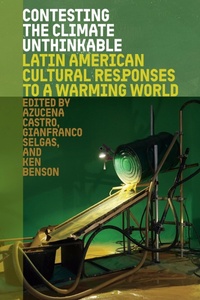
Contesting the Climate Unthinkable
Description

Examining Latin American cultural works that rethink environmental change and natural catastrophes
This volume explores Latin American cultural works from the twentieth and twenty-first centuries that reflect environmental changes brought on by colonization, capitalism, and resource exploitation. Contributors examine films, novels, photographs, and videos from the Caribbean, the Southern Cone, the Andes, and the Amazon, showcasing how artists, writers, and activists depict the scale and impact of ecological crises.
Drawing from environmental humanities, decolonial thought, and Indigenous scholarship, this book examines how relationships with the nonhuman reshape human understandings of ecological collapse and resilience. Contributors discuss movies on toxic waste in Chile and Bolivia, gothic elements in horror, art and mineral extraction in Venezuela, dystopian novels set in the Río de la Plata, Mapuche poetry and dance in protest of terricidio, and utopias in Brazilian Afrofuturistic novels. They show how speculative fiction, testimonial narratives, experimental films, and site-specific installations address environmental disasters, climate breakdown, and extractivism, revealing the colonial histories and economic structures that underpin climate change.
The chapters in this book examine artistic forms that amplify the voices of affected communities and envision more ethical futures rooted in regional cultures, geographies, and practices. Highlighting the significance of perspectives from the Global South, this volume broadens understandings of environmental justice and ways of rethinking planetary survival.
Publication of this work made possible by a Sustaining the Humanities through the American Rescue Plan grant from the National Endowment for the Humanities.
More details
Other editions
Additional editions
Persons
Azucena Castro, assistant professor of Latin American cultural studies at Rice University, is the author of Posnaturalezas poéticas: Pensamiento ecológico y políticas de la extrañeza en la poesía latinoamericana contemporánea. Gianfranco Selgas, British Academy Postdoctoral Fellow at University College London, is the author of Regionalismo ensamblado: Cultura, ecología política y extractivismos en Latinoamérica (1930?1940). Ken Benson, emeritus professor of Spanish at Stockholm University, is the author of La subversión silente. Carmen Laforet: poética y hermenéutica.
Contributors: Paul Merchant | Igor Barreto | Ken Benson | Victoria Saramago | José Carlos Díaz Zanelli | Andrés Obando | Jasmin Belmar Shagulian | Patrick Brock | Gianfranco Selgas | Sebastian Wiedemann | Roberto Roabilnho | Azucena Castro | Emily Baker | Montserrat Madariaga-Caro | Allison Mackey
Content
List of Figures
Foreword: Latin America and the ?Unthinkable?
Acknowledgments
Introduction: Contesting the Climate Unthinkable; Latin America and the Warming World
Gianfranco Selgas, Azucena Castro, and Ken Benson
Part 1. Reimagining the Land: Amerindian Aesthetics and Alternative Ecologies for a Deranged World
1. Dying Well: Micropolitics of Life Against Terricidio in Mapuche Poetics
Montserrat Madariaga-Caro
2. The Art of an Ecological Constitution: Beyond Derangement in Chile
Paul R. Merchant
3. Entangled Ruins: Nature and Postcatastrophic Landscapes in Hiram Bingham's Inca Land and José de la Riva-Agüero's Paisajes peruanos
Andrés Ernesto Obando
Part 2. The Political Ecology of Artistic Forms: Culture, Extractivism, and Environmental Imagination
4. What Is the Conflict About? Ecology, Ontology, and Decoloniality in Joseph Zárate's Guerras del Interior
José Carlos Díaz Zanelli
5. Archives of the Planetary Mine: Art, Political Ecology, and Media Geology in Chile and Venezuela
Gianfranco Selgas
6. Fiction Writing and Environmental Conservation in Latin America: The Cases of João Guimarães Rosa and Alejo Carpentier
Victoria Saramago
Part 3. Disrupting the Sensible Order in Landscapes of Contamination, Toxicity, and Wildfires
7. Embodying Anthropocene Awareness in ecogótico rioplatense
Allison Mackey
8. Haunting Trees in the Global South: Image and Life in the Rubble of Climate Change
Roberto Robalinho
9. Toxic Transits: Ghostly Double Gazes, Slow Violence, and North-South Ecologies of Inequalities in the Films Sealed Cargo (Bolivia) and Arica (Chile)
Azucena Castro
Part 4. Contesting Environmental Catastrophism: Queer Bodies, Afro-Indigenous Epistemologies, and the Crisis of Futurity
10. Culture, Inequality, and Queer Ecology in Rita Indiana's La Mucama de Omicunlé
Emily Baker
11. Toward a Cosmopolitics of the Image: Notes for a Possible Ecology of Cinematic Practices
Sebastian Wiedemann
12. Brazilian Afrofuturism, Climate Apocalypse, and Heuristic Function
Patrick Brock
Part 5. Ethnographic and Poetic Interventions
13. Choike Pürrun: The Mapuche People's Sacred Dance
Jasmin Belmar Shagulian
14. The Paths Not Seen: How I Structured My Representation of Nature
Igor Barreto
List of Contributors
Index
