

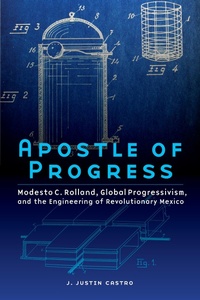
Apostle of Progress
Modesto C. Rolland, Global Progressivism, and the Engineering of Revolutionary Mexico
1st Edition
Published on 1. January 2019
378 pages
978-1-4962-1251-1 (ISBN)
Description

From the late nineteenth century to the middle of the twentieth century, Mexico experienced major transformations influenced by a global progressive movement that thrived during the Mexican Revolution and influenced Mexico's development during subsequent governments. Engineers and other revolutionary technocrats were the system builders who drew up the blueprints, printed newspapers, implemented reforms, and constructed complexity-people who built modern Mexico with an eye on remedying long-standing problems through social, material, and infrastructural development during a period of revolutionary change.
In Apostle of Progress J. Justin Castro examines the life of Modesto C. Rolland, a revolutionary propagandist and a prominent figure in the development of Mexico, to gain a better understanding of the role engineers played in creating revolution-era policies and the reconstruction of the Mexican nation. Rolland influenced Mexican land reform, petroleum development, stadium construction, port advancements, radio broadcasting, and experiments in political economy. In the telling of Rolland's story, Castro offers a captivating account of the Mexican Revolution and the influence of global progressivism on the development of twentieth-century Mexico.
In Apostle of Progress J. Justin Castro examines the life of Modesto C. Rolland, a revolutionary propagandist and a prominent figure in the development of Mexico, to gain a better understanding of the role engineers played in creating revolution-era policies and the reconstruction of the Mexican nation. Rolland influenced Mexican land reform, petroleum development, stadium construction, port advancements, radio broadcasting, and experiments in political economy. In the telling of Rolland's story, Castro offers a captivating account of the Mexican Revolution and the influence of global progressivism on the development of twentieth-century Mexico.
Reviews / Votes
"[Apostle of Progress] joins our growing corpus of biographical works on the Mexican Revolution, and its focus on an overlooked but important civil engineer adds a new dimension to our knowledge of the process of reconstruction."-JUErgen Buchenau, Hispanic American Historical Review "Through the exploration of the life and work of the ambitious middle-class Mexican engineer Modesto Rolland, Castro (Arkansas State Univ.) explores the new liberal ideas that developed in the period leading up to and following the Mexican Revolution. . . . Thoroughly researched and written in engaging prose, this work promises to be a wonderful addition to Mexican history courses at any level."-M. C. GalvAn, Choice "Castro's book represents a fine contribution to a recent body of scholarly work that seeks to reassess the roles that engineers, experts, and technocrats played in the development of modern Mexico."-GermAn Vergara, Technology and Culture "In this exceptionally well-researched and well-written biography, Castro tells the fascinating life story of this Mexican engineer to shed new light on U.S-Mexican relations, Mexico's place in global Progressivism, and the influence of technocratic ideas in post-revolutionary reconstruction-a period also accompanied by bottom-up mobilization and top-down clientelist political formations."-Matthew Vitz, Journal of Social History "Castro's Apostle of Progress is a significant achievement. In this compelling biography of the influential engineer Modesto C. Rolland, the author sheds new light on the critical yet poorly understood role of technological experts in the Mexican Revolution and its aftermath."-J. Brian Freeman, coeditor of Technology and Culture in Twentieth-Century Mexico "Justin Castro has produced an extraordinary examination of Mexican revolutionary and post-revolutionary politics through an intriguing, elucidating life-and-times biography of Modesto Rolland, multifaceted engineer, inventor, builder, and media entrepreneur. . . . This biography will intrigue any student of twentieth-century Mexican history, mirroring numerous qualities found in John W. F. Dulles's classic Yesterday in Mexico."-Roderic Ai Camp, author of Intellectuals and the State in Twentieth-Century MexicoMore details
Series
Language
English
Place of publication
Lincoln
United States
Target group
Professional and scholarly
Illustrations
38 photographs, 12 illustrations, index
File size
8,46 MB
ISBN-13
978-1-4962-1251-1 (9781496212511)
Copyright in bibliographic data and cover images is held by Nielsen Book Services Limited or by the publishers or by their respective licensors: all rights reserved.
Schweitzer Classification
Other editions
Additional editions
Joseph Justin Castro
Apostle of Progress
Modesto C. Rolland, Global Progressivism, and the Engineering of Revolutionary Mexico
Book
01/2019
University of Nebraska Press
€48.50
Shipment within 15-20 days
Joseph Justin Castro
Apostle of Progress
Modesto C. Rolland, Global Progressivism, and the Engineering of Revolutionary Mexico
Book
01/2019
University of Nebraska Press
€29.00
Shipment within 15-20 days
Person
J. Justin Castro is an associate professor of history at Arkansas State University. He is the author of Radio in Revolution: Wireless Technology and State Power in Mexico, 1897-1938 (Nebraska, 2016).
Content
List of Illustrations
Acknowledgments
Introduction: Matters of Perspective
1. Child of the Porfiriato, Child of the Periphery
2. The Reluctant Revolutionary
3. A Mexican Progressive
4. Back to the Periphery
5. War and Peace
6. Transitions
7. Opportunity, Defeat, and the Death of Virginia Garza de Rolland
8. A Stadium for Stridentopolis
9. Mr. Bothersome
10. The Undersecretary
11. Going Big
12. Out of the Ports and into the Hills
Conclusion: Final Thoughts about Modesto Rolland's Life and Legacy
Notes
Bibliography
Index
Acknowledgments
Introduction: Matters of Perspective
1. Child of the Porfiriato, Child of the Periphery
2. The Reluctant Revolutionary
3. A Mexican Progressive
4. Back to the Periphery
5. War and Peace
6. Transitions
7. Opportunity, Defeat, and the Death of Virginia Garza de Rolland
8. A Stadium for Stridentopolis
9. Mr. Bothersome
10. The Undersecretary
11. Going Big
12. Out of the Ports and into the Hills
Conclusion: Final Thoughts about Modesto Rolland's Life and Legacy
Notes
Bibliography
Index
