

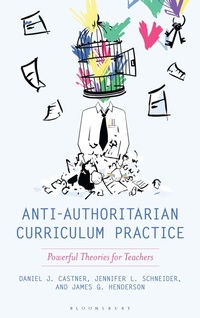
Anti-Authoritarian Curriculum Practice
Powerful Theories for Teachers
Published on 10. July 2025
176 pages
979-8-7651-5420-5 (ISBN)
Description

The pervasive politicization of education in the United States makes teachers' work extraordinarily challenging. Decades of bi-partisan accountability-based reform policies and top-down instructional management have conceived of teachers as mere technicians who consume and implement prefabricated curricular plans. Such views fail to recognize the intimate relationship between curriculum and teaching and minimize educators' professional authority.
Anti-Authoritarian Curriculum Practice is for teachers exasperated by contemporary education's politicized conditions. Instead of identifying specific authoritarian figures or ideologies, this book critiques authoritarian practices-actions that undermine accountability for how power is exercised. It advocates for anti-authoritarian curriculum practices, emphasizing the intellectual and moral responsibilities of professional curricular decision-making. Appreciating that significant decisions are made at school, district, and policy levels without teachers' meaningful involvement, the authors utilize practical curriculum theorizing to examine commonly overlooked elements of curriculum practice, emphasizing teachers' direct roles in shaping what is experienced in their classrooms. Readers are introduced to the HI-STAR process, a three-part framework that invites educators to holistically imagine curricular visions (HI), engage in study and teaching activities (ST), and assess student outcomes while reflecting on their practices (AR).
Anti-Authoritarian Curriculum Practice is for teachers exasperated by contemporary education's politicized conditions. Instead of identifying specific authoritarian figures or ideologies, this book critiques authoritarian practices-actions that undermine accountability for how power is exercised. It advocates for anti-authoritarian curriculum practices, emphasizing the intellectual and moral responsibilities of professional curricular decision-making. Appreciating that significant decisions are made at school, district, and policy levels without teachers' meaningful involvement, the authors utilize practical curriculum theorizing to examine commonly overlooked elements of curriculum practice, emphasizing teachers' direct roles in shaping what is experienced in their classrooms. Readers are introduced to the HI-STAR process, a three-part framework that invites educators to holistically imagine curricular visions (HI), engage in study and teaching activities (ST), and assess student outcomes while reflecting on their practices (AR).
More details
Language
English
Place of publication
New York
United States
Publishing group
Bloomsbury Publishing Plc
Target group
College/higher education
File size
3,62 MB
ISBN-13
979-8-7651-5420-5 (9798765154205)
Copyright in bibliographic data and cover images is held by Nielsen Book Services Limited or by the publishers or by their respective licensors: all rights reserved.
Schweitzer Classification
Other editions
Additional editions
Daniel J. Castner | James G. Henderson | Jennifer L. Schneider
Anti-Authoritarian Curriculum Practice
Powerful Theories for Teachers
Book
09/2025
Rowman & Littlefield Publishers
€31.50
Shipment within 3-4 weeks
Persons
Dr. Daniel Castner is an assistant professor of early childhood education and curriculum studies at Indiana University Bloomington. Prior to his transition to higher education, he was a public-school kindergarten teacher for 15 years in Northeast Ohio. His research describes how curriculum leadership operates in early childhood settings and examines how dedicated teachers with strong personal and professional commitments experience and negotiate the social, political, and cultural tensions within their institutions of practice.
Dr. Jennifer Schneider is an assistant professor of Curriculum Studies at Oklahoma State University (OSU) who is deeply influenced by a background studying and teaching in the arts and humanities. Her dissertation was awarded the American Association for Curriculum and Teaching's (AATC's) 2020 John Laska Dissertation Award. Challenging the longstanding dehumanizing heritage present in curriculum and teaching while working towards regenerative possibilities. Her scholarly and creativ
Dr. Jennifer Schneider is an assistant professor of Curriculum Studies at Oklahoma State University (OSU) who is deeply influenced by a background studying and teaching in the arts and humanities. Her dissertation was awarded the American Association for Curriculum and Teaching's (AATC's) 2020 John Laska Dissertation Award. Challenging the longstanding dehumanizing heritage present in curriculum and teaching while working towards regenerative possibilities. Her scholarly and creativ
Content
Preface
Chapter 1: Introduction
Section 1: Foundations of Curriculum Practice
Chapter 2: Engaging in Curriculum Work
Chapter 3: (Il)liberal, democratic, and authoritarian practices
Section 2: The HI-STAR Process
Chapter 4: Holistically Imagining Anti-Authoritarian Curriculum Practices
Chapter 5: Study, Teaching, Assessment, and Reflection (STAR)
Section 3: HI-STAR as an Intergenerational Conversation
Chapter 6: A Curriculum Legacy
Chapter 7: Building on and Extending a Curriculum Legacy
Chapter 1: Introduction
Section 1: Foundations of Curriculum Practice
Chapter 2: Engaging in Curriculum Work
Chapter 3: (Il)liberal, democratic, and authoritarian practices
Section 2: The HI-STAR Process
Chapter 4: Holistically Imagining Anti-Authoritarian Curriculum Practices
Chapter 5: Study, Teaching, Assessment, and Reflection (STAR)
Section 3: HI-STAR as an Intergenerational Conversation
Chapter 6: A Curriculum Legacy
Chapter 7: Building on and Extending a Curriculum Legacy
