

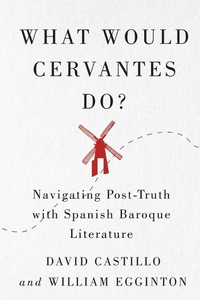
What Would Cervantes Do?
Navigating Post-Truth with Spanish Baroque Literature
1st Edition
Published on 15. January 2022
217 pages
978-0-2280-0931-3 (ISBN)
Description

The attack on the US Capitol on 6 January 2021 was a tragic illustration of the existential threat that the viral spread of disinformation poses in the age of social media and twenty-four-hour news. From climate change denialism to the frenzied conspiracy theories and racist mythologies that fuel antidemocratic white nationalist movements in the United States and abroad, What Would Cervantes Do? is a lucid meditation on the key role the humanities must play in dissecting and combatting all forms of disinformation.
David Castillo and William Egginton travel back to the early modern period, the first age of inflationary media, in search of historically tested strategies to overcome disinformation and shed light on our post-truth market. Through a series of critical conversations between cultural icons of the twenty-first century and those of the Spanish Golden Age, What Would Cervantes Do? provides a tour-de-force commentary on current politics and popular culture. Offering a diverse range of Cervantist comparative readings of contemporary cultural texts -movies, television shows, and infotainment - alongside ideas and issues from literary and cultural texts of early modern Spain, Castillo and Egginton present a new way of unpacking the logic of contemporary media.
What Would Cervantes Do? is an urgent and timely self-help manual for literary scholars and humanists of all stripes, and a powerful toolkit for reality literacy.
David Castillo and William Egginton travel back to the early modern period, the first age of inflationary media, in search of historically tested strategies to overcome disinformation and shed light on our post-truth market. Through a series of critical conversations between cultural icons of the twenty-first century and those of the Spanish Golden Age, What Would Cervantes Do? provides a tour-de-force commentary on current politics and popular culture. Offering a diverse range of Cervantist comparative readings of contemporary cultural texts -movies, television shows, and infotainment - alongside ideas and issues from literary and cultural texts of early modern Spain, Castillo and Egginton present a new way of unpacking the logic of contemporary media.
What Would Cervantes Do? is an urgent and timely self-help manual for literary scholars and humanists of all stripes, and a powerful toolkit for reality literacy.
Reviews / Votes
"This book comes at the hour of greatest need. It demonstrates unequivocally the relevance of Cervantes and the Spanish Baroque to our present predicament. Forget POTUS, FLOTUS, and SCOTUS! Only Castillo and Egginton can save us!" William P. Childers, Brooklyn College and CUNY Graduate Center "What Would Cervantes Do? is a persuasive exercise in making comparisons, and an enlightening guide both to seventeenth-century Spain and to our current circumstances." Times Literary Supplement "Castillo and Egginton are state-of-the-art readers of early modern Spanish literature and diligent investigators, well versed in theory. Castillo and Egginton recognize, eloquently and convincingly, that the baroque sensibility of 17th-century Spain - self-consciously obscure - can help to explain, or further complicate, the ups and downs of today's world and media. Highly recommended." Choice "The volume closes with a section whose title could well serve as a metonymy for the entire book: "A Cervantine Toolkit for the Post-Truth Age." The authors analyze, among other related phenomena, the extreme commodification of information on social media, which has led to "our current, deeply siloed version of the Internet [which is] the perfect marketplace of alt-realities". Ultimately, WWCD emphasizes the crucial role of the humanities in addressing and combating misinformation." Cervantes: Journal of the Cervantes Society of AmericaMore details
Series
Language
English
Place of publication
Montreal
Canada
Target group
Professional and scholarly
File size
1,50 MB
ISBN-13
978-0-2280-0931-3 (9780228009313)
Copyright in bibliographic data and cover images is held by Nielsen Book Services Limited or by the publishers or by their respective licensors: all rights reserved.
Schweitzer Classification
Other editions
Additional editions
David Castillo | William Egginton
What Would Cervantes Do?
Navigating Post-Truth with Spanish Baroque Literature
Book
01/2022
McGill-Queen's University Press
€154.75
Article not available at the moment
David Castillo | William Egginton
What Would Cervantes Do?
Navigating Post-Truth with Spanish Baroque Literature
Book
01/2022
2nd Edition
McGill-Queen's University Press
€31.00
Shipment within 15-20 days
Persons
David Castillo is professor of Spanish literature and cultural studies and director of the Humanities Institute at the State University of New York at Buffalo. William Egginton is Decker Professor in the Humanities and director of the Alexander Grass Humanities Institute at Johns Hopkins University.
Content
- Cover
- Copyright
- Contents
- Acknowledgments
- Prologue The Deadly Devolution of Language
- Part One True Lies and Other Rules of Engagement
- 1 Reality Entitlement
- 2 The Imagination of the Possible
- 3 The Art of the Real
- 4 The Apocalypse Will Not Be Televised!
- 5 From Breaking Bad to Breaking Worse
- 6 Playing the Game
- Part Two He Said, She Said
- 7 Not Your Father's Classroom
- 8 The Poison of Purity
- 9 Her Weapon
- 10 A Homeopathic Cure for Patriarchy
- Part Three A Cervantine Toolkit for the Post-Truth Age
- 11 Revelations of a Glass Man
- 12 A Posthumous Lesson
- 13 Surviving the Post-Truth Age
- Epilogue Looking for Relevance in All the Right Places
- Notes
- Bibliography
- Index
