

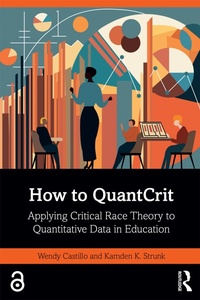
How to QuantCrit
Applying Critical Race Theory to Quantitative Data in Education
1st Edition
Published on 21. October 2024
134 pages
978-1-040-22697-1 (ISBN)
Description

How to QuantCrit equips researchers and users of quantitative data with practices to alter how they collect and analyze quantitative data. Using Quantitative Critical Race Theory (QuantCrit) as a framework, this book develops the foundation for an iterative praxis to explore a range of questions that prompt practitioners and stakeholders to be engaged critics in working towards a more just and equitable society.
The book begins with an overview of QuantCrit and its five tenets: (1) the centrality of racism; (2) numbers are not neutral; (3) categories are neither 'natural' nor given; (4) the importance voice and insight (data cannot speak for themselves); and (5) a social justice/equity orientation. Each subsequent chapter begins with a more detailed explanation and exploration of the tenet. Then, the chapters move into actionable steps that researchers and data users can take to implement QuantCrit into applied practice. Finally, the book closes with thoughts on working to use quantitative data for racial justice.
This book is intended for researchers, data users, and graduate students in education and education-related disciplines. It offers insights and suggested actions that range from working with existing data sets in more racially just ways to more radically reimagining the entire educational research process. As such, the book offers ideas and information that can be useful for anyone working with quantitative educational data.
Winner of the American Educational Studies Association Critics' Choice Book Awards 2025
The Open Access version of this book, available at http://www.taylorfrancis.com, has been made available under a Creative Commons Attribution-Non Commercial-No Derivatives (CC-BY-NC-ND) 4.0 license. The Open Access version of this book was funder by the Spencer Foundation and WT Grant Foundation.
The book begins with an overview of QuantCrit and its five tenets: (1) the centrality of racism; (2) numbers are not neutral; (3) categories are neither 'natural' nor given; (4) the importance voice and insight (data cannot speak for themselves); and (5) a social justice/equity orientation. Each subsequent chapter begins with a more detailed explanation and exploration of the tenet. Then, the chapters move into actionable steps that researchers and data users can take to implement QuantCrit into applied practice. Finally, the book closes with thoughts on working to use quantitative data for racial justice.
This book is intended for researchers, data users, and graduate students in education and education-related disciplines. It offers insights and suggested actions that range from working with existing data sets in more racially just ways to more radically reimagining the entire educational research process. As such, the book offers ideas and information that can be useful for anyone working with quantitative educational data.
Winner of the American Educational Studies Association Critics' Choice Book Awards 2025
The Open Access version of this book, available at http://www.taylorfrancis.com, has been made available under a Creative Commons Attribution-Non Commercial-No Derivatives (CC-BY-NC-ND) 4.0 license. The Open Access version of this book was funder by the Spencer Foundation and WT Grant Foundation.
Reviews / Votes
"How to QuantCrit is the first of its kind. The text provides a needed historical account of racism in social sciences statistics and offers insights into how quantitative approaches should be used to de-center whiteness while including practical use (and examples) of each QuantCrit tenets." -- Marvin G. Powell, Ph.D., George Mason University, USA"Quantitative Critical Race Theory (QuantCrit) has grown rapidly to become an important strand in research internationally. Quantitative methods have sometimes been antithetical to antiracism but QuantCrit offers a powerful new way forward. In this landmark study - the first book-length exploration of QuantCrit - Castillo and Strunk explore the approach in detail, offering real-world examples of how to apply the insights in practice. It adds up to a unique and invaluable resource for everyone with an interest in quantitative research and racial justice." -- David Gillborn, author of 'White Lies: Racism, Education and Critical Race Theory'
More details
Edition
1. Auflage
Language
English
Place of publication
London
United Kingdom
Publishing group
Taylor & Francis Ltd
Target group
College/higher education
Professional and scholarly
Illustrations
5 Tables, black and white
ISBN-13
978-1-040-22697-1 (9781040226971)
Copyright in bibliographic data and cover images is held by Nielsen Book Services Limited or by the publishers or by their respective licensors: all rights reserved.
Schweitzer Classification
Other editions
Additional editions
Wendy Castillo | Kamden K. Strunk
How to QuantCrit
Applying Critical Race Theory to Quantitative Data in Education
Book
10/2024
1st Edition
Routledge
€195.50
Shipment within 10-20 days
Wendy Castillo | Kamden K. Strunk
How to QuantCrit
Applying Critical Race Theory to Quantitative Data in Education
Book
10/2024
1st Edition
Routledge
€62.30
Shipment within 10-20 days
Persons
Wendy Castillo, Ph.D. is an Assistant Professor in Urban Education and Quantitative Methods at Montclair State University, Montclair, NJ. Her work focuses on applying a racial equity lens to quantitative methods including using QuantCrit and other anti-racism approaches.
Kamden K. Strunk, Ph.D. is a Professor of Educational Research Methodologies at Virginia Commonwealth University, Richmond, VA. His work focuses on critical approaches to quantitative methodologies, intersectional queer and trans studies in education, and improving teaching and learning conditions toward equity.
Kamden K. Strunk, Ph.D. is a Professor of Educational Research Methodologies at Virginia Commonwealth University, Richmond, VA. His work focuses on critical approaches to quantitative methodologies, intersectional queer and trans studies in education, and improving teaching and learning conditions toward equity.
Content
1. What is QuantCrit? Critical Quantitative Methodologies, Critical Race Theory, and QuantCrit as a Methodological Framework 2. The Centrality of Racism 3. Numbers Are Not Neutral 4. Categories Are Neither Neutral nor Natural 5. Voice and Insight: Data Cannot "Speak for Themselves" 6. The Necessity of a Justice and Equity Orientation 7. Conclusion: Quantitative Methodologies for Racial Justice
