

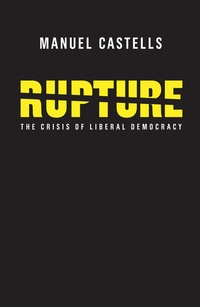
Rupture
Description

More details
Other editions
Persons
Content
II. Global Terrorism: The Politics of Fear
III. Mass Rebellion and the Collapse of Political Order
IV. Spain: Social Movements, the End of Two-Party Politics and State Crisis
V. The Obscure Clarity of Chaos
Appendix: Reading this book
Download supporting material for chapter 1
Download supporting material for chapter 3
Download supporting material for chapter 4
Download bibliography
2
GLOBAL TERRORISM: THE POLITICS OF FEAR
Fear is the most powerful of human emotions. Indiscriminate terrorism taps into this, the kind of terrorism that kills, maims, injures, kidnaps and alienates anywhere and at any time, sowing seeds of fear in people's minds. Its effects on politics are profound, for wherever there is fear, the politics of fear will surely follow. This is the sort of politics that deliberately exploits people's obvious desire for protection to institute a state of permanent emergency, which can begin to corrode and in practice ultimately negate civil liberties and democratic institutions. Although terrorism, fear and politics have always formed a sinister ménage à trois, over the last two decades they have come to occupy the forefront of daily life to such an extent that many countries find themselves in a world where children are raised in a climate of fear, and one where citizens accept being watched and monitored electronically, searches when travelling, preventative detentions and the militarization of their public spaces. This is because these precautions are always for 'other people', for those whose ethnicity or religion makes them potential suspects. Gradually, exceptions for security reasons become the norms that govern our lives.
Terrorism has no ideology other than the exaltation of death, a martial mentality that has seen multiple incarnations. Spain suffered ETA and GAL (Grupos Antiterroristas de Liberación),1 while there have been guerrilla fighters and paramilitaries in Colombia, criminal cartels and the narco-state in Mexico, Pinochet's death squads in Chile, and Palestinian and Israeli commandos in the Middle East - and so many others besides. But what has truly arrived on the global stage and transformed the political narrative is terrorism rooted in Islamic fundamentalism, and the counter-terrorism measures of nation-states that have turned the planet into a battlefield where for the most part civilians are the ones to die, particularly Muslim civilians. At the root of this form of terrorism lies the humiliation of many Muslims, disparaged by Western culture and oppressed by military dictatorships in hock to world powers, as explained by Edward Said in his book Orientalism. Its articulation as a form of combat was, however, the result of the efforts of the sorcerer's apprentices at the CIA, Mossad, Pakistan's Inter-Services Intelligence (ISI) agency and Saudi intelligence at the tail end of the Cold War. To overthrow the Soviet Union in Afghanistan, the United States, Pakistan and Saudi Arabia armed and organized Afghan warlords and recruited thousands of Islamic volunteers who were prepared to die in the fight against communist atheism. They were assembled in Pakistani training camps managed by an organization known as Al Qaeda ('the Base'), led by a profoundly religious Saudi intelligence agent who was a member of an eminent family responsible for conserving Islam's holy sites. His name: Osama Bin Laden. The strategy worked; the Soviets lost their first war in Afghanistan, like so many others who had tried and failed to conquer the country, and their influence and morale suffered a major blow. The United States had, however, underestimated the determination and aims of Bin Laden and his mujahidin. With the Soviet Union defeated, they turned their weapons towards the 'Great Satan'; if the United States were defeated, jahiliyyah (ignorance of God) would be eliminated from the world and the ummah (global community of believers in the true god) could at last come together. The task was arduous and long, an asymmetrical confrontation in which terrorism would be the key weapon because, in the words of Bin Laden, Islamic martyrs have no fear of death, while Westerners cling desperately to life. The tipping point was the audacious and brutal attack on the United States on 9/11, 2001: a day that changed the world forever. Bin Laden wanted to inspire in young Muslims the value of confronting the United States through direct action with a model attack on its power centres - and he achieved it. But he also intended to provoke the United States so that its soldiers would be sent to die in the sands of the desert and in the mountains of Afghanistan - and he achieved that too. He counted on the senseless cooperation of American neoconservative strategists and oil companies, who saw the chance to oust Saddam Hussein and impose their own control over the Middle East. Not so much for the oil, which they already have secured in the Arabian Peninsula and they could actually have obtained from Saddam Hussein himself, but rather to definitively assert their power over a crucial region in terms of the global economy and oil deals. Although Afghanistan was the source of the 9/11 attacks, the US response focused on occupying Iraq, based on the pretext of the scandalous fabrication of the existence of weapons of mass destruction. Bush, Blair and Aznar will go down in history as the irresponsible cynics who lit the touchpaper of war in Iraq that went on to spread across the entire Middle East. The invasion destabilized Iraq without being able to take control of it and exacerbated the secular conflict between Sunni and Shia Muslims, which had the paradoxical outcome of establishing a Shia government. As soon as US troops were forced to withdraw in light of the opposition to the war that helped bring Obama to the White House, this Shia government became allied with Iran and sustained by its militias. From the ruins of Iraq arose a new and formidable military terrorist organization, Islamic State, which unified Sunni military cadres from Saddam's regime, humiliated and imprisoned by the United States, with the remnants of Al-Qaeda in Iraq and Sunni tribes subjected to abuse by the Shia government. Islamic State was built up territorially, unlike Al-Qaeda, taking advantage of the power vacuum in Iraq and later Syria. In Syria, a democratic movement against the Assad dictatorship rose up in 2011, and was then manipulated and split up into factions by various powers. On the one side was Saudi Arabia, Jordan and Qatar, with an anti-Shia and anti-Iranian strategy. On the other was the United States trying to overthrow Assad, an ally of Russia and Iran. Assad's violent repression, supported militarily by Russia and the Iranian Revolutionary Guard, weakened democratic resistance and left the insurgents at the mercy of various Islamic militias, propped up by different states and Islamist networks. It was amongst this fracturing that Islamic State, led by Al Baghdadi, an Iraqi theologian tortured by the US at the infamous Abu Ghraib prison, achieved a series of military victories and established a caliphate with a global intent, with its capital in the Syrian city of Raqqa. The city resisted for a long time until it fell in 2017 to the combined assault of US and Russian bombardment, Assad's army, Syrian militias, the Kurdish Peshmerga, and the timely intervention of Turkey. The caliphate's example of power and its effective propaganda campaign and online recruitment attracted thousands of aspiring martyrs, young Muslims from across the world, but above all Europe. This is where a key connection was made, forming the basis of Islamic terrorism's dissemination in European societies, with decisive effects on the politics of Western democratic nations. The total breakdown of Iraq and Syria created millions of refugees, a consequence that combined with the bubbling over of contained rage felt by young European Muslims, who saw in the barbarity of Islamic State the chance for a purifying catharsis of their marginalized and oppressed existence, in which they felt their identity doubly negated both as Europeans and as Muslims. Their actions shattered peaceful coexistence and led to a state of permanent alert across the whole of Europe, bringing with them a wave of xenophobia and Islamophobia that transformed the European political sphere.
The acts of terrorism that have occurred in major European cities since 2014 (and since 2004 in Spain) are the result of the meeting of three factors. Firstly, the marginalization and discrimination experienced by the nearly twenty million Muslims in the European Union in terms of employment, education, housing, politics and culture, more than half of whom were in fact born in Europe and yet are not recognized as such, while their religion is stigmatized on a daily basis by their fellow citizens. This is why most attacks take place in countries with the highest representation of Muslims in the population, such as France, Belgium, Germany or the United Kingdom. Not that other countries are immune from intense jihadist activity: we need only remember Barcelona and Cambrils in Catalonia. Secondly, there is the global jihad movement symbolized initially by Al-Qaeda and subsequently by Islamic State or Boko Haram in Africa, with its images on the internet that sustain, inform and occasionally connect up young Muslims in search of meaning, in Europe and worldwide. It is this search for meaning which seems to be the third and most significant motivating factor in radicalization, a personal process through which somebody progresses from rage and rebellion to the idea of martyrdom and on to committing a terrorist act. This activity is often conducted on an individual basis or with friends and relatives, but typically incited collectively through places of worship, images designed to indoctrinate and manipulate followers, internet chat rooms, Western prisons and trips to the promised lands of Islam at war. But what is this meaning, and where does...
