

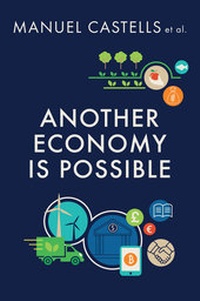
Another Economy is Possible
Culture and Economy in a Time of Crisis
1st Edition
Published on 23. May 2017
224 pages
978-1-5095-1722-0 (ISBN)
Description

Throughout the Western world, governments and financial elites responded to the financial crisis of 2008 by trying to restore the conditions of business as usual, but the economic, social and human damage inflicted by the crisis has given rise to a reconsideration of the inevitability of unfettered capitalism as a fact of life. A number of economic practices and organizations emerged in Europe and the United States that embodied alternative values: the value of life over the value of money; the effectiveness of cooperation over cut-throat competition; the social responsibility of corporations and responsible regulation by governments over the short-term speculative strategies that brought the economy to the brink of catastrophe.
This book examines the blossoming of innovative new experiments in organizing work and life that emerged in the wake of the financial crisis: cooperatives, barter networks, ethical banking, community currencies, shared time banks, solidarity networks, sharing of goods, non-monetary transactions, etc., experiments that paved the way for the emergence of a sharing economy in all domains of activity oriented toward the satisfaction of human needs. Other innovations included the creation of cryptographic virtual currencies, epitomized by bitcoin, which blended a libertarian, entrepreneurial spirit with information technology to provide an alternative to standard forms of currency. On the basis of a cross-cultural analysis of alternative economic practices, this book develops an important theoretical argument: that the economy, as a human practice, is shaped by culture, and that the diversity of cultures, as revealed in a time of crisis, implies the possibility of different economies depending on the values and power relations that define economic institutions.
This book will be of great interest to students and scholars in sociology, economics and the social sciences generally, and to anyone who wishes to understand how our societies and economies are changing today.
This book examines the blossoming of innovative new experiments in organizing work and life that emerged in the wake of the financial crisis: cooperatives, barter networks, ethical banking, community currencies, shared time banks, solidarity networks, sharing of goods, non-monetary transactions, etc., experiments that paved the way for the emergence of a sharing economy in all domains of activity oriented toward the satisfaction of human needs. Other innovations included the creation of cryptographic virtual currencies, epitomized by bitcoin, which blended a libertarian, entrepreneurial spirit with information technology to provide an alternative to standard forms of currency. On the basis of a cross-cultural analysis of alternative economic practices, this book develops an important theoretical argument: that the economy, as a human practice, is shaped by culture, and that the diversity of cultures, as revealed in a time of crisis, implies the possibility of different economies depending on the values and power relations that define economic institutions.
This book will be of great interest to students and scholars in sociology, economics and the social sciences generally, and to anyone who wishes to understand how our societies and economies are changing today.
More details
Other editions
Additional editions
Book
03/2017
Polity Press
€30.50
Shipment within 15-20 days
Book
03/2017
Polity Press
€67.50
Shipment within 15-20 days
Person
Manuel Castells is University Professor and Wallis Annenberg Chair of Communication Technology and Society at the University of Southern California, Los Angeles, as well as Professor Emeritus of Sociology and Planning at the University of California, Berkeley.
Content
- Introduction
- Chapter 1 Economy Is Culture, Sarah Banet-Weiser and Manuel Castells
- Chapter 2 Economics Without Growth, Giorgos Kallis
- Chapter 3 Analysis of Worldwide Community Economies for Sustainable Local Development, Sviatlana Hlebik
- Chapter 4 Blockchain Dreams: Imagining Techno-economic Alternatives After Bitcoin, Lana Swartz
- Chapter 5 Consumer Financial Services in the US: Why Banks May Not Be the Answer, Lisa Servon
- Chapter 6 Commoning Against the Crisis, Angelos Varvarousis and Giorgos Kallis
- Chapter 7 Alternative Economic Practices in Barcelona: Surviving the Crisis, Reinventing Life, Manuel Castells and Sviatlana Hlebik
- Chapter 8 Imagining and Making Alternative Futures: Slow Cities as Sites for Anticipation and Trust, Sarah Pink and Kirsten Seale
- Conclusion, Manuel Castells
