

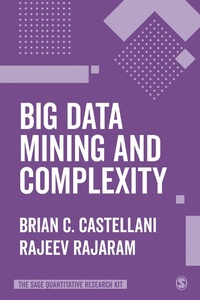
Big Data Mining and Complexity
1st Edition
Published on 1. March 2022
232 pages
978-1-5297-1099-1 (ISBN)
Description

This book offers a much needed critical introduction to data mining and 'big data'. Supported by multiple case studies and examples, the authors provide:
Digestible overviews of key terms and concepts relevant to using social media data in quantitative research.
A critical review of data mining and 'big data' from a complexity science perspective, including its future potential and limitations
A practical exploration of the challenges of putting together and managing a 'big data' database
An evaluation of the core mathematical and conceptual frameworks, grounded in a case-based computational modeling perspective, which form the foundations of all data mining techniques
Part of The SAGE Quantitative Research Kit, this book will give you the know-how and confidence needed to succeed on your quantitative research journey.
Digestible overviews of key terms and concepts relevant to using social media data in quantitative research.
A critical review of data mining and 'big data' from a complexity science perspective, including its future potential and limitations
A practical exploration of the challenges of putting together and managing a 'big data' database
An evaluation of the core mathematical and conceptual frameworks, grounded in a case-based computational modeling perspective, which form the foundations of all data mining techniques
Part of The SAGE Quantitative Research Kit, this book will give you the know-how and confidence needed to succeed on your quantitative research journey.
More details
Series
Edition
First Edition
Language
English
Place of publication
London
United Kingdom
Publishing group
Sage Publications Ltd (Digital)
Target group
College/higher education
Product notice
Reflowable
ISBN-13
978-1-5297-1099-1 (9781529710991)
Copyright in bibliographic data and cover images is held by Nielsen Book Services Limited or by the publishers or by their respective licensors: all rights reserved.
Schweitzer Classification
Other editions
Additional editions
Brian C. Castellani | Rajeev Rajaram
Big Data Mining and Complexity
Book
03/2022
1st Edition
SAGE Publications Ltd
€69.40
Shipment within 15-20 days
Persons
In addition to being a Professor of Sociology at Durham University, I am currently Adjunct Professor of Psychiatry (Northeast Ohio Medical University), Fellow of the Wolfson Research Institute for Health and Wellbeing, and Co-Editor of the Routledge Complexity in Social Science series. I am also a member of the editorial board for International Journal of Social Research Methodology and Complexity, Governance and Networks.
Trained as a sociologist, clinical psychologist and methodologist (statistics and computational social science), I have spent the past ten years developing a new case-based, data-mining approach to modeling complex social systems - called the SACS Toolkit - which my colleagues and I have used to help researchers, policy makers and service providers address and improve complex public health issues such as community health and well-being; infrastructure and grid reliability; mental health and inequality; big data and data mining; and globalization and global civil society. We have also recently developed the COMPLEX-IT R-studio software app, which allows everyday users seamless access to such high-powered techniques as machine intelligence, neural nets, and agent-based modeling to make better sense of the complex world(s) in which they live and work.
Rajeev Rajaram is a Professor of Mathematics at Kent State University. Rajeev's primary training is in control theory of partial differential equations and he is currently interested in applications of differential equations and ideas from statistical mechanics and thermodynamics to model and measure complexity. He and Brian Castellani have worked together to create a new case - based method for modeling complex systems, called the SACS Toolkit, which has been used to study topics in health, health care, societal infrastructures, power - grid reliability, restaurant mobility, and depression trajectories. More recently, he is interested in mathematical properties of entropy based diversity measures for probability distributions.
Trained as a sociologist, clinical psychologist and methodologist (statistics and computational social science), I have spent the past ten years developing a new case-based, data-mining approach to modeling complex social systems - called the SACS Toolkit - which my colleagues and I have used to help researchers, policy makers and service providers address and improve complex public health issues such as community health and well-being; infrastructure and grid reliability; mental health and inequality; big data and data mining; and globalization and global civil society. We have also recently developed the COMPLEX-IT R-studio software app, which allows everyday users seamless access to such high-powered techniques as machine intelligence, neural nets, and agent-based modeling to make better sense of the complex world(s) in which they live and work.
Rajeev Rajaram is a Professor of Mathematics at Kent State University. Rajeev's primary training is in control theory of partial differential equations and he is currently interested in applications of differential equations and ideas from statistical mechanics and thermodynamics to model and measure complexity. He and Brian Castellani have worked together to create a new case - based method for modeling complex systems, called the SACS Toolkit, which has been used to study topics in health, health care, societal infrastructures, power - grid reliability, restaurant mobility, and depression trajectories. More recently, he is interested in mathematical properties of entropy based diversity measures for probability distributions.
Content
Chapter 1: Introduction
Part 1: Thinking Complex and Critically
Chapter 2: The Failure of Quantitative Social Science
Chapter 3: What is Big Data?
Chapter 4: What is Data Mining
Chapter 5: The Complexity Turn
Part 2: The Tools and Techniques of Data Mining
Chapter 6: Case-Based Complexity: A Data Mining Vocabulary
Chapter 7: Classification and Clustering
Chapter 8: Machine Learning
Chapter 9: Predictive Analytics and Data Forecasting
Chapter 10: Longitudinal Analysis
Chapter 11: Geospatial Modeling
Chapter 12: Complex Network Analysis
Chapter 13: Textual and Visual Data Mining
Chapter 14: Conclusion: Advancing A Complex Digital Social Science
Part 1: Thinking Complex and Critically
Chapter 2: The Failure of Quantitative Social Science
Chapter 3: What is Big Data?
Chapter 4: What is Data Mining
Chapter 5: The Complexity Turn
Part 2: The Tools and Techniques of Data Mining
Chapter 6: Case-Based Complexity: A Data Mining Vocabulary
Chapter 7: Classification and Clustering
Chapter 8: Machine Learning
Chapter 9: Predictive Analytics and Data Forecasting
Chapter 10: Longitudinal Analysis
Chapter 11: Geospatial Modeling
Chapter 12: Complex Network Analysis
Chapter 13: Textual and Visual Data Mining
Chapter 14: Conclusion: Advancing A Complex Digital Social Science
